 Reading Ants
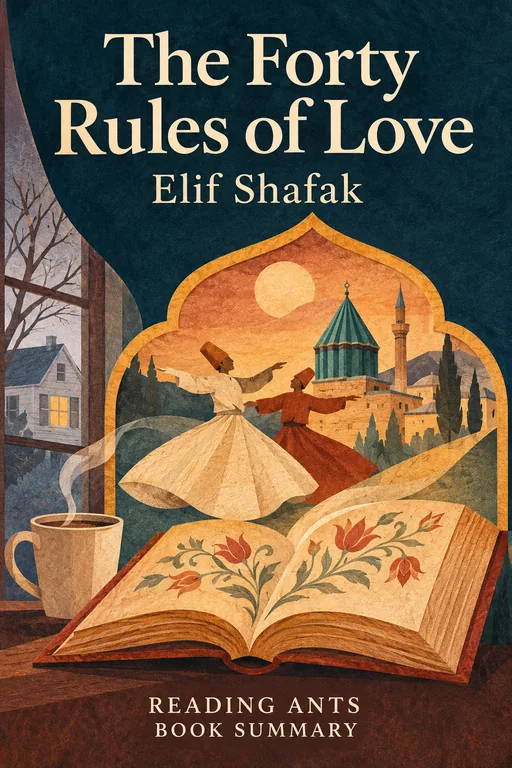
The Forty Rules of Love
A lonely American housewife reads a novel about the poet Rumi and his mysterious teacher Shams, and finds her own life changed by love.
Overview
The Forty Rules of Love is a novel by the Turkish-British writer Elif Shafak, first published in 2009. It tells two stories at once. One is set in the thirteenth century, in Konya, in present-day Turkey, and tells how the preacher Rumi met a wandering dervish named Shams of Tabriz. The other is set in Massachusetts in 2008, where a woman named Ella reads a manuscript about them. The book is inspired by Sufism, a mystical tradition within Islam that stresses love and spiritual growth. It has been very popular around the world.
Main Characters
- Ella Rubinstein: a forty-year-old Jewish-American woman, a mother of three, who is unhappy in her marriage.
- Aziz Z. Zahara: a mysterious writer, who is the author of the manuscript, and who becomes Ella’s correspondent.
- Rumi: a respected thirteenth-century scholar and preacher in Konya.
- Shams of Tabriz: a wandering dervish, who becomes Rumi’s teacher and companion.
- Kimya: a young woman raised in Rumi’s house, who marries Shams.
- David: Ella’s husband, who has been unfaithful.
Full Summary
Ella’s Quiet Life
Ella Rubinstein lives in Northampton, Massachusetts, with her husband and three children. On the outside, she has everything, but her marriage is cold, and she feels empty. She takes a job as a reader for a literary agent, and is given a manuscript called Sweet Blasphemy, by a writer named Aziz Z. Zahara.
As she reads it, she is drawn into another world, and begins to write to Aziz by email. He is a wanderer who writes on spiritual topics, and who seems to understand her.
Rumi Meets Shams
The manuscript tells how Rumi, a respected preacher in Konya in 1244, is living a comfortable life. He has a family, a following and a reputation. Then he meets Shams, a ragged wanderer, who challenges his beliefs. Shams does not follow rules, and insists that love, and not ritual, is the heart of faith.
The two become inseparable. Rumi’s students and family are jealous, and angry that he has neglected his duties. Shams teaches him forty “rules,” which are given throughout the story, such as that the way we see God is a reflection of how we see ourselves.
Kimya
In the meantime, Rumi’s household is thrown into confusion. His wife, Kerra, feels neglected, and his younger son, Ala al-Din, is troubled by the way his father spends all of his time with a stranger. Shams has no home and no property, and he often speaks harshly, but he has a way of seeing people clearly, and the people who meet him find that he has changed them.
Kimya, a young woman whom Rumi adopted as a child and who still lives in his house, falls in love with Shams. Part of Rumi’s family is hostile to Shams, including Ala al-Din, while the elder son, Sultan Walad, is more sympathetic. Some rumors say that Shams has bewitched Rumi. Kimya is caught between them, and she is lonely and afraid.
Shams, who feels that his time in Konya is coming to an end, leaves for a time, and Rumi is deeply heartbroken. He sends Sultan Walad to find him, and Sultan Walad finds him in Damascus and brings him back. After he returns, he and Kimya marry, but Shams does not treat her as a husband would. When he gently turns away her attempt to win him, her heart is broken, and she falls ill and dies.
The Death of Shams
After Kimya’s death, tensions increase. A group of men, including Rumi’s own son Ala al-Din, hire a killer to get rid of Shams. One night, Shams is stabbed in the courtyard of Rumi’s house and thrown into a well, a death the manuscript shows from the killer’s point of view. Rumi finds the well and cries out that Shams has been killed. The “forty rules” are Shafak’s literary invention, not a historical list.
Rumi, devastated, turns his grief into poetry. His poems, which are today among the best-known in the world, are an expression of his love for his lost friend.
Ella and Aziz
Meanwhile, Ella finds that her life is changing. She and Aziz fall in love by email, and she begins to see her own life in a new way. She meets Aziz in person in Boston, and he tells her that he has a terminal illness. Her marriage, strained by her husband’s affairs, comes apart, and she leaves her husband to be with Aziz.
The two travel together for about a year and then go to Konya, where Aziz collapses and dies in a hospital, as he had wished to die in the city of Rumi. He is buried there, and Ella, who has chosen to follow her heart, decides to start a new life on her own, one day at a time.
The two stories mirror each other. In the thirteenth century, a respected scholar is changed by a stranger who asks him to look beyond rules and titles, and in the modern story, a woman who has lived a comfortable but empty life is changed by the words of a writer whom she has never met. In both, love is shown as a force that breaks old habits, and that asks a high price from those who follow it.
Why It Matters
The Forty Rules of Love became an international bestseller, particularly in Turkey, where it sold hundreds of thousands of copies. It introduced many Western readers to Sufism, and to the poetry of Rumi, who has been, in recent decades, one of the best-selling poets in the United States. The book also makes a case for a spirituality that is open, tolerant and focused on love. Its mix of history and the present was seen as a way of bringing an old story to modern readers. It has been translated into dozens of languages.
Key Takeaways
- Love is a path. The book sees love as the way to understand God and oneself.
- Rules can be broken in the name of love. Shams challenges rigid religion.
- A teacher can change a life. Rumi’s life is transformed by Shams.
- It is never too late to change. Ella begins a new life at forty.
- Stories connect across time. The two tales mirror each other.
What We Can Learn
The book invites us to look inward, and to question the roles that we have been given. Ella finds new energy when she follows her heart. It encourages us to be open to unexpected teachers and friends.
It also shows that faith can be about compassion and tolerance, not only about rules. Finally, it reminds us that it is never too late to change a life that is not working, though change takes courage, and may bring pain. It can also be a good start for a conversation between people of different faiths, since it shows how much Muslims, Jews and Christians can share in their search for love and meaning.
Criticism and Counterpoints
Some critics find the book too sentimental, and the modern story less compelling than the historical one. The “rules” can seem like simple sayings, and some scholars say that the book simplifies Sufism, and takes a loose view of the historical facts. Others say that the character of Ella is a stereotype. The book’s portrayal of Rumi and Shams, in particular, is fictional, and should not be taken as history.
Who Should Read It
This book is for readers who like spiritual stories, romance and history, and who are curious about Rumi. It is a good book for a book club. Those who prefer realistic or serious historical fiction may find it too idealized.
Want the whole book?
A summary is a taste, not the meal. Here is where to find the full book.
You reached the end 🎉
Nicely done. Mark this one as read, and we will suggest what to read next.
Read this next
The Alchemist
Paulo Coelho
A young Spanish shepherd follows a recurring dream across the desert to the Egyptian pyramids in search of treasure, and learns that the journey toward one's dream is itself the greatest treasure.
🌍 World Literature
Siddhartha
Hermann Hesse
A gifted young man leaves teachers, wealth and family behind in search of enlightenment, only to discover through love, grief and a river that wisdom must be lived rather than borrowed.
🌍 World Literature
The Prophet
Kahlil Gibran
Before sailing home, a wise exile answers a city's questions about love, work, freedom and death, presenting life as a unity built from apparent opposites.
🌍 World Literature
Masnavi
Rumi
Rumi's long Persian poem uses stories, jokes and parables to teach that the soul is separated from its source and is happiest when it returns to it through love.
🎭 Epics, Drama & Poetry
The Kite Runner
Khaled Hosseini
A wealthy boy in Kabul betrays his loyal best friend on the day of a kite tournament, and decades later, after fleeing to America, he returns to a Taliban-ruled Afghanistan to try to make things right.
✨ Modern Fiction
The Little Prince
Antoine de Saint-Exupery
A pilot stranded in the desert meets a small boy from a tiny planet, who teaches him that the most important things in life, like love and friendship, can only be seen with the heart.
🌍 World LiteratureWant something different?
Pick another topic and we will show you three books to start with.