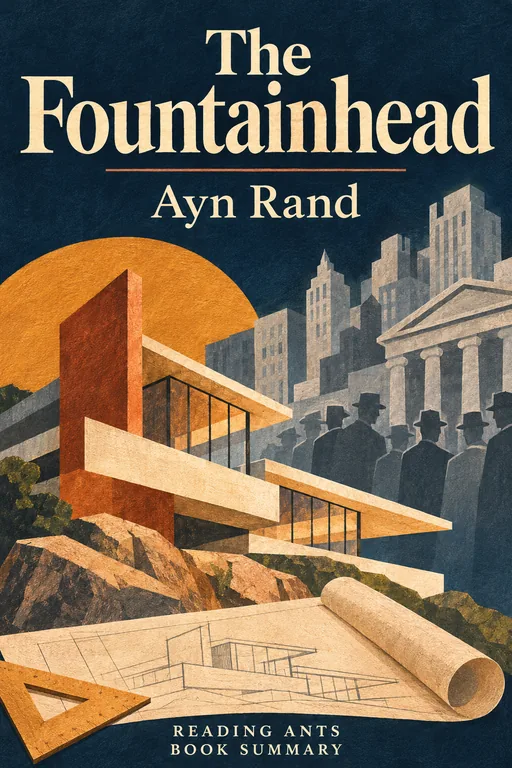
The Fountainhead
Howard Roark, an uncompromising young architect, refuses to bend his designs to popular taste, and the novel follows his struggle against a society that rewards conformity and betrays those who create.
Overview
The Fountainhead is a novel by Ayn Rand, published in 1943 after being rejected by many publishers. It became a bestseller by word of mouth, and made Rand famous. It follows the career of Howard Roark, an architect who is based loosely on figures like Frank Lloyd Wright, from the 1920s to the 1940s, in New York. The book is an argument for individualism and against collectivism, and it presents the author’s philosophy, later called Objectivism, which values reason, self-interest and creative achievement. It is also a drama with love, rivalry and a famous courtroom speech.
Main Characters
- Howard Roark: a gifted, independent architect who will not compromise his vision.
- Peter Keating: Roark’s classmate, a charming, mediocre architect who goes for popularity.
- Dominique Francon: a beautiful, intelligent newspaper columnist, who is torn between her admiration for Roark and her belief that the world will destroy greatness.
- Ellsworth Toohey: a powerful critic who promotes collectivist ideas and seeks control over people.
- Gail Wynand: a self-made newspaper magnate who sells to the public what it wants.
- Henry Cameron: Roark’s mentor, an old architect who has fallen out of fashion.
Full Summary
Expelled and Apprenticed
The novel begins with Howard Roark’s expulsion from an architecture school because he refuses to follow the traditional style. He goes to New York to work for the neglected modernist Henry Cameron. Roark’s classmate, Peter Keating, graduates with honors and is hired by a successful firm, where he rises by flattery and borrowing ideas. Keating often turns to Roark for help, and Roark gives it, without bitterness, as he is indifferent to success of the usual kind.
Roark’s Struggle
When Cameron retires, Roark opens his own office and takes jobs where he can. He gets a commission for a temple, which he designs, but it is attacked by critics led by Ellsworth Toohey. Dominique Francon, who writes for a newspaper, is drawn to him, but fears that the world will destroy him. She writes against his work, and tries to prevent his success, as a way of protecting his integrity from a corrupt public.
Roark is willing to take poor work rather than compromise, and when his office fails he labors for a time in a granite quarry, a job that shows his physical strength and his refusal of easy comfort. His few clients are people who value originality, and he gives them buildings that are plain, bold and well made.
Dominique and Roark
Dominique first meets Roark at that quarry, which her father owns, near her family’s estate, and their relationship begins with violence and desire, in a scene in which she is assaulted, and which the book portrays as a kind of consensual surrender, but which readers have strongly contested. She leaves and, concluding that the world will never honor men like Roark, chooses to live in it on its own terms, marrying Peter Keating and then the publisher Gail Wynand.
Wynand and Toohey
Gail Wynand rose from a poor background, with a ruthlessness that once ruined a man who later took his own life, and controls a newspaper empire that manipulates opinion by giving people what they want. He admires Roark, and hires him to design a home. Wynand and Roark become friends, and Wynand sees what he could have been. Toohey, who wants to dominate the culture by encouraging mediocrity and self-sacrifice, schemes to control Wynand’s papers and to destroy Roark.
Toohey writes a column that praises mediocrity as a sign of equality, and quietly persuades people to sacrifice their own tastes. His method is subtle: he never gives orders, but influences committees and critics until the best work is ignored. Roark is the one person he cannot persuade.
The Dynamite
Keating, whose career is failing, asks Roark to design a housing project, Cortlandt Homes. Roark agrees on two conditions: that it be built exactly as he drew it, and that his part stay secret, so that Keating takes the credit. When Roark finds that the design has been changed without his permission, he blows up the building. At his trial, he gives a speech defending the creator’s right to his work and arguing that the independent mind is the source of progress. He speaks without a lawyer, and says that he did not blow up the building to harm anyone, but because the work was his, and he had the right to say how it was used. His speech is the philosophical center of the book. The jury finds him not guilty.
Triumph
Wynand, who had given in to public opinion and attacked Roark before the trial, regrets it, and closes his newspaper, the Banner. Dominique leaves Wynand to be with Roark, and they marry. Roark is given the commission to build the Wynand Building, the tallest skyscraper in New York. In the final scene, Dominique rides the elevator to the top, to find him at the summit, building the future.
Why It Matters
The Fountainhead has sold millions of copies and remains popular, particularly in the United States, among readers attracted to its message of individual achievement. It was adapted into a 1949 film starring Gary Cooper and Patricia Neal. It also has been the introduction to Rand’s philosophy for many readers, and has influenced libertarian and conservative thought, as well as architects and entrepreneurs.
The book has also been widely criticized by philosophers and critics, and remains controversial. It continues to spark debate about selfishness, collectivism and creativity.
Architects and designers still argue over whether Roark is a hero or a warning, and the book is often given to young people who feel pressure to conform, which shows how strongly it speaks to the wish to be true to oneself.
Key Takeaways
- Integrity matters to a creator. Roark refuses to compromise.
- Originality is often punished. Society resists new ideas.
- Independence versus conformity. Roark and Keating are opposites.
- Popularity is not value. Wynand’s success is hollow.
- Self-respect gives strength. Roark is guided by his own standards, not by the opinions of others.
What We Can Learn
The novel encourages us to think about the difference between doing what is popular and doing what we believe is right. Roark’s commitment to his standards shows the value of integrity, even when it is hard.
It also encourages us to be wary of those who use moral language to gain power over others. Toohey is a villain who praises sacrifice while collecting influence, and the story invites readers to look for such patterns.
At the same time, it can lead us to ask how to balance individual ambition with care for others, which the novel largely dismisses.
Criticism and Counterpoints
Many critics and philosophers consider the novel’s ideas simplistic and its characters unrealistic: heroes are perfect and villains are cartoonish, and the speeches are long and preachy. The rape scene has been strongly condemned as glorifying sexual violence. Its view that selfishness is a virtue is criticized as ignoring the value of cooperation and community.
Architects note that Roark’s isolated genius does not match how architecture works, which depends on collaboration. Some find the writing melodramatic. But admirers love its passion and clear conviction.
Who Should Read It
This book suits mature readers who want to think about individualism. It is very long, contains a controversial sexual assault scene, and is strongly ideological. Readers may want to read criticism alongside it.
Want the whole book?
A summary is a taste, not the meal. Here is where to find the full book.
You reached the end 🎉
Nicely done. Mark this one as read, and we will suggest what to read next.
Read this next
Atlas Shrugged
Ayn Rand
In a near-future America sinking under government control, the most talented people vanish one by one on a mysterious "strike," and a railroad executive, Dagny Taggart, tries to hold the country together and finds who is behind it.
📜 Classics
The Great Gatsby
F. Scott Fitzgerald
A mysterious millionaire throws lavish parties on Long Island in the hope of winning back the woman he loved years ago, but his dream collides with the careless cruelty of the rich.
📜 Classics
Brave New World
Aldous Huxley
In a future world where people are made in factories, programmed for their roles and kept happy with drugs and entertainment, a man raised outside the system discovers that this perfect comfort comes at the cost of everything that makes us human.
📜 Classics
Pride and Prejudice
Jane Austen
Quick-witted Elizabeth Bennet and the proud, wealthy Mr. Darcy badly misjudge each other, and only by facing their own faults do they find their way to love.
📜 Classics
Nineteen Eighty-Four
George Orwell
In a future Britain ruled by an all-seeing Party, one man secretly rebels by keeping a diary and falling in love, and discovers just how completely a totalitarian state can crush the human mind.
📜 Classics
To Kill a Mockingbird
Harper Lee
In a small Alabama town in the 1930s, young Scout Finch watches her father, a lawyer, defend a Black man falsely accused of a crime, and learns hard lessons about prejudice, courage and seeing the world through other people's eyes.
📜 ClassicsWant something different?
Pick another topic and we will show you three books to start with.