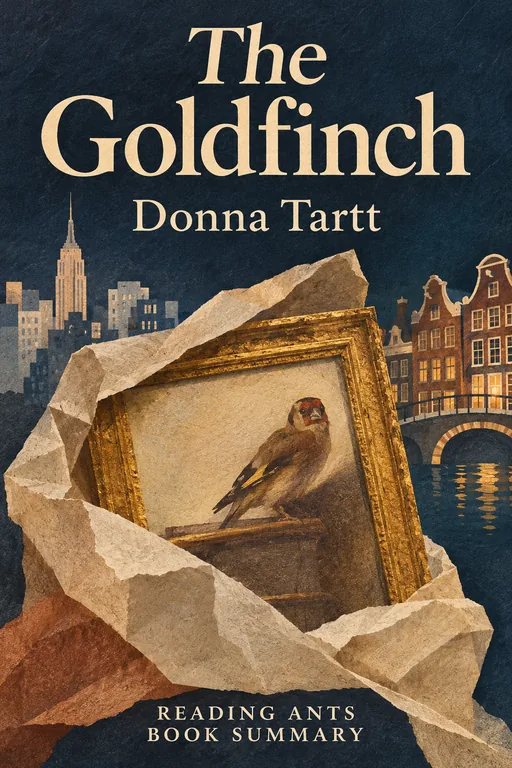
The Goldfinch
After surviving a bombing at a New York museum in which his mother dies, a thirteen-year-old named Theo Decker takes a priceless painting, and the secret shapes his life through grief, addiction and crime.
Overview
The Goldfinch is a novel by Donna Tartt, published in 2013, which won the Pulitzer Prize for Fiction in 2014. It is Tartt’s third novel, written over about a decade. The story is narrated by Theo Decker, who looks back at his life from a hotel room in Amsterdam, and moves from New York to Las Vegas and back, and then to Europe. The central object is a real painting, The Goldfinch (1654) by the Dutch artist Carel Fabritius, which Theo takes from the museum. It is a big, absorbing novel, in the tradition of Dickens, about loss, beauty and the redemptive power of art.
Main Characters
- Theo Decker: the narrator, a boy who loses his mother and drifts into adulthood.
- Boris Pavlikovsky: Theo’s Ukrainian-Russian friend in Las Vegas, wild, charming and loyal.
- Hobie (James Hobart): an antique furniture restorer who takes Theo in.
- Pippa: a girl whom Theo meets at the museum and loves for years.
- Mrs. Barbour: the mother of a wealthy school friend, who shelters Theo.
- Theo’s mother (Audrey): a loving woman whose death changes his life.
- Larry Decker: Theo’s alcoholic, gambling father.
Full Summary
The Museum
Theo, a thirteen-year-old boy, goes to the Metropolitan Museum of Art with his mother, who loves paintings, and who wants to see a Dutch exhibition. They are due at a meeting at his school later, where Theo is in trouble. As they look at the paintings, a bomb goes off. Theo wakes in the rubble, and meets a dying old man, who points to the painting of a small bird chained to its perch, and gives him a ring. In a daze, Theo takes the painting and leaves. His mother is dead.
Theo’s memories of the minutes before the explosion are vivid: a red-haired girl and an old man in the room, the whispers of the guards and the sudden dark. He drifts out through the smoke, clutching the painting, and goes home to wait for his mother, who does not return.
New York
Theo, who is taken in by a wealthy friend’s family, the Barbours, on Park Avenue, hides the painting, and lives with guilt. He seeks out the antique dealer, Hobie, whose partner was the man who gave him the ring, and begins to spend time in his workshop, a place of calm. He is also drawn to Pippa, a red-haired girl who survived the bombing, whom he thinks about constantly. He feels himself suspended between his old life and a new one.
Las Vegas
Theo’s father, a feckless gambler, reappears and takes him to live in a half-empty Las Vegas suburb, with his girlfriend. Theo makes friends with Boris, an adventurous, neglected boy who has lived in many countries. The two boys drink, take drugs and talk, and Boris becomes his best friend. Theo’s father, hounded by a loan shark, gets drunk and dies in a car crash, leaving Theo alone. He takes a bus back to New York.
Boris and Theo roam the empty housing development, drinking vodka, playing in the empty pools, and sharing stories of their broken homes. Boris, who is both a bad influence and a loyal friend, teaches Theo to survive, and his gift for finding beauty in chaos stays with him.
Return to Hobie
In New York, Theo returns to Hobie, who takes him on as an apprentice. He grows up working with antiques, and becomes involved in selling forged furniture, a deception that ensnares him in a scandal. He is engaged to Kitsey Barbour, a girl from the Barbour family, but still thinks of Pippa. His addiction to pills grows worse. He feels that he is a fraud in many ways.
Amsterdam
Boris, whom Theo has not seen in years, reappears and reveals that he stole the painting from Theo long ago, and that criminals have since used it as collateral. Out of guilt, he wants to recover it. The two fly to Amsterdam, where the plan to retrieve the painting goes wrong, armed men confront them, and Theo kills Boris’s attacker. Left alone in his hotel, Theo spirals into paranoia and drug use and contemplates suicide.
Resolution
Boris returns and explains that he has tipped off the art recovery police about the dealers, so the painting is recovered for the museum. Boris receives a large reward and shares it with Theo, who uses the money to buy back the fake antiques he sold. He reflects on what the painting has meant to him: it has been a connection to his mother, and a symbol of the beauty that endures. The novel ends with a long meditation in which he affirms that life, despite its pain, is worth living, and that art can save us.
Why It Matters
The Goldfinch was a bestseller and sparked a heated debate among critics, with some praising it as a masterpiece and others dismissing it as overlong and sentimental. It won the Pulitzer Prize, and was adapted as a film in 2019, though the film was less successful. It brought attention to Fabritius’s painting, which is in the Mauritshuis museum in The Hague.
The book is a rare modern example of a big, plot-driven novel with ambitions of literary depth, and has drawn passionate fans.
The painting at the center of the book is a real one, and visitors to the Mauritshuis in The Hague often mention the novel when they see it, a rare case in which a work of fiction has changed how people look at a famous artwork.
Key Takeaways
- Grief can shape a whole life. Theo’s loss defines him.
- Beauty can be a lifeline. The painting comforts him.
- Friendship may be unreliable but valuable. Boris is both.
- Guilt and secrets are heavy. Theo’s theft haunts him.
- Art connects the living and the dead. The painting links Theo to his mother.
What We Can Learn
The novel suggests that people may cope with loss in strange ways, such as holding on to a physical object, and invites us to be patient with those who are mourning.
It also shows how addictions and lies can grow from pain, and how hard it is to break a pattern without help.
Finally, it reminds us of the value of art, and how a single image may stay with a person for life.
It also reminds us that people who are grieving may not think clearly, and need patience, as well as practical help.
Criticism and Counterpoints
Some critics found the novel too long, with a bloated last section and an implausible plot, especially in Amsterdam, and others disliked its sentimental philosophy. The critic James Wood argued that its tone, language and story belong in children’s literature, though others defended it. The portrayal of women is thin, and Pippa seems to exist mainly as an object of Theo’s longing.
Some think that the philosophical ending is overly neat. The novel has also been compared unfavorably with The Secret History. Still, many readers adore it.
Who Should Read It
This book is for mature readers. It is long, with drug use, violence and loss. It is an absorbing read for those who like richly detailed fiction.
It is best read slowly, over several weeks.
Want the whole book?
A summary is a taste, not the meal. Here is where to find the full book.
You reached the end 🎉
Nicely done. Mark this one as read, and we will suggest what to read next.
Read this next
The Secret History
Donna Tartt
A California boy named Richard Papen, who transfers to a Vermont college and joins a small circle of classics students, is drawn into a murder, and the book follows how a group of brilliant friends destroy each other.
✨ Modern Fiction
Great Expectations
Charles Dickens
A poor orphan boy suddenly receives a fortune from a secret benefactor and becomes a gentleman in London, but he learns that wealth and status mean nothing without loyalty, kindness and gratitude.
📜 Classics
David Copperfield
Charles Dickens
From a sad childhood of cruelty and poverty to adult success as a writer, David Copperfield tells his own life story, with unforgettable friends and villains along the way.
📜 Classics
A Little Life
Hanya Yanagihara
Four college friends move to New York and build careers over decades, but the story gradually focuses on Jude St. Francis, a brilliant lawyer whose childhood trauma shapes his life and tests the love of those around him.
✨ Modern FictionThe Catcher in the Rye
J. D. Salinger
After being expelled from his boarding school, a lonely, sarcastic sixteen-year-old wanders New York City for three days, struggling with grief, phoniness and the frightening idea of growing up.
📜 Classics
The Kite Runner
Khaled Hosseini
A wealthy boy in Kabul betrays his loyal best friend on the day of a kite tournament, and decades later, after fleeing to America, he returns to a Taliban-ruled Afghanistan to try to make things right.
✨ Modern FictionWant something different?
Pick another topic and we will show you three books to start with.