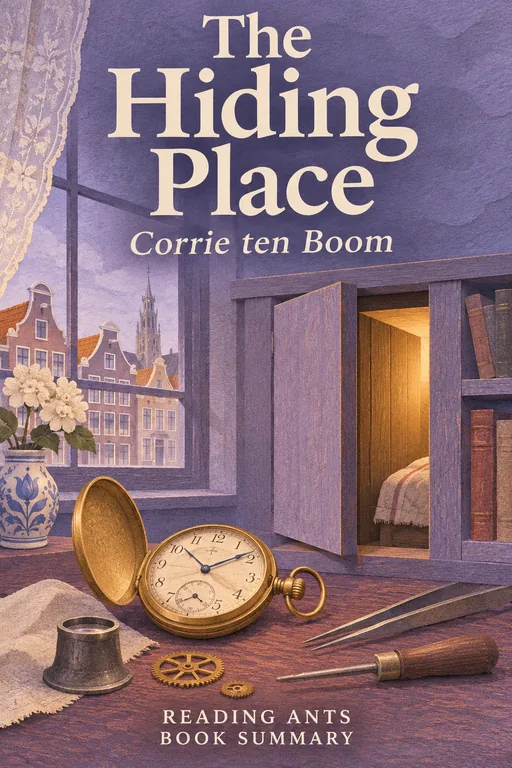
The Hiding Place
Corrie ten Boom tells how her Dutch family hid Jews from the Nazis in their home, how they were arrested and sent to prison and a concentration camp, and how her faith helped her to endure and to forgive.
Overview
The Hiding Place is a memoir by Corrie ten Boom, a Dutch watchmaker, written with John and Elizabeth Sherrill and published in 1971. She grew up in a close Christian family in Haarlem in the Netherlands, where her father ran a watch shop in their home, called the Beje. When Germany occupied the country in 1940, the family began to shelter people in danger. The book moves from the peaceful years before the war, through the dangerous work of the resistance, to the prison and camp, and ends with the author’s life after the war. It is a story of courage, faith and mercy.
Full Summary
A Family and a House
Corrie describes her childhood in a tall, narrow house, where her gentle father, Casper, her older sister Betsie and other relatives live. The family is warm and hospitable, helping neighbors and strangers, and they follow their Christian faith in daily life. Corrie, who becomes the first woman in the Netherlands to be licensed as a watchmaker, works in her father’s shop. In these early chapters, the family is shaped by love and by a sense of duty to others.
The War Comes
In May 1940, German forces invade the Netherlands, and gradually life changes. Food is rationed, Jews are forced to wear a star and are removed from jobs, and neighbors begin to disappear. When a frightened Jewish neighbor needs help, the ten Booms take him in without hesitation. Corrie, her sister and her father see that they cannot simply watch. They begin to take part in a network that finds safe places for those who need to hide.
The Secret Room
With the help of an architect sent by the underground, the family builds a small hidden room behind a false wall in Corrie’s bedroom, along with a buzzer to warn the guests of danger. Over time, Jews and resistance members come and go, and sometimes stay for weeks. The family practices emergency drills so that the guests can reach the hiding place within moments. Corrie finds herself, to her surprise, becoming skilled at deception, and is torn between her principle of honesty and her duty to protect lives.
Arrest
In February 1944, the Gestapo, tipped off by an informer, raid the house. The family is arrested, along with others who happened to be there, and the soldiers search for hidden people. Six who are in the secret room are not found, and are later rescued by the underground. Corrie’s elderly father is taken with the rest, and dies in a hospital ten days after his arrest. Corrie and Betsie are put in prison, where they are questioned and kept for months.
Camp and Ravensbruck
The sisters are transferred to Vught, a camp in the Netherlands, and then to Ravensbruck, a large camp for women in Germany. The conditions are terrible: overcrowded barracks full of fleas, hunger, forced labor and cruel guards. Betsie, though weak, encourages others and insists that they should thank God even for the fleas. Corrie has smuggled in a small Bible, and the sisters hold services at night. Betsie’s health fails, and she dies in December 1944. In their last months together she had spoken of a house where survivors could recover after the war.
Release and Forgiveness
Corrie is released, apparently because of a clerical mistake, shortly before many women in her group are killed. After the war, she opens a home for survivors, in her sister’s memory, and begins to speak about forgiveness. One of the most famous passages describes a church meeting in Germany, where a former guard from Ravensbruck approaches her and asks for forgiveness. Corrie struggles, but she prays for help, takes his hand, and finds that she can forgive him. She spends the rest of her life traveling and speaking.
Why It Matters
The Hiding Place became a best-selling classic of Christian literature and of Holocaust memoirs. It tells of ordinary people who acted with courage and compassion, and shows the cost of that choice. Its emphasis on forgiveness has made it an inspiration to many readers, and the story was adapted as a film in 1975. The house in Haarlem is now a museum, and ten Boom was honored by Yad Vashem as one of the Righteous Among the Nations for her rescue of Jews. The book is also valued as a record of life in the occupied Netherlands and in the camps. It continues to be read in schools, churches and by those interested in stories of moral courage.
Key Takeaways
- Ordinary people can resist evil. The ten Booms acted from conscience.
- Faith can sustain. Corrie and Betsie drew strength from prayer in the worst conditions.
- Small acts matter. A hidden room and a ration card saved lives.
- Forgiveness is hard and powerful. The meeting with the guard shows its cost.
- Loss and hope go together. Betsie’s dream became Corrie’s work.
What We Can Learn
The book invites us to think about what we would do if someone came to our door in need. It shows that courage does not always look like heroism, but can be a series of small, faithful choices. It also invites reflection on forgiveness, which does not mean forgetting or excusing, but choosing not to be ruled by bitterness. Readers of any belief can learn from the warmth of the family and its generosity toward strangers. And we can honor survivors by listening to their stories, and by standing against hatred today.
Criticism and Counterpoints
Some readers and scholars point out that the book is told from a strongly religious viewpoint, which may not be shared by all, and that it was written decades after the events, so some details may be reconstructed or shaped by memory. The book was written with co-authors, and the 1975 film changes some details. Others have said that the emphasis on forgiveness can be hard for some survivors of atrocities, for whom it is not an easy or expected response. Historians generally agree about the main outline of the ten Boom family’s work.
Who Should Read It
This book is for readers who are interested in World War II, in stories of courage, and in questions of faith and forgiveness. It is clear, warm and suitable for mature young readers, though it includes scenes of persecution and death. Those who are looking for a purely secular or historical account may want to read it alongside other books.
Want the whole book?
A summary is a taste, not the meal. Here is where to find the full book.
You reached the end 🎉
Nicely done. Mark this one as read, and we will suggest what to read next.
Read this next
The Diary of a Young Girl
Anne Frank
A Jewish teenage girl hiding from the Nazis in a secret apartment in Amsterdam records two years of fear, family quarrels, first love and big dreams in a diary that became one of the most famous books in the world.
👤 Real Lives
Night
Elie Wiesel
Elie Wiesel tells, in short and searing pages, how as a teenager he was taken from his hometown of Sighet to Auschwitz and Buchenwald, lost his family and watched his faith and childhood break apart.
👤 Real Lives
If This Is a Man
Primo Levi
Primo Levi, an Italian Jewish chemist, describes with clarity and restraint his eleven months as a prisoner in the Auschwitz camp, and asks what it means to remain human when everything is taken from you.
👤 Real Lives
Man's Search for Meaning
Viktor E. Frankl
A psychiatrist who survived the Nazi concentration camps explains that even in the worst suffering, people can choose their attitude, and that finding a reason to live is what gives us the strength to endure.
👤 Real Lives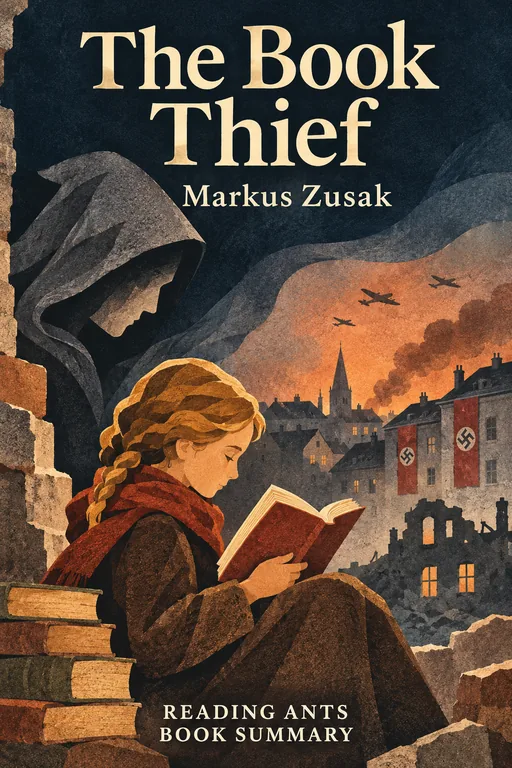
The Book Thief
Markus Zusak
Death narrates how a foster child in Nazi Germany steals books, learns the power of words and forms loving bonds that war eventually destroys.
🎒 Young Adult
Long Walk to Freedom
Nelson Mandela
Nelson Mandela tells his own story, from a village childhood to twenty-seven years in prison to becoming South Africa's first democratically elected president, and shows how patience, courage and forgiveness helped end apartheid.
👤 Real LivesWant something different?
Pick another topic and we will show you three books to start with.