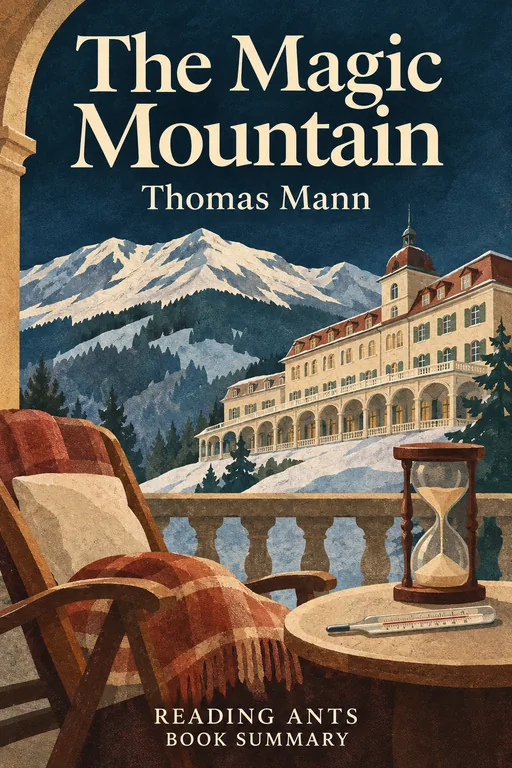
The Magic Mountain
Original title: Der Zauberberg
A young engineer visits a mountain sanatorium for three weeks and stays for seven years, caught between illness, love and the great ideas of his age.
Overview
The Magic Mountain is a long novel by the German writer Thomas Mann, published in 1924. It is set in a sanatorium, a kind of hospital for people with tuberculosis, in the Swiss Alps, in the years before the First World War. The book is a “novel of education,” in which a young man learns about life, but it is also a portrait of European society just before it fell apart. It is full of debates about time, death, politics and the meaning of life. Mann won the Nobel Prize in Literature in 1929, and this novel is counted among his major works.
Main Characters
- Hans Castorp: a young, ordinary engineer from Hamburg.
- Joachim Ziemssen: Hans’s cousin, a soldier being treated for tuberculosis.
- Clavdia Chauchat: a mysterious Russian patient whom Hans falls in love with.
- Lodovico Settembrini: an Italian humanist who believes in reason and progress.
- Leo Naphta: a Jewish-born Jesuit who argues for a harsh, extreme view of society.
- Mynheer Peeperkorn: a wealthy, forceful Dutch visitor.
- Hofrat Behrens: the chief doctor of the sanatorium.
Full Summary
A Short Visit
Hans Castorp, a young man of ordinary tastes, travels to Davos in Switzerland to visit his cousin Joachim at the sanatorium, for a stay of three weeks. He is struck by the strange atmosphere: the rich meals, the rest cures on balconies, the talk of illness, and the sense that time moves differently on the mountain.
Soon he catches a cold, and the doctors examine him. They find that he too has a slight illness, and they suggest that he stay for treatment. He agrees, and the three weeks begin to stretch.
Clavdia
Hans is fascinated by Clavdia Chauchat, a Russian woman, who is careless and graceful, and who slams the dining room door every time she comes in. He falls in love with her, though they hardly speak at first. When she leaves for a time, he feels lost.
His feelings for her connect with his memory of a boy he admired in school. Eventually, at a carnival party, they speak, and he confesses his love.
Two Teachers
Hans becomes a pupil of two men who debate for his soul. Settembrini, an Italian, believes in reason, progress and the dignity of humanity. Naphta, who is a Jesuit and also a kind of revolutionary, defends discipline, terror and the rule of spirit over body. Their arguments go on for hundreds of pages.
Hans listens and is moved by both, but he is not sure he agrees with either. He also learns about science, biology, music and death, and he reads books about the human body, the origin of life and the nature of time. Dr. Behrens and the other doctors show him X-ray pictures of the inside of his own chest, and he looks at them with a mixture of fear and wonder.
Meanwhile, life at the sanatorium goes on, with its meals, its gossip and its small rituals. Hans, who has no plan to leave, slowly forgets his job and his home in Hamburg, and he comes to think that the world below is far away.
The Snow
In one famous chapter, well before the end, Hans goes out on skis and is caught in a snowstorm. Lost and cold, he has a vision of a sunlit world, in which people are kind to one another, but behind them he sees a terrible scene. He understands that humans owe their respect to life, and not to death. But when he returns to the sanatorium, the insight fades.
Time Passes
The seasons turn, and the years pass. Hans watches patients come and go, and some die. Joachim, who is impatient to be a soldier, leaves the sanatorium against medical advice, but later he returns, and he dies.
Clavdia returns, accompanied by Mynheer Peeperkorn, a wealthy man with a big personality, and Hans befriends him. Peeperkorn eventually takes his own life, after he feels his powers are failing, and Clavdia then leaves for good.
Settembrini and Naphta’s arguments grow bitter, and they end in a duel in which Settembrini fires into the air and Naphta shoots himself.
Thunder
After seven years, the First World War breaks out, like a thunderclap. The “magic” of the mountain ends, and the patients scatter. Hans joins the army. The last view of him is as a young soldier on a battlefield, stumbling through the mud and singing a song, in the middle of the shells. The narrator asks whether love might rise from the death and war.
Why It Matters
The Magic Mountain is widely considered one of the greatest German novels of the twentieth century. It is a deep study of how people think about time, illness and death. It also captures the intellectual world of Europe before the war, with the clash between liberal reason and radical ideologies. The sanatorium has become a symbol of a closed society, cut off from reality, just before catastrophe. Mann’s mixture of irony, humor and philosophy is admired, and the book has influenced many later writers and thinkers. It is also one of the best-known examples of the “novel of formation,” in which a young person is slowly shaped by ideas and experience, and it remains a favorite of readers who like to spend a long time with one book.
Key Takeaways
- Time is flexible. In a closed world, days blur and years vanish.
- Ideas matter. The debates of Settembrini and Naphta show how thoughts shape societies.
- Illness teaches. Facing sickness and death changes how Hans sees life.
- Love and attraction are mysterious. Hans’s feeling for Clavdia unsettles him.
- Isolation is dangerous. The comfortable mountain hides the coming war.
What We Can Learn
The book invites us to think about how we use time. It is easy to drift, as Hans does, putting off real choices while life goes by. It encourages us to ask whether we are living in a bubble of comfort that keeps us from seeing the world.
It also shows the value of listening to different viewpoints without immediately taking sides. Hans learns from his teachers, but he comes to his own conclusions. Finally, the book suggests that we should honor life, even as we accept death, and make choices that favor life and kindness.
Criticism and Counterpoints
The novel is very long, and many readers find its philosophical debates slow and heavy. Hans is a passive hero, and some feel that the story is unclear and has little plot. The women characters are seen mostly from his point of view. Others note that the characters of Settembrini and Naphta are more like symbols than people, and that the ending feels sudden. Even so, it is widely admired for its depth.
Who Should Read It
This book is for patient adult readers and mature teens who enjoy long, slow novels full of ideas. It is a good choice for those who like thinking about time, health and history. Readers who want a fast plot should choose something else, but those who enjoy reading slowly may find it a lasting favorite.
Want the whole book?
A summary is a taste, not the meal. Here is where to find the full book.
You reached the end 🎉
Nicely done. Mark this one as read, and we will suggest what to read next.
Read this next
The Plague
Albert Camus
When plague seals an Algerian city off from the world, ordinary people must choose between denial, private escape and the patient shared work of resisting suffering.
🌍 World Literature
The Trial
Franz Kafka
A respectable senior bank officer is arrested one morning for a crime nobody will name, and is dragged through a vast, senseless legal system that he can neither understand nor escape.
🌍 World Literature
Mrs Dalloway
Virginia Woolf
On a June day in 1923, Clarissa Dalloway prepares to host a party in London, while the shell-shocked war veteran Septimus Smith moves toward a crisis, and the two lives touch only at the story's end.
📜 Classics
Doctor Zhivago
Boris Pasternak
A Russian doctor and poet lives through the First World War, the revolution and the civil war, torn between his family, a lasting love and a country that has no place for him.
🌍 World Literature
The Little Prince
Antoine de Saint-Exupery
A pilot stranded in the desert meets a small boy from a tiny planet, who teaches him that the most important things in life, like love and friendship, can only be seen with the heart.
🌍 World Literature
Things Fall Apart
Chinua Achebe
Okonkwo, a proud and fearsome leader in an Igbo village in Nigeria, struggles against his own fears and against the arrival of British missionaries and colonial rulers, who change his world forever.
🌍 World LiteratureWant something different?
Pick another topic and we will show you three books to start with.