 Reading Ants
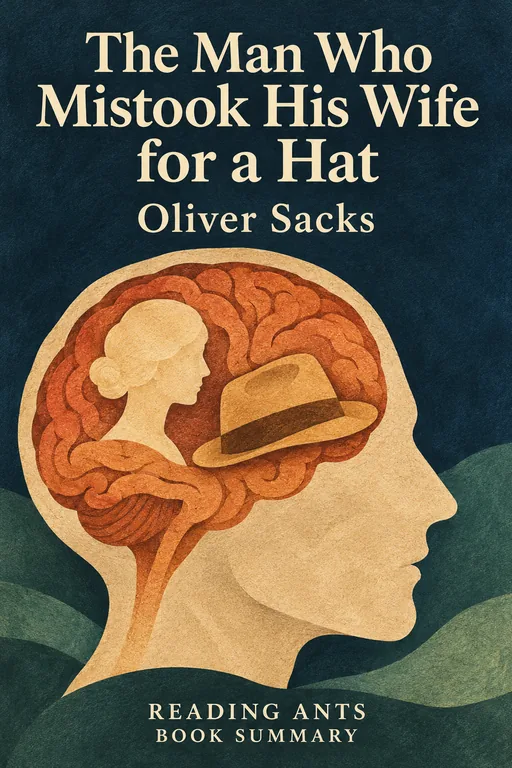
The Man Who Mistook His Wife for a Hat
Neurologist Oliver Sacks tells the stories of patients with strange brain disorders, showing how they reveal the workings of the mind and the resilience of the human spirit.
Overview
The Man Who Mistook His Wife for a Hat and Other Clinical Tales is a collection of case histories by Oliver Sacks, a British-born neurologist who lived in New York and worked as a physician and professor. It was published in 1985 and became one of the best-selling books about the brain. Sacks was convinced that medical records often missed what mattered about a patient’s life, so he wrote about each person as an individual with a story. The twenty-four essays are grouped into four parts: Losses, Excesses, Transports and The World of the Simple. They show the effects of brain damage or unusual brain function, and they ask what it means to be a self.
Full Summary
1. Losses
The idea: The first part describes patients who lost a function. The title story tells of Dr. P., a gifted music teacher with visual agnosia: he could see shapes but could not recognize faces or objects, mistaking his wife’s head for a hat, yet he could still sing and organize his life through music. In “The Lost Mariner,” Sacks describes Jimmie G., who, because of alcohol-related brain damage, has lost the ability to form new memories and lives in the past of 1945. Another patient, Christina, loses her sense of her body’s position and must learn to move by sight alone.
In real life: These cases remind us how many abilities we take for granted, such as recognizing a face or remembering a conversation.
2. Excesses
The idea: The second part looks at conditions in which the brain does too much. Sacks describes Witty Ticcy Ray, a man with Tourette’s syndrome, whose body and speech are full of rapid tics and outbursts, but who is also quick, inventive and talented as a jazz drummer. Another case, “Cupid’s Disease,” is an elderly woman whose mild neurosyphilis made her unusually energetic and flirtatious. Sacks does not just list symptoms but also considers how patients live with and sometimes use their condition.
In real life: Some people with unusual neurological conditions find creative ways to adapt, and doctors can help by seeing the whole person.
3. Transports
The idea: The third part deals with “transports,” states in which patients are carried to other times and places by dreams, seizures or memories. Sacks tells of an elderly woman who began to hear music from her childhood, which turned out to come from a seizure in her brain, and of patients whose long-buried memories and emotions came flooding back after taking the drug L-dopa. He also tells of a young man whose sense of smell became sharp as a dog’s after a drug-induced episode. These accounts show how closely memory, imagination and perception are connected in the brain, and how the mind creates experience.
In real life: Smells or songs can suddenly bring back vivid memories, a mild version of what these patients experience.
4. The world of the simple
The idea: The last part describes people with developmental disabilities who have remarkable talents. Sacks recounts the story of twin brothers who, though they could barely manage daily life, could instantly identify prime numbers by some mysterious sense, and of an artist with autism who drew amazing pictures. He also describes a young woman who found joy in storytelling and music despite significant intellectual difficulties. Sacks argues that we should look for people’s strengths, not just their limitations.
In real life: Teachers who notice and build on a child’s special talents can help them flourish.
5. The doctor and the patient
The idea: In his writing and in his postscripts, Sacks reflects on the role of the physician. He argues that it is not enough to describe a disease; we must understand how a person experiences it, as a narrative of illness. He suggests that science has a tendency to neglect the individual, and that we need both objective knowledge and sympathetic attention to the person. Many of his patients taught him that identity and dignity survive even when abilities are gone.
In real life: A good doctor asks not just “What is wrong?” but “What is your life like?”
6. What the cases reveal
The idea: Throughout the book, Sacks shows that the study of unusual cases illuminates how the typical brain works. Losing one ability shows how it normally functions, and surprising strengths reveal the brain’s flexibility. His main message is that each of these people is a person, not just a case, and that they offer insights into what it means to be human, including the role of memory, music, perception and love.
In real life: Understanding differences in how brains work can make us more tolerant and curious.
Why It Matters
The Man Who Mistook His Wife for a Hat helped create the genre of popular neurology and made Sacks famous. It was adapted into a chamber opera by the composer Michael Nyman, and it influenced plays, films and a generation of readers and doctors. Sacks’s earlier book Awakenings was made into a film in 1990, five years after this book, starring Robin Williams and Robert De Niro.
The book changed how many people thought about brain disorders by presenting patients with respect and curiosity instead of pity, and it became a model for narrative medicine.
Key Takeaways
- The brain shapes who we are. Damage can change perception and identity.
- Patients are people. Each has a story and a point of view.
- Strengths coexist with deficits. Many patients have unexpected abilities.
- Memory and music are powerful. They can reach people when words fail.
- Compassion is part of medicine. Listening matters as much as diagnosis.
What We Can Learn
The book teaches us to be curious and respectful when we meet people who think or perceive differently. Behind unusual behavior, there is often a world that makes sense from the inside.
It also shows how to look at problems from a new angle. Sacks’s practice of spending time with each patient and noticing details offers a model of careful attention.
Finally, it encourages gratitude for ordinary abilities, such as recognizing a friend or remembering yesterday, and a sense of wonder about the brain.
Criticism and Counterpoints
Some critics, including doctors and disability advocates, have argued that Sacks sometimes treated patients as curiosities, and that the stories can be seen as exploiting people’s misfortunes for an audience. Others have questioned the accuracy of some accounts, noting that Sacks sometimes altered details, combined cases or embellished stories, as later revealed in his letters and by journalists.
A few neurologists felt that his focus on rare cases could mislead readers about common conditions. Sacks acknowledged that he disguised identities and used literary techniques. Even so, most readers consider the book a moving and thoughtful exploration of the brain, as long as it is read as storytelling.
Who Should Read It
This book suits teenagers and adults who are curious about the brain. The chapters are short and can be read in any order. It is a humane introduction to neurology, though some cases are sad or unsettling.
Want the whole book?
A summary is a taste, not the meal. Here is where to find the full book.
You reached the end 🎉
Nicely done. Mark this one as read, and we will suggest what to read next.
Read this next
When Breath Becomes Air
Paul Kalanithi
Paul Kalanithi, a young neurosurgeon, writes about facing terminal lung cancer at thirty-six and asks what makes a life meaningful when time is short.
👤 Real Lives
The Emperor of All Maladies
Siddhartha Mukherjee
Physician Siddhartha Mukherjee tells the history of cancer from ancient times to the present, showing how doctors and researchers have fought a disease that is, at its heart, a distortion of our own cells.
🔬 Science
Thinking, Fast and Slow
Daniel Kahneman
Our minds run on two systems, a fast, intuitive one and a slow, careful one, and understanding how the fast system fools us can help us make better decisions about money, risk, work and happiness.
🧩 Mind & Psychology
Predictably Irrational
Dan Ariely
Behavioral economist Dan Ariely uses entertaining experiments to show that people's decisions are shaped by predictable mental quirks, such as relativity, the lure of "free" and social norms, rather than by cool, rational calculation.
🧩 Mind & Psychology
Nudge
Richard H. Thaler and Cass R. Sunstein
Because people are not perfectly rational, the way choices are presented strongly affects what they choose, and designers of choices can gently steer people toward better decisions without taking away their freedom.
🧩 Mind & Psychology
Stumbling on Happiness
Daniel Gilbert
Harvard psychologist Daniel Gilbert explains, with wit and research, that we are surprisingly poor at predicting what will make us happy, because the imagination fills in details wrongly, and he suggests that other people's experience is often a better guide than our own forecasts.
🧩 Mind & PsychologyWant something different?
Pick another topic and we will show you three books to start with.