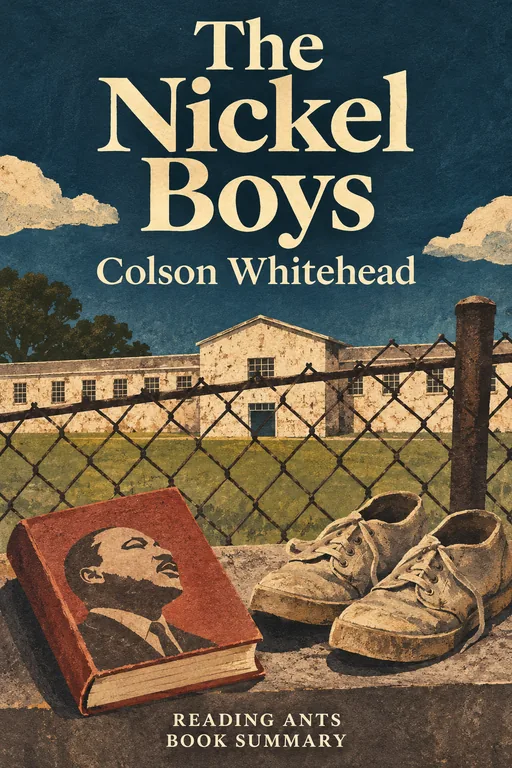
The Nickel Boys
In 1960s Florida, a bright Black teenager, Elwood Curtis, inspired by Martin Luther King Jr., is wrongly sent to the Nickel Academy, a brutal reform school, where he tries to hold on to his ideals, while his friend Turner insists that survival requires compromise.
Overview
The Nickel Boys is a novel by Colson Whitehead, published in 2019, which won the Pulitzer Prize for Fiction in 2020, making him one of the few authors to win the prize twice. It is based on the real Dozier School for Boys in Marianna, Florida, which operated for over a century and where investigations discovered unmarked graves of boys. In the novel, the school is called the Nickel Academy. The story follows Elwood and Turner, and ends with a sudden twist in a later time. The book is short, spare and powerful, and treats the legacy of segregation and state violence.
Main Characters
- Elwood Curtis: a studious, idealistic boy who believes in justice and equality.
- Turner: Elwood’s friend at Nickel, cynical and street-smart.
- Hattie: Elwood’s grandmother, who raises him.
- Spencer: the cruel superintendent.
- Mr. Hill: Elwood’s high school teacher, who encourages him.
- Desmond and Jaimie: other boys at the school.
Full Summary
A Boy with a Record
In Tallahassee, Elwood, a high school student, is given a record of speeches by Martin Luther King Jr., Martin Luther King at Zion Hill, as a Christmas gift in 1962, which gives him a new belief in the power of dignity. He works at a cigar store owned by Mr. Marconi, and is a model student; a teacher, Mr. Hill, encourages him to take college courses. But, on his way to class, he accepts a ride from a stranger in a stolen car, and is arrested, though he had nothing to do with the theft. He is sent to the Nickel Academy in 1963.
His grandmother Hattie works at a hotel, and warns him about the dangers of being Black in the South, but also encourages his hope. The record of Dr. King’s speeches, a gift, is his most precious possession, and he plays it again and again, learning the lines by heart.
Arrival
Nickel, which claims to rehabilitate boys, is segregated, with Black and white boys in separate wings. Its facilities for white boys are better. The Black students are given the hardest labor, poor food and little teaching. Elwood, who believes that he can earn his way out, is a model prisoner. He befriends Turner, a boy who has been at the school for a while, and who warns him not to be naïve.
On his first day, he is given a uniform, made to work in the fields and told the rules. The boys are sorted by race, and the Black boys are given the worst tasks. Elwood sees the white boys on the other side, and sees that the grass there is greener, a small detail that tells much about how the school works.
The White House
The school has a building known as the White House, where boys are taken at night to be beaten with a strap. The beatings are brutal, and some boys do not return. Elwood is beaten after he tries to intervene when a boy is bullied. He is badly hurt, and spends time in the infirmary, where he sees the evidence that the school’s officials are corrupt, taking food and supplies for themselves.
Two Views
Elwood continues to believe in King’s teaching, that love can conquer hate, and tries to stay hopeful. Turner, who has seen too much, believes that the only way to survive is to keep your head down. Their debate is the heart of the novel. Elwood writes a complaint for visiting federal inspectors, hoping to report the abuses. Turner warns him that it will put them both in danger; the complaint is passed to the school’s staff, which puts Elwood at risk.
Turner tells Elwood that the school is run on lies, and that the officials profit from supplies meant for the boys. Elwood, who writes down the details, believes that the truth will set them free, while Turner says that the truth will get them killed. Their friendship holds the book together.
The Escape
When Turner learns that the staff plan to kill Elwood for his complaint, he urges them to run, and they flee together. They escape in the night, but are pursued by the school’s men. Elwood is shot and killed, and Turner makes his way north, finding refuge in New York. His escape is a bitter victory.
The Twist
In the final chapters, years later, Turner is a successful man in New York, who has taken the name Elwood Curtis, in honor of his friend, and has built a life. When the school is investigated, and the graves discovered, he is forced to face his past. He reveals his real name to his wife, and decides to return to Florida to tell the truth about what happened to his friend.
Why It Matters
The Nickel Boys is regarded as one of the most important novels of recent years, and it drew attention to the real history of the Dozier School, where more than a hundred boys are known to have died. The film adaptation, Nickel Boys (2024), directed by RaMell Ross, has been critically praised. The book also shows how stories of abuse by the state can be buried for decades.
By treating the story with restraint, Whitehead shows the horror without sensationalizing it, and invites readers to think about justice and memory.
Key Takeaways
- Institutions can hide cruelty. Nickel’s abuses were covered up.
- Idealism and realism both matter. Elwood and Turner each have a point.
- Racism shaped the justice system. Black boys were punished harshly.
- History is buried and discovered. The graves reveal the truth.
- Identity can carry another’s memory. Turner lives for two.
What We Can Learn
The novel invites us to look at the history of institutions in our own communities, and to ask who was harmed and whose stories were silenced.
It also shows that faith in justice can be tested but is worth keeping, and that survival may require courage of different kinds.
Finally, it reminds us of the importance of memory, and of bearing witness for those who cannot.
It also shows that the stories of the vulnerable are often buried, and that digging them up takes courage, patience and the willingness to listen.
Criticism and Counterpoints
Some readers find the book’s economy of style too restrained, and wish for more depth in the secondary characters. Others feel that the twist at the end is jarring or complicated, and takes attention from the story of Elwood. Some find the violence hard to read, though it is not graphic.
A few critics say that the novel is more like a historical report than a novel. Still, most praise its power.
Who Should Read It
This book is for mature readers. It deals with violence, abuse and racism, though in a restrained way. It is short and moving, and is a good book for discussion.
Want the whole book?
A summary is a taste, not the meal. Here is where to find the full book.
You reached the end 🎉
Nicely done. Mark this one as read, and we will suggest what to read next.
Read this next
The Underground Railroad
Colson Whitehead
Cora, an enslaved young woman on a Georgia cotton plantation, escapes on a literal underground railroad of tunnels and trains, and flees through a series of American states, each a different version of the nation's racism, pursued by a relentless slave catcher.
✨ Modern Fiction
Invisible Man
Ralph Ellison
An unnamed young Black man moves from the South to Harlem and passes through one false identity after another, until he realizes that he is invisible to a society that sees only what it expects, and he retreats underground to write his story.
📜 Classics
Native Son
Richard Wright
Bigger Thomas, a young Black man in 1930s Chicago who feels trapped by poverty and racism, accidentally kills a white woman and then commits another crime, and the novel shows how a society shaped him and then condemned him.
📜 Classics
Just Mercy
Bryan Stevenson
Lawyer Bryan Stevenson tells how he defended people condemned or imprisoned unfairly, especially a Black man named Walter McMillian who was sentenced to death for a crime he did not commit, and argues that mercy and justice must go together.
⚖️ Politics & Society
Between the World and Me
Ta-Nehisi Coates
In a letter to his teenage son, Ta-Nehisi Coates describes what it means to live in a Black body in America, and reflects on fear, history and the struggle to be free.
⚖️ Politics & Society
The Kite Runner
Khaled Hosseini
A wealthy boy in Kabul betrays his loyal best friend on the day of a kite tournament, and decades later, after fleeing to America, he returns to a Taliban-ruled Afghanistan to try to make things right.
✨ Modern FictionWant something different?
Pick another topic and we will show you three books to start with.