 Reading Ants
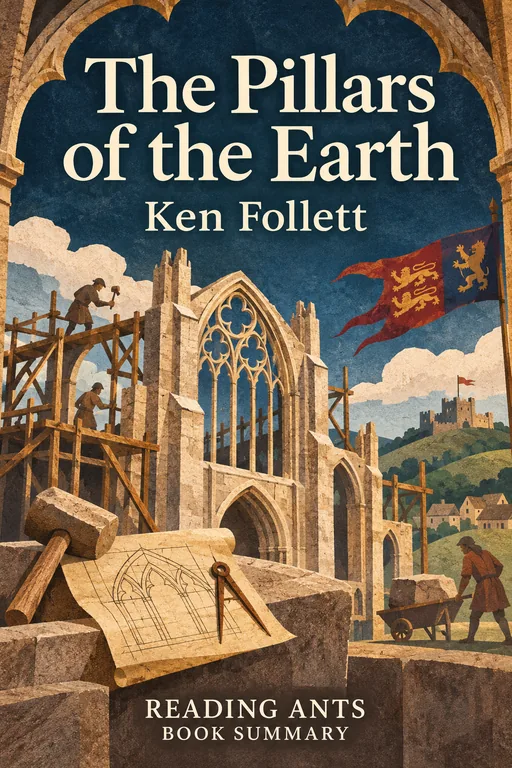
The Pillars of the Earth
Across half a century in twelfth-century England, a master builder named Tom, a determined prior named Philip, and a family of power-hungry nobles struggle over the building of a great cathedral in the fictional town of Kingsbridge.
Overview
The Pillars of the Earth is a historical novel by Ken Follett, published in 1989. It spans the years from the 1120s to the 1170s, and is centered on the Anarchy, the English civil war between King Stephen and the Empress Matilda over the throne. The story centers on the construction of a Gothic cathedral, and on the people whose lives intersect over it: a builder who dreams of a masterpiece, a monk who wants to rebuild a priory, a bishop who schemes for power and a noblewoman who wants to reclaim her family’s lands. Follett, who was known for thrillers, wrote it after long research into medieval architecture. It became a huge best-seller, and led to a sequel, World Without End.
Main Characters
- Tom Builder: a skilled master mason who wants to build a cathedral.
- Prior Philip: a pious, practical monk who becomes prior of Kingsbridge.
- Aliena: the daughter of an earl, who loses everything and becomes a wool merchant.
- Jack Jackson: Tom’s stepson, a talented young builder with new ideas.
- William Hamleigh: a cruel, ambitious young lord.
- Waleran Bigod: a scheming bishop who is Philip’s enemy.
- Ellen: Jack’s mother, an outcast living in the forest.
- Richard: Aliena’s brother, a knight.
Full Summary
The White Ship and the Poor Builder
The story begins in the early 1120s, with a hanging, and with the shadow of the White Ship disaster, which drowned the heir to the English throne and left the succession in doubt. Tom Builder, a master mason, is out of work and tramping with his family. His wife dies in childbirth, and he leaves the baby in the woods, to save the child’s life, and later it is taken by monks. Tom meets a woman named Ellen, who lives in the forest, and they become partners.
Kingsbridge
Tom arrives in Kingsbridge, where he is hired by Prior Philip, who has taken over a struggling priory. A fire destroys the old church, and Tom begins to plan a new cathedral. Meanwhile, a bishop, Waleran, plots against the prior and tries to take control of the town. Aliena, whose father, the Earl of Shiring, has been jailed, hears that her family has been ruined by William Hamleigh, who has taken their castle, and she is left almost penniless.
Philip, who is practical and loyal, works to bring order to the priory, pushing for fair treatment of the monks and the townspeople. He studies wool markets and building, and his humane leadership contrasts with the cruelty of the nobles. He is not a saint, but he is honest, and he grows into the role.
Violence and Loss
William Hamleigh attacks and ruins Aliena, assaulting her, in a scene that shapes her life. Her father dies, and she becomes the guardian of her brother, Richard, and sets herself to rebuild the family fortune. She starts to trade in wool, living by her wits and saving her money. Jack, Ellen’s young son, who is clever and inventive, meets Aliena, and they fall in love, though their path is difficult.
Aliena keeps a promise to her dying father to look after Richard, and sells wool to make a living. She learns to bargain, to defend herself and to run a business, and a network of weavers and traders comes to depend on her.
The Anarchy
The civil war between Stephen and Matilda destroys the countryside. Philip struggles to protect Kingsbridge, using his skill and the loyalty of the townspeople. Tom dies, and Jack, who has studied cathedrals in France, returns and takes over the building, bringing new ideas about pointed arches and flying buttresses. Meanwhile, the king is captured, then freed. William’s power rises.
The Church and the King
A key plot is the conflict between the church and the king. Waleran, an ambitious bishop, schemes against Philip for power, and Philip must navigate these politics. Jack and Aliena, long separated, are finally brought together, and marry. Years later, in 1170, Archbishop Thomas Becket is murdered in Canterbury Cathedral, and William and Waleran are drawn into the plot against him. William is convicted of sacrilege and hanged, and Waleran is exposed and loses his bishopric.
The Triumph
By the end of the story, the cathedral is built. Jack has completed the building, a masterpiece of the new style, and Philip has become a bishop. The cathedral stands as a symbol of human ambition and perseverance, as well as the labor of many ordinary people.
The novel closes with the public penance that King Henry II is made to perform for Becket’s murder, in which Philip, now a bishop, takes part, and with the sense that the town has earned its place; the finished cathedral stands as a monument that would last for centuries.
Why It Matters
The Pillars of the Earth is one of the best-selling historical novels of all time, selling over twenty million copies. It was adapted into a television miniseries in 2010. The book brought the world of medieval construction to life, and many readers have said that it inspired their interest in architecture. It broadened Follett’s readership, and spawned further novels set in Kingsbridge.
Its picture of the Middle Ages, focused on ordinary workers, builders and monks, as well as nobles, makes history seem close and vivid.
Follett has said that he was drawn to cathedrals as a lifelong interest, and the novel helped to inspire a wave of historical fiction set in the Middle Ages. Many readers still visit real cathedrals with the book in mind.
Key Takeaways
- Great works need patience. The cathedral takes decades.
- Ambition can build or destroy. Some seek power, others seek beauty.
- Cruelty is punished eventually. Justice arrives, if slowly.
- Ordinary people create history. Builders and merchants matter.
- Love and loyalty endure. Jack and Aliena are tested by separation and war.
What We Can Learn
The novel shows that large projects, whether a cathedral or a career, depend on skill, planning and the work of many people. It encourages us to be patient and to value those who do the labor.
It also shows how power, when misused, harms the powerless, and invites us to consider how institutions can protect people.
Finally, it reminds us that new ideas, like Jack’s pointed arches, often meet resistance, but can lead to improvement.
It also shows that good leaders, like Philip, combine vision with practical care for people, and that building something lasting often means working with people we do not like.
Criticism and Counterpoints
Critics point out that the characters are somewhat stereotyped, with clear heroes and villains, and that the dialogue is modern. Others object to the amount of sexual violence in the book, which some find gratuitous. Historians note that Follett takes liberties with history, simplifies medieval politics and gives modern attitudes to his characters.
The plot’s heavy use of coincidence and repeated cycles of disaster and recovery can feel formulaic. Some find the book long. Still, it is greatly enjoyed by readers who like historical sagas.
Who Should Read It
This book suits mature readers. It is very long, and includes rape, murder and violence. It is a gripping read for those interested in medieval history and architecture.
Readers who enjoy long, plot-driven sagas will find it hard to put down.
Want the whole book?
A summary is a taste, not the meal. Here is where to find the full book.
You reached the end 🎉
Nicely done. Mark this one as read, and we will suggest what to read next.
Read this next
The Name of the Rose
Umberto Eco
A Franciscan friar investigates deaths in a medieval abbey, where the struggle to control books and laughter proves more dangerous than any supernatural curse.
🌍 World Literature
The Kite Runner
Khaled Hosseini
A wealthy boy in Kabul betrays his loyal best friend on the day of a kite tournament, and decades later, after fleeing to America, he returns to a Taliban-ruled Afghanistan to try to make things right.
✨ Modern Fiction
The Bluest Eye
Toni Morrison
In 1940s Ohio, a poor Black girl named Pecola Breedlove, who believes that she is ugly, prays for blue eyes, and the community's failure to protect her leads to tragedy.
✨ Modern Fiction
Song of Solomon
Toni Morrison
Macon "Milkman" Dead, a self-absorbed young man from Michigan, goes south in search of a family treasure and finds instead his family's history, and learns to take responsibility and to fly.
✨ Modern Fiction
Beloved
Toni Morrison
A formerly enslaved woman living in Ohio after the Civil War is haunted by the ghost of the daughter she killed to save her from slavery, and by the painful memories she has tried to bury.
✨ Modern Fiction
Roots: The Saga of an American Family
Alex Haley
Beginning with Kunta Kinte, a young man seized from his village in the Gambia in 1767, this family saga follows seven generations of his descendants through slavery, the Civil War and freedom in America.
✨ Modern FictionWant something different?
Pick another topic and we will show you three books to start with.