 Reading Ants
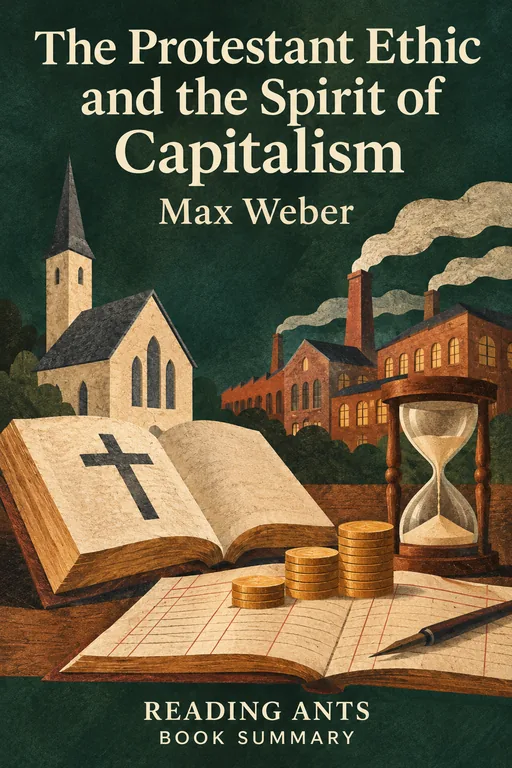
The Protestant Ethic and the Spirit of Capitalism
Original title: Die protestantische Ethik und der Geist des Kapitalismus
German sociologist Max Weber argues that certain Protestant beliefs, especially those of Calvinism, helped to create the disciplined, work-centered attitude that made modern capitalism possible, even though capitalism later outgrew its religious roots.
Overview
The Protestant Ethic and the Spirit of Capitalism was first published in German in 1904 and 1905, in the form of two essays, by Max Weber, a founder of modern sociology. Weber asked why modern capitalism, with its rational pursuit of profit and systematic organization of work, arose first in Western Europe and not elsewhere. He observed that, in Germany and elsewhere, business leaders and skilled workers were more often Protestant than Catholic, and wondered whether religious ideas played a role. The book is one of the most influential and debated works in social science.
Full Summary
1. The puzzle: religion and economic life
The idea: Weber starts with a statistical observation, that in mixed-religion regions of Germany, Protestants tended to be more represented among owners of capital and in higher technical education. He asks whether there is a connection between religious beliefs and economic behavior. He also distinguishes the spirit of capitalism, an attitude that values making money as a duty and an end in itself, from the simple greed that has existed in all ages. This attitude was novel.
In real life: Two groups with equal opportunities may behave differently because of the values that they were raised with.
2. The spirit of capitalism: Benjamin Franklin
The idea: To illustrate this spirit, Weber quotes the writings of Benjamin Franklin, who advised that time is money, credit is money, and that honesty and punctuality are useful. For Franklin, he says, earning more and more money is seen as a duty, a calling, and not for the sake of pleasure. This is strange, since the goal is not to enjoy wealth but to keep increasing it. Weber calls this attitude a peculiar ethic, which regards work as a moral obligation.
In real life: A person who works hard for its own sake, not only to buy things, shows this attitude.
3. The idea of a calling
The idea: Weber traces the notion of a calling, a task given by God, to the Reformation, in particular to Martin Luther, who held that daily work in the world is a form of serving God, rather than a lower activity than monastic life. This was a new valuation of ordinary work. The idea raised the moral status of labor and the business life, and encouraged people to perform their duties diligently.
In real life: A cook who regards cooking as a worthy vocation may take pride in the work.
4. Calvinism, predestination and worldly asceticism
The idea: Weber argues that the doctrine of predestination in Calvinism, which held that God has already decided who will be saved, created great anxiety, since believers could not know whether they were among the elect. Preachers urged believers to see themselves as chosen and to fight doubt, and recommended intense, disciplined activity in one’s worldly calling as the best cure for anxiety. The result was a worldly asceticism: hard work, saving and avoiding luxury. Wealth was dangerous if it led to idleness and enjoyment, but welcome as the fruit of work done as a duty, so earnings tended to be saved and reinvested rather than spent.
In real life: A person who is anxious about the future may work obsessively to find reassurance.
5. Methodical life and rational capitalism
The idea: This ethic, Weber says, made believers methodical in daily life, with a systematic organization of time, money and conduct, which was well suited to business. Such people saved and reinvested their profits, avoided waste and were honest in dealings, which built trust. Other Protestant groups, such as Pietists, Methodists and Baptists, added their own versions. Weber suggests that this combination of work discipline and thrift helped capitalism to take root.
In real life: A habit of planning and saving makes it easier to start a business.
6. The iron cage
The idea: In the conclusion, Weber says that the religious motives faded, but the habits remained. Modern people are now bound to the economic order, and must work as a result of the system itself, whether or not they hold the beliefs. He describes this as an iron cage, in which people are trapped by the demands of rational efficiency, “specialists without spirit,” and a world in which the original meaning has gone. He ends by wondering what will come next.
In real life: Someone may feel stuck in routines that no longer have a purpose.
Why It Matters
Weber’s essay is one of the most influential works in sociology, and has been debated for over a century. It helped to establish the idea that cultural values and religious ideas can shape economic life, in contrast with theories such as Marx’s that put material conditions first. The phrases “Protestant work ethic” and “iron cage” have entered general vocabulary. The book led to a large literature of testing, supporting and criticizing the thesis. It also exemplifies Weber’s method of interpretive sociology, which seeks to understand the meaning that people give to their actions.
Key Takeaways
- Ideas can shape economies. Beliefs influence how people work and save.
- Work can be a calling. The Reformation raised the status of everyday labor.
- Anxiety drove discipline. Calvinist doctrine encouraged systematic effort.
- Habits outlast beliefs. The work ethic continued after the religion faded.
- Rationalization has costs. Efficiency can become an iron cage.
What We Can Learn
You can use the book to think about the values you were raised with, and how they affect your attitudes toward work, money and time. Ask whether you work to live or live to work, and what gives your work meaning. Notice the way that organizations and schedules shape life. Be cautious about simple explanations of why some societies became rich, and remember that other factors, such as geography, politics and trade, also matter. Reading Weber with his critics helps to see how scholars test big ideas.
Criticism and Counterpoints
Many historians and economists dispute Weber’s thesis. They point out that capitalism and commercial development flourished in Catholic regions, such as Italy, before the Reformation, and that the link between Protestantism and prosperity may be explained by other factors such as literacy. Some say that he underestimated other forces such as law, state power and trade. Others argue that the cause may run the other way, since communities already inclined to business may have been more likely to turn Protestant. Still, many defend the value of his insights about culture and motivation.
Who Should Read It
This book is for students of sociology, history, religion and economics. It is dense, with long footnotes, and best read with a guide. Those who want an easier way into Weber can start with a summary, or read the first and last chapters.
Want the whole book?
A summary is a taste, not the meal. Here is where to find the full book.
You reached the end 🎉
Nicely done. Mark this one as read, and we will suggest what to read next.
Read this next

The Wealth of Nations
Adam Smith
A nation's true wealth is not its stock of gold but the goods and services its people produce, and that wealth grows fastest when people specialize, trade freely and compete, with government providing justice, defense and public goods.
💰 Money & Economics
Democracy in America
Alexis de Tocqueville
After touring the United States in the 1830s, the young Frenchman Alexis de Tocqueville wrote a penetrating study of American democracy, praising its energy and liberty, and warning about its dangers, such as the tyranny of the majority and a retreat into private life.
⚖️ Politics & Society
The General Theory of Employment, Interest and Money
John Maynard Keynes
Keynes argues that an economy can get stuck with high unemployment because total spending is too low, and that governments can and should act to raise demand when private spending falls short.
💰 Money & Economics
Bowling Alone
Robert D. Putnam
Political scientist Robert Putnam shows with a wealth of data that Americans have become less connected to one another in clubs, churches, unions and neighborhoods since the 1960s, and argues that this loss of social capital weakens democracy and well-being.
⚖️ Politics & Society
The Autobiography of Benjamin Franklin
Benjamin Franklin
Benjamin Franklin tells the story of his rise from a poor Boston boy to a successful printer, inventor and public leader in Philadelphia, and shares his methods of self-improvement.
👤 Real Lives
The Prince
Niccolo Machiavelli
A Renaissance diplomat advises rulers to judge their actions by results rather than morality, arguing that a successful leader must sometimes be cunning and ruthless to win and keep power.
⚖️ Politics & SocietyWant something different?
Pick another topic and we will show you three books to start with.