 Reading Ants
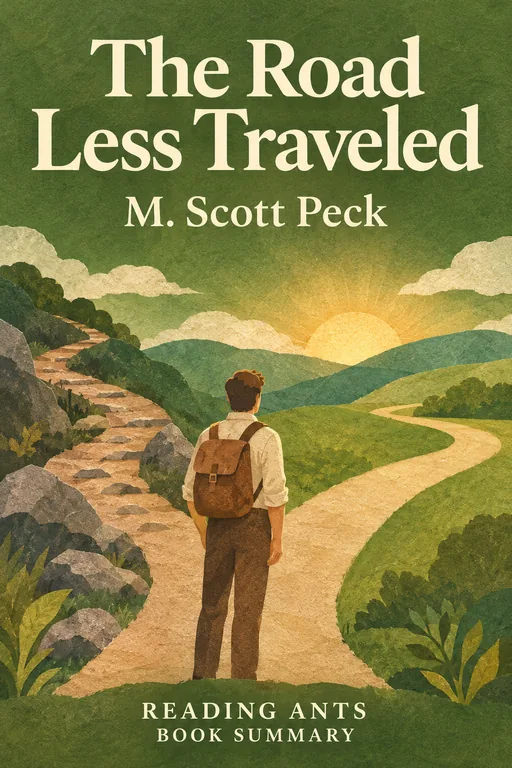
The Road Less Traveled
Psychiatrist M. Scott Peck opens with the statement that life is difficult, and argues that real growth comes from facing problems, with discipline, love and a willingness to accept grace, and he draws on his work with patients to show how.
Overview
The Road Less Traveled: A New Psychology of Love, Traditional Values and Spiritual Growth was published in 1978 by M. Scott Peck, an American psychiatrist. Peck was an unknown author and the book came out without fanfare. It sold slowly at first, after a major publisher turned down the manuscript and Simon & Schuster printed a small first run, and it spread by word of mouth, including through Alcoholics Anonymous, helped by one enthusiastic early review in the Washington Post. It reached the national bestseller lists only about five years after publication. The book has four sections: discipline, love, growth and religion, and grace. Peck draws on his clinical experience, using stories of patients whose names and details he changed to protect their privacy, and mixes psychology with religious and moral ideas. The famous first line says that life is difficult, which he says is a great truth, and that once we accept it, it no longer troubles us.
Full Summary
1. Life is difficult: the need for discipline
The idea: Peck says that life is a series of problems, and that the pain of solving them is what gives meaning, since that is how we grow. Many people avoid problems, and the pain that goes with them, and this avoidance is the root of mental illness. He proposes four tools of discipline: delaying gratification, which means facing the painful first and enjoying afterward; accepting responsibility; dedication to the truth; and balancing. These are the methods for dealing with life’s problems.
In real life: Doing homework first and playing afterward is delayed gratification.
2. Delaying gratification and taking responsibility
The idea: The author describes delaying gratification as scheduling the pain and pleasure of life so that you face the pain first and enjoy the pleasure afterward. He tells of a patient who procrastinated at work because, like her habit of eating the frosting of a cake first, she did the enjoyable part of her job first. Children learn the skill early, and Peck argues that the quality of parenting, above all loving attention and example, shapes whether they develop it. He then deals with responsibility: we cannot solve a problem until we accept it as ours, yet some people blame others or circumstances, as an army sergeant in Okinawa did when he blamed the island for his drinking. Peck describes neurotics, who take too much responsibility, and people with character disorders, who take too little, and says many people are a mixture. Health lies in the lifelong task of working out what is truly one’s own responsibility.
In real life: A student who blames a teacher for every bad grade may never look at how they study.
3. Dedication to truth and balance
The idea: Peck argues that dedication to truth means a lifelong willingness to examine one’s view of reality, and to revise it, which is hard, since our “maps” of reality must be redrawn as we and the world change, and clinging to an outdated map is, in his view, the basis of much mental illness. Truth requires openness to challenge, and honesty, with oneself and others, including a warning that withholding important information is a form of lying. The fourth tool, balancing, is a kind of discipline applied to discipline itself: it brings flexibility and judgment, for example in deciding when to express anger or when to be fully honest, and at its core it means the painful act of giving up things, such as a habit or a desire, sometimes even a whole way of life. Together, these form the basis of a disciplined life.
In real life: Updating your opinion when you learn that you were wrong is an act of truthfulness.
4. Love as the will to nurture growth
The idea: In the second part, Peck defines love as a choice to put in effort in order to help yourself, or another person, to grow spiritually. Love is an act of will, not just a feeling, and involves effort and sometimes discomfort. He distinguishes love from falling in love, which he describes as a temporary collapse of ego boundaries, and from dependency, in which a person seeks to be taken care of. Real love, he says, respects the other person’s separateness.
In real life: A parent who lets a child struggle with a problem, out of love, is nurturing growth.
5. Growth and religion
The idea: The third part looks at growth and religion. Peck says everyone has a religion, meaning a view of what life is about, however limited or unconscious, and that spiritual growth is a journey out of a narrow view into a wider one, which starts with questioning what we were taught. He uses three case histories, Kathy, Marcia and Ted, to ask whether belief in God is a sign of illness. Kathy had to question and discard the belief her mother and church taught her in order to grow, while a belief in God grew naturally in Marcia, and Ted’s abandoned belief had to be recovered as part of his healing. Peck concludes that the answer is sometimes yes and sometimes no, and warns that scientists can throw out the baby with the bath water, or fall into tunnel vision.
In real life: Questioning what you were taught about the meaning of life is part of growing up.
6. Grace: the help that we do not control
The idea: In the last part, Peck discusses grace, which he defines as a powerful force originating outside human consciousness that nurtures spiritual growth. He illustrates it with what he calls the miracles of health, of the unconscious, and of serendipity, and suggests that human beings are helped by a power beyond ordinary understanding. Some of these examples, such as dreams, point to the unconscious, while others point beyond the individual, and he ties grace to God. He says we cannot will ourselves into grace, but we can open ourselves to it by becoming disciplined and loving, and he ends by saying that its existence shows human growth matters to something greater than ourselves.
In real life: Sometimes help arrives unexpectedly, from a friend or a chance event, just when needed.
Why It Matters
The Road Less Traveled was one of the best-selling self-help books ever, with more than ten million copies sold. It brought psychology, spirituality and ethics together, and Peck himself noted that many readers wrote to thank him for saying things they had already thought and felt but were afraid to talk about. It popularized the idea that facing problems is the way to grow. The book’s first line is often quoted, and its definition of love as an act of will has been widely discussed. It also led to further books by Peck, who became a well-known speaker on the lecture circuit. Even critics acknowledge its impact.
Key Takeaways
- Life is difficult. Accepting this reduces the sense of unfairness.
- Face problems. Avoidance leads to deeper trouble.
- Discipline has four tools. Delay gratification, take responsibility, seek truth and balance.
- Love is an act of will. It aims to help another to grow.
- Stay open to grace. Help can come from beyond our control.
What We Can Learn
You can use the book to look at the way you deal with problems. Ask whether you avoid some, and what happens when you face them. Practice delaying gratification in small ways, such as finishing a hard task first. Take responsibility for your part in conflicts. Notice whether your love for someone includes care for their growth, and not only your own needs. Be honest with yourself and open to revising your view. At the same time, read critically, since the book contains controversial opinions, and use it as a prompt for thinking.
Criticism and Counterpoints
Critics say that Peck’s mix of psychiatry and religion is not scientific, and that his views on grace are speculative, resting on case stories, dreams and his own beliefs rather than systematic evidence. Peck himself says that grace cannot be explained by conventional science, and he treats claims of telepathy as scientifically established, which many scientists would dispute. Others note that his definitions, for example of love, are his own, and that his writing is sweeping and sometimes harsh, for example in calling dependency in healthy adults a sickness or character-disordered parents disastrous. Later revelations about his own conduct, including his own acknowledgment, in a later book, of extramarital affairs, have led some readers to question his authority. A few find the book dated. But many say that its core message about facing problems is sound.
Who Should Read It
This book is for readers who like reflective, serious self-help with a spiritual dimension. It is long, but easy to read. Those who prefer a purely scientific approach to psychology, or who dislike religious language, may find some of it hard to accept.
Want the whole book?
A summary is a taste, not the meal. Here is where to find the full book.
You reached the end 🎉
Nicely done. Mark this one as read, and we will suggest what to read next.
Read this next
Man and His Symbols
Carl G. Jung
Carl Jung and four of his followers explain, for general readers, how dreams and symbols express the unconscious mind, and how paying attention to them can help a person grow into a more whole self.
🧩 Mind & Psychology
The Art of Loving
Erich Fromm
Psychoanalyst Erich Fromm argues that love is not a feeling that simply happens to us but a skill that must be learned, requiring care, responsibility, respect and knowledge, and that modern society makes it harder to practice.
🧩 Mind & Psychology
Man's Search for Meaning
Viktor E. Frankl
A psychiatrist who survived the Nazi concentration camps explains that even in the worst suffering, people can choose their attitude, and that finding a reason to live is what gives us the strength to endure.
👤 Real Lives
The Denial of Death
Ernest Becker
Cultural anthropologist Ernest Becker argues that the fear of death is the main force behind human behavior, and that much of what we do, from heroic deeds to work, religion and politics, is an attempt to deny our mortality.
🧩 Mind & Psychology
Mere Christianity
C. S. Lewis
C. S. Lewis, the author of the Narnia stories, explains and defends the central beliefs that most Christians share, using reason, plain language and vivid examples.
🕊️ Philosophy & Religion
Atomic Habits
James Clear
Big changes in life come not from huge leaps but from tiny habits repeated every day, and you can build good habits (and break bad ones) by designing your life so the right choices are obvious, attractive, easy and satisfying.
🌱 Self-ImprovementWant something different?
Pick another topic and we will show you three books to start with.