 Reading Ants
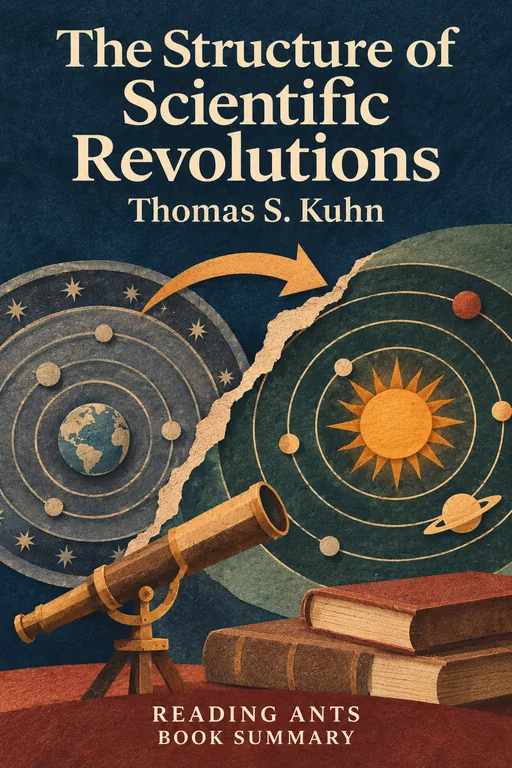
The Structure of Scientific Revolutions
Thomas Kuhn argues that science does not advance by steady accumulation of facts but through long periods of normal work within a shared framework, interrupted by revolutionary shifts that change the way scientists see the world.
Overview
The Structure of Scientific Revolutions is a short book by the American historian and philosopher of science Thomas Kuhn, published in 1962. Kuhn, who had trained as a physicist, became interested in how science really works after studying the history of the field. He was struck that older scientific writings made sense only if one understood the assumptions of their time, and that science did not simply progress by adding new facts to old. His book introduced the term paradigm shift, which has since entered everyday language. It became one of the most cited academic works of the twentieth century and changed how people think about science.
Full Summary
1. Normal science and paradigms
The idea: Kuhn says that most of the time scientists work in a period of normal science, guided by a paradigm: a set of shared theories, methods, examples and standards that define how to do research in a field. For instance, Newtonian physics provided a paradigm for centuries. Within it, scientists solve puzzles, refining measurements and applying the theory to new situations. They don’t generally try to disprove the paradigm, but assume it is correct.
In real life: A textbook teaches a field’s accepted framework, and students learn to solve problems in the approved way.
2. Anomalies and crisis
The idea: Over time, results turn up that the paradigm cannot explain, called anomalies. At first they are often investigated, set aside or explained away. But as anomalies accumulate, or when one is especially significant, confidence in the paradigm begins to erode, and the field enters a crisis. Scientists start to try new ideas and question basic assumptions. This is a stressful time, with debates and competing approaches.
In real life: When a long-trusted method begins to fail in many cases, people start to ask whether the method itself is the problem.
3. Scientific revolutions
The idea: A crisis may be resolved by the appearance of a new paradigm that explains the anomalies and promises further discoveries. The shift from the old to the new is a scientific revolution, as when the Earth-centered view of the universe gave way to the Copernican system, or when Newtonian physics was replaced by Einstein’s relativity and quantum theory. Kuhn argues that such shifts are not simply logical steps but involve a change in how scientists see the world, something like a gestalt switch, as when a drawing suddenly looks like a different image.
In real life: Chemists once explained burning by an invisible substance called phlogiston, until Lavoisier’s work on oxygen reorganized the field.
4. Why paradigms are hard to compare
The idea: Kuhn suggests that rival paradigms are partly incommensurable: they use concepts, standards and problems differently, so supporters of different paradigms may talk past each other. Scientists on opposite sides may not agree on what counts as a good explanation. As a result, choosing between paradigms is not just a matter of weighing evidence by a neutral rule. It also involves persuasion, trust and, sometimes, generational change, as older scientists retire.
In real life: Two people with different basic assumptions can look at the same facts and draw different conclusions.
5. How science progresses
The idea: Kuhn argues that science does make progress, but not by approaching a final truth. Instead, each new paradigm generally solves problems more effectively than its predecessor, though it may lose some earlier explanations, and the field moves forward by solving more puzzles. He also notes that textbooks often present history as a straight line of accumulating discoveries, which hides the revolutions. This “tidying” of history gives students a misleading picture.
In real life: A history class that only describes success stories may skip the false starts and arguments that really took place.
6. The role of community
The idea: Throughout, Kuhn emphasizes that science is a social activity. Scientific communities hold shared beliefs, train new members and judge each other’s work. Their values shape which questions are asked and which answers are accepted. He does not say that science is arbitrary, but that it cannot be understood without considering the people and institutions that do it.
In real life: Scientific journals, conferences and peer review are examples of the community deciding what is accepted.
Why It Matters
Kuhn’s book transformed the philosophy and history of science and affected many other fields, such as sociology, economics, education and management. The phrase “paradigm shift” is now used to describe any major change in thinking, from technology to politics. The book sold over a million copies, which is very high for an academic work.
It also challenged the view that science is purely logical and cumulative, prompting new research on the social and historical aspects of science. Many scholars credit it with starting a new era of “science studies,” and its ideas are now discussed in courses on history, sociology, education and management as well as in philosophy.
Key Takeaways
- Normal science works within a paradigm. Most research solves puzzles.
- Anomalies build up. Unexplained results can lead to crisis.
- Revolutions change worldviews. New paradigms redefine problems.
- Communities matter. Science is a shared human enterprise.
- History is not a straight line. Progress includes upheavals and disagreement, not just steady gains.
What We Can Learn
The book encourages us to be aware of the assumptions behind our beliefs. If we see that our field or culture works inside a framework, we can ask what might be hidden and be open to challenges.
It also teaches patience with new ideas. Revolutionary ideas often meet resistance, and it can take time and evidence for them to be accepted, which should make us both careful and receptive.
Finally, it shows that science is a human activity with creativity and disagreement, and that this does not make it less valuable.
Criticism and Counterpoints
Critics argue that Kuhn’s account makes science seem irrational or relativistic, as if truth depended only on agreement in a community. The philosopher Karl Popper held that science advances through bold conjecture and attempts to refute them, not through normal puzzle solving. Others say that Kuhn used the word “paradigm” in many different ways, as critics such as Margaret Masterman noted, which made it unclear.
Historians of science have also argued that actual scientific revolutions are less sudden and sharp than Kuhn suggested. Kuhn himself later clarified that he did not think science was irrational. The book remains a classic, though its claims are debated.
Who Should Read It
This book suits older teenagers and adults interested in science, history and philosophy. It is short but abstract, and some readers find it demanding. It is a good starting point for thinking about how science really works.
Want the whole book?
A summary is a taste, not the meal. Here is where to find the full book.
You reached the end 🎉
Nicely done. Mark this one as read, and we will suggest what to read next.
Read this next
A Short History of Nearly Everything
Bill Bryson
Bill Bryson sets out to understand how we know what we know about the universe, the Earth and life, and tells the story through the odd, brilliant and sometimes unlucky people who figured it out.
🏛️ History
The Demon-Haunted World
Carl Sagan
Carl Sagan defends science as a candle in the dark against superstition and pseudoscience, and offers a "baloney detection kit" of tools for thinking critically and for testing claims.
🔬 Science
Cosmos
Carl Sagan
Carl Sagan takes readers on a journey from the Earth to the edge of the universe, blending astronomy, history and philosophy to show how humanity came to understand the cosmos and our place in it.
🔬 Science
Thinking, Fast and Slow
Daniel Kahneman
Our minds run on two systems, a fast, intuitive one and a slow, careful one, and understanding how the fast system fools us can help us make better decisions about money, risk, work and happiness.
🧩 Mind & Psychology
A Brief History of Time
Stephen Hawking
One of the world's greatest physicists explains, with almost no math, what we know about the origin, structure and fate of the universe, from the Big Bang to black holes and the nature of time itself.
🔬 Science
On the Origin of Species
Charles Darwin
All living things are related and have slowly changed over immense periods of time, shaped by natural selection, the process by which individuals better suited to their environment survive and pass on their traits.
🔬 ScienceWant something different?
Pick another topic and we will show you three books to start with.