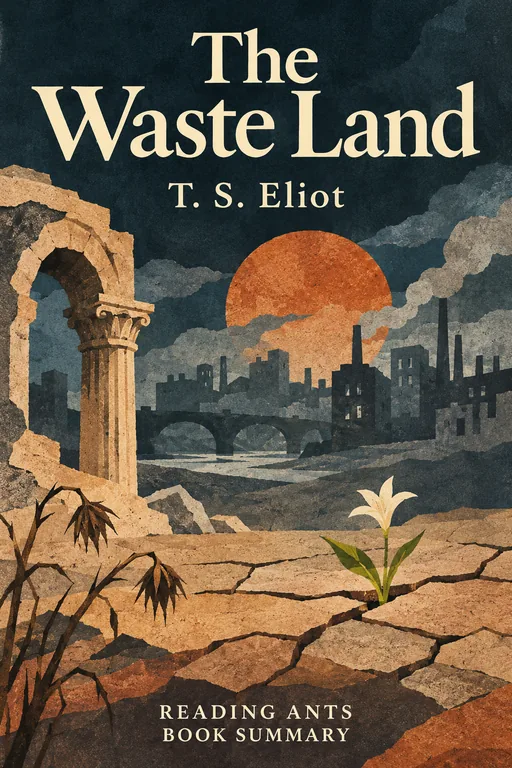
The Waste Land
In a patchwork of voices, myths, quotations and scenes of modern city life, Eliot's famous poem portrays a broken, spiritually barren post-war Europe, and hints at the possibility of renewal.
Overview
The Waste Land is a long poem by T. S. Eliot, an American-born poet who lived in England, published in 1922. It runs to 434 lines, in five sections, and was heavily edited by his friend Ezra Pound, who cut it by about half. The poem is difficult and fragmentary, jumping between voices, places and times, and including quotations from many languages and sources, from the Bible to Dante to Hindu texts. It was written in the aftermath of World War I, during a time of disillusion, and in the midst of Eliot’s own unhappiness and nervous collapse. It is one of the most influential poems of the twentieth century, and is often seen as the defining work of modernist poetry.
Main Characters
The poem does not have characters in the usual sense. It has a shifting set of voices and figures: the narrator, who changes identity, Madame Sosostris, a fortune teller with a deck of tarot cards, the typist and the clerk, whose joyless encounter is described, Tiresias, the blind prophet of Greek myth who has been both man and woman and who sees everything, the Fisher King, a figure from the legend of the Holy Grail, and the hooded figure, who walks beside the speaker in the final part.
Full Summary
The Burial of the Dead
The poem begins with a famous line that says that April is the cruelest month, since it breeds lilacs out of the dead land and stirs dull roots with spring rain. Instead of welcoming spring, the speaker prefers winter, which kept him warm in forgetfulness. A series of voices follows: a woman remembers a childhood on a sled, a prophet warns of fear in a handful of dust, and a fortune-teller, Madame Sosostris, reads cards that foretell drowning and a crowd of people walking in circles. The section ends with a vision of London Bridge, where crowds of the dead flow over the bridge, and a man greets a former comrade, asking if the corpse he planted in the garden has begun to sprout.
A Game of Chess
The second section moves between rich and poor settings. In a luxurious room, a wealthy woman sits at her dressing table, her mind restless, asking her companion why he never speaks. The scene is full of rich objects and unease. Then the setting changes to a London pub, where two women discuss a friend named Lil, whose husband is coming home from the army, and who has been told to get new teeth and has had several children. The barman’s call, “Hurry up please, it’s time,” echoes through the section, as a sign of closing time and of time running out.
The Fire Sermon
The third section draws on the Buddha’s sermon on desire as a fire. It begins by the Thames, where the usual litter, such as empty bottles, is gone, and the speaker remembers the line from Spenser’s wedding poem about sweet Thames running softly. Tiresias then appears and observes a scene in a small flat, where a typist, bored, receives a clerk who makes an unwanted, mechanical advance, and she submits indifferently. The scene is a bleak picture of sex without love or real desire. The section ends with fragments from songs and a prayer, as if the fire were burning away the speaker’s illusions.
Death by Water
The short fourth section describes the death of Phlebas the Phoenician, a sailor who forgot about the cry of the gulls, the swell of the sea and the profit and loss. His body is picked clean by the current, and he passes through the stages of age and youth. The poem warns that everyone, whether a gentile or a Jew, who turns the wheel and looks to windward, should think of Phlebas, who was once as tall and handsome as you.
What the Thunder Said
The final section is set in a desert, with rocks and no water. It refers to the journey to Emmaus in the Gospels, in which a third figure walks beside two travelers, and to the legend of the Holy Grail. A thunderclap sounds, and its message is in three Sanskrit words that call for giving, sympathizing and self-control. The speaker sits on the shore, fishing, with the arid plain behind him, and asks whether he should at least set his lands in order. The poem ends with a chorus of fragments and a final blessing in Sanskrit, a word for peace.
Why It Matters
The Waste Land is one of the landmark texts of modernism, and has shaped English-language poetry for a century. Its technique of collage, in which fragments of voices and quotations are placed side by side without explanation, influenced poets and artists, and its mood captured the sense of loss after the war. It was published at the same time as Joyce’s Ulysses, and the two works are often seen as defining a moment in literature.
The poem’s lines are among the most quoted of the century, and Eliot received the Nobel Prize in Literature in 1948.
Key Takeaways
- Modern life can feel empty. The poem shows spiritual drought.
- Past and present are connected. Myth and history echo in the city.
- Fragmentation is the form. The poem’s structure mirrors a broken world.
- Disconnection harms relationships. The scenes of love show indifference.
- Renewal remains possible. The thunder suggests rain may come.
What We Can Learn
The poem teaches that reading can be a form of discovery, and that a hard text can reward patient attention. We do not need to understand every reference to feel its mood.
It also invites us to think about the effects of war, loss and alienation on a society, and what might restore meaning.
Finally, it shows how old stories and sacred writings can still speak to modern experience.
It also shows how a work of art can speak to a whole generation by giving a shape to a shared mood, and why poems can matter in times of crisis.
Criticism and Counterpoints
Many readers find the poem too difficult and obscure, and complain that it depends on notes and a scholarly knowledge of other works. Eliot himself added notes, which some critics see as a hoax or an attempt to give an impression of depth. Others have criticized the poem’s pessimism, its attitudes toward women, and its antisemitic references, which are found in some of Eliot’s early work.
Some scholars say that the poem’s unity depends on the editing of Pound. Even so, it is widely recognized as a major achievement.
Who Should Read It
This poem suits mature readers. It is short but dense, and is best read with a guide or notes. Hearing it read aloud is helpful, and it can be read more than once.
Want the whole book?
A summary is a taste, not the meal. Here is where to find the full book.
You reached the end 🎉
Nicely done. Mark this one as read, and we will suggest what to read next.
Read this next
Ulysses
James Joyce
On a single day in Dublin, 16 June 1904, an advertising salesman named Leopold Bloom and a young teacher named Stephen Dedalus wander the city, and their paths finally cross in a novel that recasts Homer's *Odyssey* in everyday life.
📜 Classics
Leaves of Grass
Walt Whitman
Walt Whitman's lifelong book of free-verse poems celebrates the self, the body, democracy, nature and ordinary Americans, in a bold new voice that changed poetry.
🎭 Epics, Drama & Poetry
The Divine Comedy
Dante Alighieri
Lost in a dark wood in the middle of his life, the poet Dante journeys through Hell, Purgatory and Heaven, guided first by the poet Virgil and then by his beloved Beatrice, on a quest to understand sin, redemption and divine love.
🎭 Epics, Drama & Poetry
The Canterbury Tales
Geoffrey Chaucer
A group of about thirty pilgrims on the road from London to Canterbury pass the time by telling stories, in a poem that paints a lively picture of English society in the late fourteenth century.
🎭 Epics, Drama & Poetry
Mrs Dalloway
Virginia Woolf
On a June day in 1923, Clarissa Dalloway prepares to host a party in London, while the shell-shocked war veteran Septimus Smith moves toward a crisis, and the two lives touch only at the story's end.
📜 Classics
The Odyssey
Homer
After the Trojan War, the clever hero Odysseus struggles for ten years against monsters, gods and temptations to return home to his faithful wife and son, then must win back his house from the men trying to steal it.
🎭 Epics, Drama & PoetryWant something different?
Pick another topic and we will show you three books to start with.