 Reading Ants
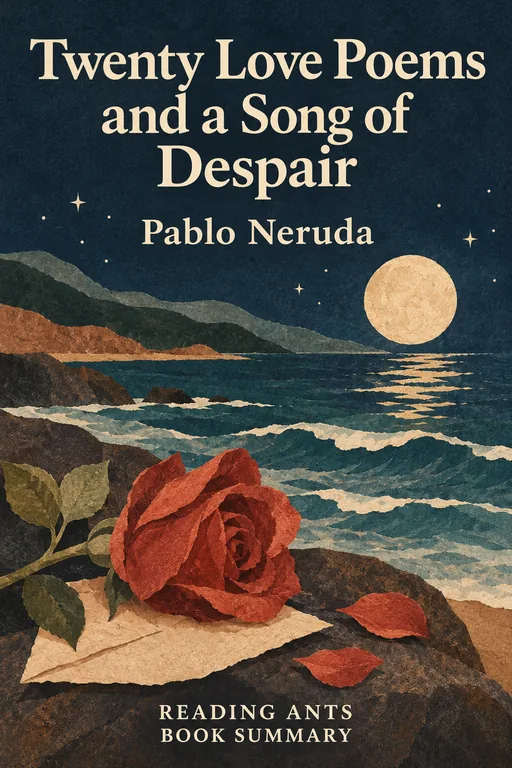
Twenty Love Poems and a Song of Despair
Original title: Veinte poemas de amor y una canción desesperada
In twenty short poems and a final lament, a young Chilean poet writes of desire, memory and loss, using the sea, the earth and the night sky to describe the body and the pain of a love that has ended.
Overview
Twenty Love Poems and a Song of Despair (Veinte poemas de amor y una canción desesperada) is a collection by the Chilean poet Pablo Neruda, published in 1924 when he was nineteen. It made him famous in the Spanish-speaking world, and became one of the best-selling books of poetry in the Spanish language, selling millions of copies. The poems explore the feelings of a young man in love: longing, joy, jealousy and sorrow. They are known for their strong images drawn from nature, such as the sea, the wind, the earth and the stars. Neruda later won the Nobel Prize in Literature in 1971, and this early book remains among the most loved of his works.
Main Characters
The poems have two figures: the speaker, a young man whose feelings change from poem to poem, and the beloved, who is addressed as “you.” The beloved is not described in a realistic way, but through images: a body like the earth, eyes like the sea, a voice like a river. The beloved is generally taken to be drawn from women whom Neruda had loved in his youth, though the poems do not name them. Nature is another presence, serving as a mirror for the lovers’ moods.
Full Summary
Desire and the Body
The collection opens with a poem that compares the body of a woman to the world: white hills, white thighs, a body like the earth. The speaker feels that he is a tunnel, abandoned by the birds, and that the night has invaded him. He sees desire as a force that makes him part of nature, and that makes the beloved something larger than a person, a landscape in which he loses himself.
The language is sensual but also restless: Neruda mixes images of the earth with the pull of the sea, so that desire seems like a natural force. The speaker is at times overwhelmed by what he feels, and sometimes seems to be both the hunter and the hunted.
Longing and Absence
Several poems describe the speaker’s longing when the beloved is far away. He remembers her as she was, and her absence is felt almost as a presence. The wind, the moon and the evening seem to carry her image. He tries to tell her what he feels, but the words fall short, and the sea seems to be speaking for him. The tone is tender and sad, as he realizes that love is shaped by distance.
Poems of this kind often end by turning back to the landscape, as though the poet could only speak of love through the world around him.
Joy and Union
There are also poems of happiness. In several, her presence makes him feel complete. The speaker is thrilled by the closeness of the beloved, and feels that his life has opened. Images of light, water and spring give a sense of renewal. These poems show that Neruda is not only a poet of sadness, but of the pleasure of being alive.
The speaker says that he wants to do with her what spring does with the cherry trees. The images are playful and warm, and show a young man amazed by happiness.
Doubt and Distance
As the book goes on, the mood darkens. The speaker senses that the beloved is drifting away, or that he cannot hold her. He says that he no longer loves her, and yet he does. In one of the best-known poems, he says that tonight he can write his saddest lines, because he no longer has her, and he notes how brief love can be and how long forgetting takes. The poem expresses a feeling that many readers know, of being unable to forget.
The Song of Despair
The final poem, the “Song of Despair,” is a long lament. The speaker addresses his memory of the beloved, using images of the sea, shipwreck and abandonment. The poem ends with the hour of departure, and the sense that there is nothing left but silence. Yet its energy shows that grief itself becomes a kind of song. Taken as a whole, the book follows the arc of a love affair, moving from desire through joy and doubt to loss, and it gives that arc a dark closing note. The young poet seems to learn that the same imagery of sea, wind and night that once expressed happiness can also express its ending, which is part of why the collection feels so complete and so honest about the pain of love.
Why It Matters
Twenty Love Poems is one of the most widely read books of poetry in the world, translated into dozens of languages. It has given generations of lovers words for their feelings, and a number of its lines are used in letters, cards and on social media. It began Neruda’s career as a poet of love and later of politics, and helped to establish a new Latin American poetic voice.
The book also shows how powerful, and how personal, poems of feeling can be, and why they are loved by young readers.
Key Takeaways
- Love and nature are intertwined. Images of the sea and earth express feelings.
- Absence can be a presence. Memory keeps the beloved near.
- Joy and sorrow are linked. The book moves from happiness to loss.
- Words can only partly hold love. The speaker struggles to express it.
- Grief can become art. The final lament turns pain into song.
What We Can Learn
The poems show that strong feelings can be given shape in words, and that doing so can bring clarity and a kind of consolation. Even a young poet’s heartbreak can speak to many people.
They also remind us to notice the world around us, and that nature offers images for our moods.
Finally, they show that love, even when it ends, is worth having, and that it leaves traces in the way we see.
It also reminds us that being honest about our feelings, even sad ones, is a part of being fully alive.
Criticism and Counterpoints
Some critics find that the poems are too romantic and sentimental, and that the beloved is treated more as an object, a landscape to be possessed, than as a person. Neruda himself, later in life, felt that the book was immature, and some feminist readers have criticized his attitudes toward women, particularly after he admitted in his memoirs to an act of sexual violence in his youth.
Others say that the poems’ surreal imagery is sometimes vague, and translations vary, with some losing the music. Still, the poems are loved by readers.
Who Should Read It
This book suits mature teenagers and adults. The poems are short and can be read in any order. They contain sensual language and heartbreak. A bilingual edition lets readers enjoy the Spanish sounds.
Want the whole book?
A summary is a taste, not the meal. Here is where to find the full book.
You reached the end 🎉
Nicely done. Mark this one as read, and we will suggest what to read next.
Read this next
Leaves of Grass
Walt Whitman
Walt Whitman's lifelong book of free-verse poems celebrates the self, the body, democracy, nature and ordinary Americans, in a bold new voice that changed poetry.
🎭 Epics, Drama & Poetry
Love in the Time of Cholera
Gabriel Garcia Marquez
Two people separated in youth meet again in old age, forcing readers to ask whether lifelong romantic devotion is noble, selfish or inseparably both.
🌍 World Literature
The Prophet
Kahlil Gibran
Before sailing home, a wise exile answers a city's questions about love, work, freedom and death, presenting life as a unity built from apparent opposites.
🌍 World Literature
The Odyssey
Homer
After the Trojan War, the clever hero Odysseus struggles for ten years against monsters, gods and temptations to return home to his faithful wife and son, then must win back his house from the men trying to steal it.
🎭 Epics, Drama & Poetry
Hamlet
William Shakespeare
A grieving prince of Denmark learns from his father's ghost that his uncle murdered the king to take the throne, and his struggle to decide whether and how to take revenge leads to madness and death.
🎭 Epics, Drama & Poetry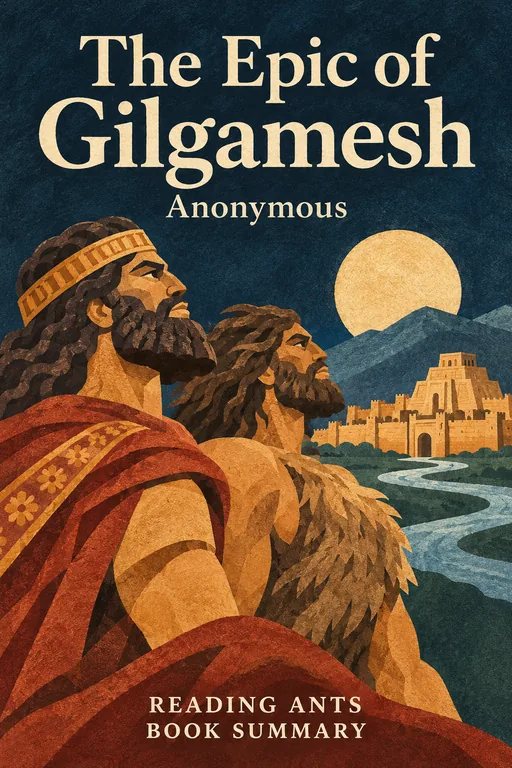
The Epic of Gilgamesh
Anonymous
A proud, powerful king of ancient Mesopotamia gains a true friend, loses him to death, and journeys to the edge of the world in search of eternal life, only to learn that what lasts is the life and legacy we leave behind.
🎭 Epics, Drama & PoetryWant something different?
Pick another topic and we will show you three books to start with.