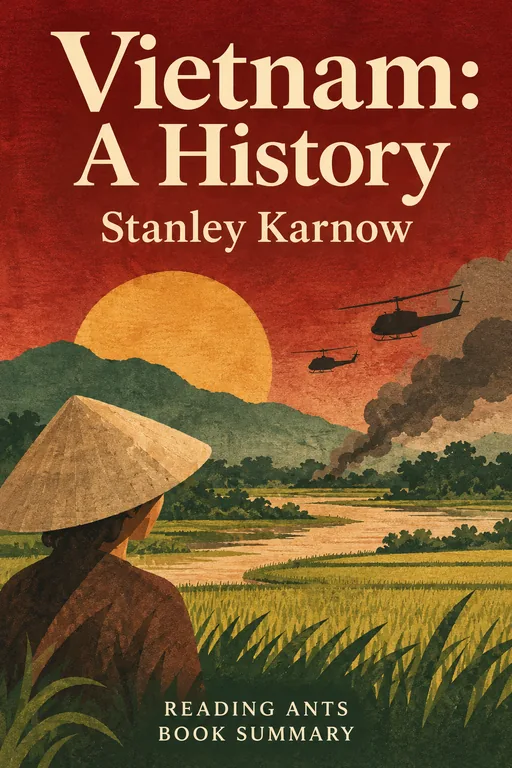
Vietnam: A History
Journalist Stanley Karnow gives a broad account of Vietnam's long struggle with outside powers and of how the United States became involved, fought and lost a war that divided America and devastated Vietnam.
Overview
Vietnam: A History was published in 1983 by Stanley Karnow, an American journalist who reported from Asia for many years and who was in Vietnam during the war. The book, about 750 pages long, was written to accompany a television documentary series, and it became a best-seller and a standard introduction to the subject. It gives the background of Vietnam’s past and of French colonial rule, though most of its pages deal with the years from 1945 to 1975. It follows the rise of communist and nationalist movements, the American involvement from the 1950s, the war’s escalation and the final collapse of the South Vietnamese government in 1975. Karnow writes clearly and tries to give the perspectives of all sides.
Full Summary
1. A land of long resistance
The idea: Karnow presents Vietnam as a country with a long history of struggle against foreign rulers, particularly China, which ruled it for about a thousand years. In the nineteenth century, France took over the country and made it part of its colonial empire in Indochina, completed with the Indochinese Union in 1887. Karnow shows how French rule produced an educated class of Vietnamese, whose nationalist feeling grew as they wanted to be free of foreign control.
In real life: A people who have a long memory of being ruled by outsiders will not easily accept a new ruler.
2. Ho Chi Minh and the fight against France
The idea: The most important Vietnamese nationalist leader was Ho Chi Minh, a communist who had traveled abroad and who led a movement that declared independence in 1945. A long war against French forces followed, which ended with the French defeat at Dien Bien Phu in 1954, and a peace conference in Geneva which temporarily divided the country into a communist North and a non-communist South. The United States had been helping France with large amounts of aid and began to take on a bigger role in the South.
In real life: A group that has a clear goal, such as independence, can outlast a stronger one.
3. America steps in
The idea: American leaders, worried about the spread of communism in Asia, supported a South Vietnamese government led by Ngo Dinh Diem. The theory, often called the domino theory, held that if one country fell to communism, its neighbors would too. Diem’s rule was authoritarian and unpopular with many, and Karnow shows how American advisers and money flowed in. In 1963, Diem was overthrown and killed in a coup by South Vietnamese generals, after American officials had signaled that they would not stop it, which left the South in turmoil.
In real life: Backing a leader who lacks the support of his own people can be a trap.
4. Escalation under Johnson
The idea: After an incident in the Gulf of Tonkin in 1964, the American Congress gave President Lyndon Johnson wide power to act. In 1965, the United States began a sustained bombing campaign against the North and sent combat troops. By 1968, more than half a million American soldiers were in Vietnam. Karnow follows the decisions in Washington and Saigon as the war came to rely on American firepower against an enemy that was patient and prepared to take heavy losses, and he shows how the fighting became bogged down.
In real life: Using more and more force may not work if the other side has a stronger will to continue.
5. The Tet Offensive and the turn
The idea: In early 1968, North Vietnamese and Viet Cong forces launched surprise attacks on cities and towns across the South, during the Tet holiday. They suffered heavy losses and did not hold their gains, but the offensive shocked Americans, who had been told that the enemy was nearly beaten. Public support for the war fell. Johnson announced that he would not seek re-election, and talks began.
In real life: When what officials say does not match what people see, trust quickly drops.
6. Nixon, withdrawal and the fall of Saigon
The idea: President Richard Nixon began to withdraw American troops while building up South Vietnamese forces, a policy called Vietnamization, and also widened the war with attacks into neighboring Cambodia and Laos. A peace agreement was signed in 1973, and the last American combat troops left. Fighting continued, and in 1975 the North launched a final offensive. South Vietnam collapsed, and Saigon fell at the end of April. The country was reunited under communist rule.
In real life: Leaving a conflict can be as hard as entering it, and the people who stay behind often pay the price.
7. The aftermath and the lessons
The idea: The cost of the war was immense: Vietnamese deaths are estimated at roughly one million to three million, about 58,000 Americans died, and the war left deep scars on both countries. In Karnow’s telling, American policy was shaped by the Cold War idea of containing communism, while for many Vietnamese the struggle was also about national independence, and many readers conclude that the United States misjudged the nature of the conflict. Many readers also take from the book a lesson about the need for humility, and for knowledge of other cultures, in foreign policy.
In real life: To help another community, you must first understand what they want and why.
Why It Matters
Vietnam: A History became a bestseller and a standard reference, and the documentary series on public television reached a vast audience. It helped to spark public debate about the history and meaning of the war. The book drew on interviews with participants on several sides, and the television series was praised by critics as even-handed, which helped make the narrative widely trusted. The war still influences debates about foreign policy and military power, from the phrase “Vietnam syndrome” to arguments over whether and when to intervene abroad. The book is widely read as an introduction to the subject, and it remains a valuable starting point for anyone who wants a clear overview of a complex and painful chapter in history.
Key Takeaways
- Nationalism was central. The Vietnamese fought above all for independence.
- America misread the conflict. Cold War assumptions shaped decisions.
- Escalation did not bring victory. Military power did not solve a political problem.
- Truth and trust matter. Public support fell when reality contradicted official claims.
- Understand before you act. Knowledge of local history and culture is essential.
What We Can Learn
The history teaches us to look for the motives of the people involved in a conflict, and not just the label that outsiders give. It warns of the danger of assuming that one’s side will win, and of ignoring evidence that does not fit one’s plan. It also shows the power of patience and determination. When you study a war or a crisis, read accounts from different sides, and remember the experience of ordinary people. Finally, it encourages us to ask hard questions of our leaders, and to value honesty about mistakes.
Criticism and Counterpoints
Critics disagree sharply about it. Some, such as the linguist Noam Chomsky, argued that Karnow shared the assumptions of American officials, treating the war as a well-meant failure, and did not explain why the United States could not build political support in the South. Others argued that he treated the Vietnamese communists too much as nationalists, and too little as communists. A reviewer in Kirkus found the second half more focused on decisions and actions than on underlying causes. Historians have since had access to new archives, including from Vietnam and the former Soviet bloc, which have changed some of the understanding of decisions on both sides. The book is also a general narrative of a very long story. Still, it holds up as a readable and balanced introduction.
Who Should Read It
This book is for students and general readers who want a complete overview of the Vietnam War and its background. It is long but easy to read. Readers who want the latest scholarship or a view from Vietnamese archives should add recent studies, and those who find war stories upsetting should be aware that the book discusses violence.
Want the whole book?
A summary is a taste, not the meal. Here is where to find the full book.
You reached the end 🎉
Nicely done. Mark this one as read, and we will suggest what to read next.
Read this next
A Bright Shining Lie
Neil Sheehan
Neil Sheehan uses the life of the American officer John Paul Vann to tell how the United States became entangled in the Vietnam War, and how leaders on both sides kept telling a hopeful story that was untrue.
🏛️ History
The Guns of August
Barbara W. Tuchman
Barbara Tuchman gives a gripping account of the first month of the First World War in 1914, showing how plans, pride and misjudgment led the great powers into a conflict that none was able to stop.
🏛️ History
The Making of the Atomic Bomb
Richard Rhodes
Richard Rhodes tells the full story of nuclear weapons, from the physics discoveries of the late nineteenth century to the secret wartime project that built the first bombs and the explosions over Hiroshima and Nagasaki in 1945.
🏛️ History
The Quiet American
Graham Greene
In French colonial Vietnam in the early 1950s, a jaded British journalist, Thomas Fowler, watches an idealistic young American, Alden Pyle, cause harm with his good intentions, and must decide whether to betray him.
📜 Classics
Sapiens: A Brief History of Humankind
Yuval Noah Harari
Humans came to rule the planet not because we are the strongest animals but because we can believe in shared stories (gods, nations, money, companies) that let millions of strangers cooperate.
🏛️ History
Guns, Germs, and Steel
Jared Diamond
Some societies came to conquer others not because their people were smarter or better, but because geography gave them a head start in farming, animals, germs and technology.
🏛️ HistoryWant something different?
Pick another topic and we will show you three books to start with.