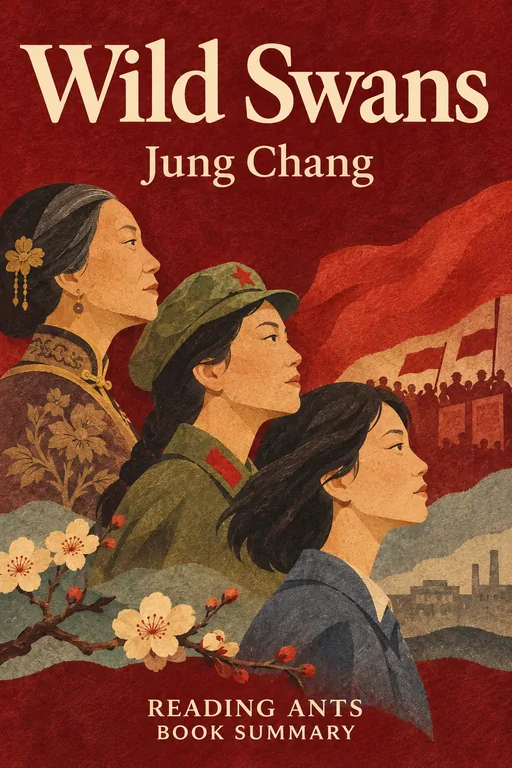
Wild Swans
Through the lives of her grandmother, her mother and herself, Jung Chang tells the story of China across the twentieth century, from warlords and foot binding to the Communist revolution and the Cultural Revolution.
Overview
Wild Swans: Three Daughters of China is a family history and memoir by Jung Chang, who was born in China in 1952, grew up under Mao Zedong’s rule and moved to Britain in 1978 to study. She wrote the book in English and it was published in 1991. By following three generations of women, her grandmother, her mother and herself, she shows how huge political changes affected ordinary lives. The book became one of the best-selling nonfiction books ever published in English, though it has been banned in mainland China. Its style is personal and direct, and it blends family stories with the larger history of the country.
Full Summary
1. The grandmother and the age of warlords
The idea: The story begins with Chang’s grandmother, Yu-lin, who was born in the early 1900s and had her feet bound as a child, a painful custom meant to make women’s feet small and “beautiful.” In China’s chaotic time of rival warlords, she was given as a concubine to a general, which was a common fate for girls from families with few options. She had a daughter, Bao Qin, who would become the author’s mother. After the general’s death, she remarried a doctor and the family lived in a time of great uncertainty. Her story shows how little control women had over their lives.
In real life: Learning how foot binding and concubinage worked helps explain why many Chinese women later welcomed new laws that gave them more rights.
2. The mother and the Communist cause
The idea: Chang’s mother grew up amid war with Japan and a civil war between Nationalists and Communists. As a young woman she was drawn to the Communist movement, which promised justice, equality for women and an end to poverty. She married a Communist official, who would become the author’s father, and both believed deeply in the cause. After the Communists took power in 1949, they were given positions in the new government, and the family hoped for a better future.
In real life: People often join a movement because it offers hope, and the strength of that hope can make it hard to see the movement’s faults.
3. Early years of the People’s Republic
The idea: In the 1950s, the new regime brought some improvements, such as better education and public health, but also campaigns against supposed enemies and demands for loyalty. Chang describes how the Great Leap Forward, Mao’s plan to rapidly industrialize, led to a terrible famine around 1959 to 1961, in which tens of millions of people died. Her parents, as officials, saw the suffering and began to have doubts, though they were careful about what they said. Chang’s own childhood, in comfortable circumstances at first, gave her a sense that her family belonged to a privileged class.
In real life: A policy that sounds ambitious on paper can cause huge harm when leaders cannot be questioned.
4. The Cultural Revolution begins
The idea: In 1966, Mao launched the Cultural Revolution, urging young people to attack “bourgeois” and “revisionist” influences. Chang, then fourteen, was swept up in the excitement as a Red Guard, but she soon saw the violence and fear. Her father, who dared to criticize some policies, was denounced and humiliated. Her family was torn apart, with her parents sent to labor camps and re-education. Teachers, intellectuals and officials were beaten, and many died or took their own lives. The author describes watching a society turn on itself.
In real life: When loyalty to a leader becomes more important than truth, neighbors and even families can be turned against each other.
5. Exile, labor and her father’s decline
The idea: Chang’s father suffered a mental breakdown after years of persecution and died in the mid-1970s. She herself was sent to the countryside, as were millions of urban youths, where she worked in the fields, and later as a “barefoot doctor” and electrician. She describes the hard physical labor, the poverty of rural life and her growing disillusion with the political system. She also describes the small acts of kindness and the stubborn hope of those around her.
In real life: Many people who lived through the period carry health problems and painful memories, which are often not talked about even within families.
6. Mao’s death and a new path
The idea: After Mao died in 1976, the country slowly began to change. Chang had already begun studying English at Sichuan University in 1973, and in 1978, with the new, more open atmosphere, she won a scholarship to study in Britain, becoming one of the first people from China to do so after the Cultural Revolution. She left behind her mother, who had survived years of persecution, and who later helped her to write the book by telling her story at length. The book ends with the sense of a new beginning and a wish that the story be told.
In real life: Oral history, such as a mother telling her daughter what happened, can preserve what official records leave out.
Why It Matters
Wild Swans introduced millions of readers in the West to the human experience of twentieth-century China. It has sold millions of copies and has been translated into dozens of languages. It remains a common text in classes about modern Asia and about memoir writing, and it has inspired many other family histories.
Its power comes from the intimate view it gives. Rather than describing political leaders from a distance, it shows how decisions in the capital changed the lives of a family, which makes history easier to understand and remember.
Key Takeaways
- Personal stories show history. Three women’s lives reveal a century of change.
- Women’s roles transformed. From bound feet to modern careers in a few generations.
- Ideals can turn to terror. Revolutionary hope led to persecution.
- Silence and fear spread. People learned to hide their thoughts.
- Telling the truth matters. Memory is a way of resisting forgetting.
What We Can Learn
The book shows that the ordinary choices people make, such as whom to trust, what to say and when to stay silent, are shaped by the society they live in. Reading about the pressure on Chang’s family helps us understand why people behave as they do under strict control.
It also reminds us that change can come very fast. In three generations, a society moved from bound feet to space travel, and it is worth asking how such changes affect people’s lives and relationships.
Finally, the book is an example of courage: Chang’s mother endured years of suffering and kept her dignity, and her daughter later told the story. Telling a hard truth with honesty and without bitterness is something readers can admire and learn from.
Criticism and Counterpoints
Some historians have said that the book is based on personal memory and family stories, which cannot always be checked, and that it presents events from the point of view of a family of officials who suffered, rather than of the many peasants and workers who had different experiences. Others have argued that its picture of Mao and of the Communist movement is too negative, or have questioned particular details.
Chang’s later biography of Mao, written with her husband, was also criticized by some historians as one-sided. Even so, many scholars regard Wild Swans as a valuable and moving account of life in China, particularly for its description of the Cultural Revolution, and it is widely used as a source for understanding how ordinary people lived through that period.
Who Should Read It
This book suits mature teenagers and adults. It is long but easy to follow, and it includes scenes of violence, famine and persecution that can be upsetting. It is a good starting point for readers who want to understand modern China through a personal story.
Want the whole book?
A summary is a taste, not the meal. Here is where to find the full book.
You reached the end 🎉
Nicely done. Mark this one as read, and we will suggest what to read next.
Read this next
The Good Earth
Pearl S. Buck
A poor Chinese farmer named Wang Lung rises from poverty to wealth through hard work and his love of the land, but his prosperity brings new troubles, and his children turn away from the earth that made them.
📜 Classics
The Joy Luck Club
Amy Tan
Four Chinese immigrant mothers and their American-born daughters tell interlocking stories of hardship, love and misunderstanding across the gap between two cultures, as the daughters finally begin to understand who their mothers really are.
✨ Modern Fiction
Sapiens: A Brief History of Humankind
Yuval Noah Harari
Humans came to rule the planet not because we are the strongest animals but because we can believe in shared stories (gods, nations, money, companies) that let millions of strangers cooperate.
🏛️ History
Guns, Germs, and Steel
Jared Diamond
Some societies came to conquer others not because their people were smarter or better, but because geography gave them a head start in farming, animals, germs and technology.
🏛️ HistoryThe Histories
Herodotus
Herodotus, often called the father of history, tells how the Greeks and the Persians came into conflict and fought the great wars of the early fifth century BCE, with long, colorful detours into the lands, customs and legends of the known world.
🏛️ HistoryHistory of the Peloponnesian War
Thucydides
Thucydides, an Athenian general turned historian, records the long war between Athens and Sparta in the fifth century BCE and uses it to study power, fear, politics and how human nature behaves in crisis.
🏛️ HistoryWant something different?
Pick another topic and we will show you three books to start with.