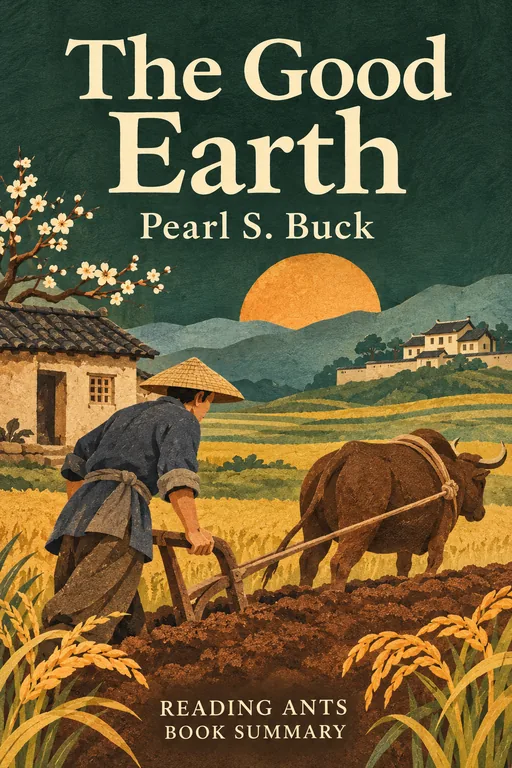
The Good Earth
A poor Chinese farmer named Wang Lung rises from poverty to wealth through hard work and his love of the land, but his prosperity brings new troubles, and his children turn away from the earth that made them.
Overview
The Good Earth is a novel by Pearl S. Buck, an American writer who grew up in China as the daughter of missionaries. It was published in 1931, and won the Pulitzer Prize in 1932, and Buck received the Nobel Prize in Literature in 1938, in part for this book. The story is set in rural China in the early twentieth century, before the revolution, and follows the life of Wang Lung, a farmer, and his wife O-lan. Written in simple, biblical style, it gives Western readers a picture of Chinese peasants as real people, and tells of the relationship of people to land, family and fortune.
Main Characters
- Wang Lung: a hardworking farmer who values the land above all.
- O-lan: his plain, strong and silent wife, a former slave in the Great House of Hwang.
- Lotus: a beautiful courtesan whom Wang Lung brings home as a concubine when he becomes rich.
- Wang Lung’s father: an old man who lives with the family.
- Wang Lung’s sons and daughters: three sons, who grow up to follow different paths, and daughters, one of whom is mentally disabled.
- The House of Hwang: the once-great landowning family, which declines.
Full Summary
A Wedding Day
Wang Lung, a poor farmer, wakes up on his wedding day, and goes to the House of Hwang, where he is to receive his bride, O-lan, a slave in the household. She is plain but strong, and a good worker. They begin a hard but loyal life together, working in the fields and tending the home.
Wang Lung is proud and a little nervous as he leads her home, and O-lan says very little. She cooks, cleans and works in the fields beside him, even on the day after she gives birth. He values her work but hardly notices her as a person, which will matter later. O-lan gives birth to their first son, then more children, and the family’s fortunes slowly improve, as Wang Lung buys more land.
Famine and the South
When the harvest fails and famine strikes, Wang Lung has to sell most of his belongings, and the family nearly starves. His uncle and others take advantage of them. A new daughter is born, but O-lan, in her despair, kills the baby, since they cannot afford to keep her. In desperation, Wang Lung takes the family south to a big city, where they live in poverty, begging, pulling a rickshaw and collecting scraps. They are hungry and homeless.
The Fortune
During a riot in the city, the rich are looted and Wang Lung and O-lan find themselves with a handful of gold and jewels. With this unexpected fortune, they return to their land. Wang Lung buys more fields from the declining House of Hwang, hires laborers and becomes a rich landowner. The family builds a bigger house, and the sons are sent to school, which Wang Lung could never have attended.
As a landowner, Wang Lung becomes a respected man in the village. His uncle, who earlier took advantage of him, now begs for favors and turns out to be linked to a local band of thieves, and Wang Lung has to deal with the demands of relatives who want a share of his luck. He keeps his love for the earth, but he begins to enjoy the comfort and status his money brings.
Lotus and Decline
As Wang Lung grows wealthy, he becomes restless, and falls in love with Lotus, a young woman from a teahouse, and brings her home as a concubine, ignoring the loyal O-lan. O-lan, who has lost her health, bears this silently, and then dies. Wang Lung’s household is troubled by jealousy and by the extravagance of Lotus. He is also troubled by his sons, who are not interested in the land. His eldest becomes a scholar and a lazy man, and the others look for other careers.
Old Age
Wang Lung grows old, and grows closer to the land again. He is troubled by his uncle’s bandit-linked family, including his cousin, the uncle’s son, who becomes a soldier, and by the squabbles of his sons. He senses that his sons may sell the land when he dies. He moves back to his old house and lives out his days with the dream of staying close to the earth.
He also faces the disappointments of his children: his eldest son looks down on farm work, his second son becomes a merchant, and his youngest runs away to become a soldier. His daughter, who is slow in mind, remains with him, and he cares for her tenderly, knowing that she cannot be left alone when he dies.
The End
At the end, Wang Lung is dying, and hears his sons speak of selling the land after his death. He begs them not to, saying that when they sell the land they are finished. They promise that they will not, but, privately, they smile at each other. The final scene suggests that the family’s rise has already begun its decline, and that the connection to the earth is fading.
Why It Matters
The Good Earth was one of the best-selling American novels of the 1930s, and made Buck the first American woman to win the Nobel Prize in Literature. It brought attention to the lives of ordinary Chinese people and helped to shape Western views of China, at a time when most depictions were stereotyped. It was adapted into a 1937 film and a 1930s stage version, though the film cast white actors in Chinese roles, which has been criticized.
The book also gave a lasting picture of the importance of land and family in agrarian societies.
Key Takeaways
- Land gives security and identity. Wang Lung’s life is tied to his fields.
- Wealth can corrupt. Prosperity brings temptation and conflict.
- Loyalty and silence can be strength. O-lan endures much.
- Each generation changes. The sons turn away from the soil.
- Poverty and famine are brutal. Survival forces hard choices.
What We Can Learn
The novel invites us to think about what we value and how success may change us. Wang Lung’s early virtues of hard work and gratitude fade as he gets rich.
It also reminds us to appreciate the people who make our lives possible. O-lan works tirelessly and receives little thanks until it is too late.
Finally, it shows that connection to nature and family is easily lost, and that each generation must decide what to keep.
It also shows how easily we take loyal people for granted. O-lan’s quiet strength is the foundation of the family’s success, and Wang Lung only sees this when she is dying.
Criticism and Counterpoints
Some critics, including Chinese writers, said that the novel presents a simplified or Western-filtered view of China, and that Buck’s style, modeled on the English Bible, makes the characters seem remote. Others note that the women in the novel are treated as property and that their suffering is presented as normal.
The depiction of infanticide, concubinage and extreme poverty is disturbing. Some historians argue that the book does not capture the real political upheavals in China at the time. Still, many readers find it moving.
Who Should Read It
This book suits mature teenagers and adults. It is easy to read, with simple language, but it contains difficult subjects such as poverty, famine and mistreatment of women. It is a good introduction to Chinese rural life in the early twentieth century.
Want the whole book?
A summary is a taste, not the meal. Here is where to find the full book.
You reached the end 🎉
Nicely done. Mark this one as read, and we will suggest what to read next.
Read this next
Wild Swans
Jung Chang
Through the lives of her grandmother, her mother and herself, Jung Chang tells the story of China across the twentieth century, from warlords and foot binding to the Communist revolution and the Cultural Revolution.
🏛️ History
Dream of the Red Chamber
Cao Xueqin
The rise and decline of an aristocratic household unfolds through a sensitive boy's bonds with two remarkable young women, revealing beauty made fragile by family power and impermanence.
🌍 World Literature
The Joy Luck Club
Amy Tan
Four Chinese immigrant mothers and their American-born daughters tell interlocking stories of hardship, love and misunderstanding across the gap between two cultures, as the daughters finally begin to understand who their mothers really are.
✨ Modern Fiction
Gone with the Wind
Margaret Mitchell
Scarlett O'Hara, a headstrong Georgia belle, fights to save her family plantation through the Civil War and Reconstruction, while pursuing the wrong man and losing the right one.
📜 Classics
The Grapes of Wrath
John Steinbeck
Driven off their Oklahoma farm by drought and the banks during the Great Depression, a poor family travels west to California in search of work, only to find exploitation and hunger, yet they hold on to their dignity and compassion.
📜 Classics
Pride and Prejudice
Jane Austen
Quick-witted Elizabeth Bennet and the proud, wealthy Mr. Darcy badly misjudge each other, and only by facing their own faults do they find their way to love.
📜 ClassicsWant something different?
Pick another topic and we will show you three books to start with.