 Reading Ants
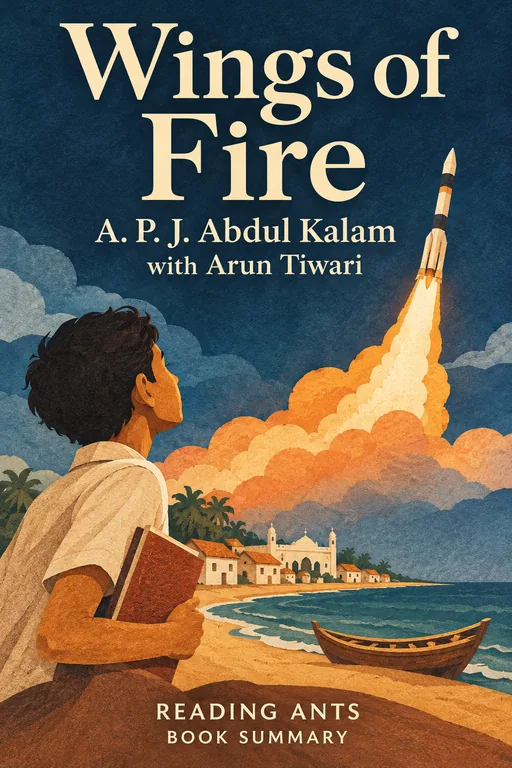
A. P. J. Abdul Kalam tells how a boy from a poor family in a small town in southern India became a leading rocket scientist and helped build India's space and missile programs.
Overview
Wings of Fire: An Autobiography was written by Avul Pakir Jainulabdeen Abdul Kalam with the writer Arun Tiwari, and published in 1999. Kalam was born in 1931 in Rameswaram, a pilgrimage town on an island in Tamil Nadu. He worked as a scientist and engineer at India’s space and defense organizations and later served as the country’s eleventh president, from 2002 to 2007, which came after this book. He was widely known as the “Missile Man of India” and as the “People’s President.” The book describes his childhood, his career and his belief in dreaming big, and it has become one of the best-selling Indian autobiographies, especially among young readers.
Full Summary
1. A boyhood in Rameswaram
The idea: Kalam grows up in a modest family of boat owners. His father, Jainulabdeen, is a devout and generous man with little formal education, and his mother, Ashiamma, is kind and loving. In a town where people of different faiths live side by side, young Kalam sees his father pray in the mosque and friends of other religions, which teaches him respect for everyone. He sells newspapers to help the family, and he is inspired by a teacher, Sivasubramania Iyer, who helps him to see that he can rise through learning and effort. He also loves to watch birds, which sparks his interest in flight.
In real life: A caring teacher or a good friend can encourage a child to aim higher than his surroundings suggest.
2. College and a lost dream
The idea: Kalam studies physics at college in Tiruchirappalli and then goes on to study aeronautical engineering in Madras. His dream is to become a fighter pilot. However, when he tries out for the Indian Air Force, he finishes ninth in a selection where only eight places are available, and his dream seems to end. Disappointed, he goes to the Himalayan town of Rishikesh and meets a spiritual teacher, who tells him to accept his fate and move on. He does, and starts to look for a new path.
In real life: A setback can redirect a person to something even better, as long as they do not give up.
3. A scientist at the space program
The idea: Kalam joins a research organization and later the Indian Space Research Organisation (ISRO), under the guidance of Vikram Sarabhai, the founder of India’s space program. He is selected to work on a satellite launch vehicle and later leads the project to develop India’s first indigenous satellite launch vehicle, the SLV-III. The book describes the early days of the program, when scientists worked with tiny budgets and sometimes even carried rocket parts on bicycles. In 1980, the SLV-III launched the Rohini satellite into orbit, making India one of a small group of space-faring nations.
In real life: Great projects often begin with limited resources and rely on the enthusiasm and teamwork of small groups.
4. Learning from failure and leadership
The idea: Kalam describes setbacks, including failed launches, and the way his mentors, such as Satish Dhawan, responded. After a failure for which Kalam was the project head, Dhawan took responsibility in front of the press, and then, after the later success, gave the credit to the team. Kalam draws a lesson about leadership: a leader shares credit and takes blame. He also stresses the value of a team where each person has a role and feels respected.
In real life: Good leaders protect their teams in difficult times and share the glory in good ones.
5. Missiles and national defense
The idea: Kalam, who began his career in defense research and then moved to the space organization, returns to the Defence Research and Development Organisation and leads the Integrated Guided Missile Development Programme, which created missiles such as Prithvi and Agni. He describes the challenges of building complex systems in a country that faced limits on technology imports. He emphasizes self-reliance and the importance of training young engineers. He later helps lead the nuclear tests of 1998, which the book mentions briefly as part of a national effort.
In real life: Countries and companies that want to depend less on others often invest in education and training.
6. A vision for the future
The idea: In the closing chapters, Kalam shares his thoughts on India’s development, advocating science, technology and education, and a vision of India as a developed nation. He often addresses young people, urging them to dream, work hard and keep learning. He also reflects on the importance of values and humility, and on how his family and teachers shaped him. The title refers to his belief that people can find the “wings of fire” within themselves.
In real life: Setting a big goal and working on it a little every day is more effective than waiting for the perfect chance.
Why It Matters
Wings of Fire has sold millions of copies and has been translated into many languages. It is especially popular with students in India, for whom Kalam became a role model, and is often given as a gift. Its message that talent can come from any background has encouraged many young people from small towns.
The book also gives an inside view of India’s scientific growth in the second half of the twentieth century, from the early space program to defense research, written in a simple, warm style. Schools across India hold reading events around it, and Kalam’s own habit of speaking with students, which he continued as president and afterward, strengthened the book’s reputation as a message from a mentor to the young.
Key Takeaways
- Dream big. Kalam believed that young people should aim high.
- Failure is a teacher. Setbacks were part of every success.
- Good teachers change lives. His mentors shaped him.
- Leadership means sharing credit. He learned this from Dhawan.
- Humility and service matter. Kalam stayed modest despite fame.
What We Can Learn
The book shows that where we start does not decide where we end up. Kalam’s family had little money, but he worked hard, read and was open to guidance, which carried him far.
It also teaches how to handle disappointment. When he missed out on becoming a pilot, he did not give up, and later he did work that gave him a different but meaningful way to fly.
Finally, it reminds us how much we depend on others. Kalam gave thanks to his family, teachers and colleagues, and treated teamwork as the basis of every big achievement.
Criticism and Counterpoints
Some critics say that the book is overly optimistic and patriotic, and that it gives little discussion of the problems or controversies around India’s missile and nuclear programs, including their cost and the risks of an arms race. Others note that it presents many events from Kalam’s own point of view and does not mention conflicts in the organizations.
Some readers find the style simple and repetitive, and that it relies on inspirational advice. Supporters respond that its plain tone is one reason it is loved by young readers. It is best read as an inspiring memoir and not as a full history of India’s science.
Who Should Read It
This book suits students from about age ten, as well as adults looking for encouragement. The language is simple and the chapters are short. It is useful for anyone interested in science, engineering or the story of a modern nation.
Want the whole book?
A summary is a taste, not the meal. Here is where to find the full book.
You reached the end 🎉
Nicely done. Mark this one as read, and we will suggest what to read next.
Read this next
The Story of My Experiments with Truth
Mohandas K. Gandhi
Mohandas Gandhi recounts his early life and his experiments in honesty, nonviolence and self-discipline, from a shy boy in India to a lawyer in South Africa and the leader of a movement.
👤 Real Lives
I Am Malala
Malala Yousafzai with Christina Lamb
Malala Yousafzai tells how a girl who loved school stood up for girls' education in Pakistan's Swat Valley, was shot by the Taliban at age fifteen, survived, and became a global voice for children's right to learn.
👤 Real Lives
Shoe Dog
Phil Knight
The founder of Nike tells how a young runner with a borrowed idea and almost no money built a small shoe-importing business, through crisis after crisis, into one of the most famous brands in the world.
💼 Business
Steve Jobs
Walter Isaacson
The authorized biography of Apple's co-founder follows a brilliant, demanding and often cruel perfectionist whose focus on beautiful design transformed computers, music, phones and animated movies.
💼 Business
Man's Search for Meaning
Viktor E. Frankl
A psychiatrist who survived the Nazi concentration camps explains that even in the worst suffering, people can choose their attitude, and that finding a reason to live is what gives us the strength to endure.
👤 Real Lives
The Diary of a Young Girl
Anne Frank
A Jewish teenage girl hiding from the Nazis in a secret apartment in Amsterdam records two years of fear, family quarrels, first love and big dreams in a diary that became one of the most famous books in the world.
👤 Real LivesWant something different?
Pick another topic and we will show you three books to start with.