 Reading Ants
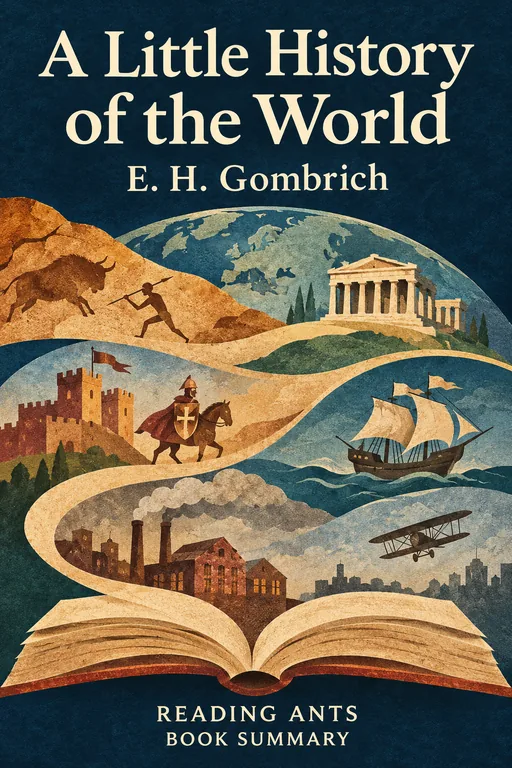
A Little History of the World
Original title: Eine kurze Weltgeschichte für junge Leser
In a warm, conversational voice, the art historian E. H. Gombrich tells the story of humanity from the Stone Age to the twentieth century, as if explaining it to a curious young person.
Overview
A Little History of the World was written by Ernst Hans Gombrich, an Austrian-born art historian who later lived in Britain and became famous for his book The Story of Art. He wrote it quickly in Vienna in the mid-1930s, when he was in his twenties, after a publisher asked him to turn a set of history notes into a book for young readers. It was published in German in 1936, and, with the rise of the Nazis, it was little known outside German-speaking countries for decades. An English translation appeared in 2005, and it has since become a favorite for families. It has short chapters, a friendly tone and a strong sense of storytelling, and it is meant to be read aloud or alone.
Full Summary
1. Once upon a time and the first people
The idea: Gombrich begins by explaining what history is: stories about the past, collected from things people left behind. He reminds readers that things were different in the distant past and that much has changed. He then moves to the earliest humans, who learned to make tools, use fire and eventually farm. He explains how the move from hunting to farming allowed people to settle in villages and later in cities, and how writing made it possible to keep records.
In real life: Much of what we know about ancient peoples comes from objects, such as tools and pots, and from bits of writing.
2. The great civilizations of the ancient world
The idea: The book next tells of the early civilizations: Egypt, with its pharaohs, pyramids and gods; Mesopotamia, with its cities and kings; and later the Israelites, Greeks and Persians. Gombrich explains these societies in a lively way, offering short portraits of powerful rulers and of ordinary beliefs. He pays attention to how different peoples understood the world, such as the Greeks’ love of questions and debate.
In real life: Many words, ideas and games we use today, from alphabets to democracy, trace back to these early societies.
3. Greece, Rome and the spread of faiths
The idea: The story continues with the philosophers and heroes of Greece, the conquests of Alexander the Great and the rise of the Roman Empire. Gombrich describes how Rome grew from a small city to a huge power and then declined. He also tells of the rise of new religions, including Buddhism, Christianity and later Islam, and of thinkers such as the Buddha and Confucius. Throughout, he shows how ideas spread through travel, conquest and trade.
In real life: Roman roads, laws and language shaped much of Europe, which is why many European languages have Latin roots.
4. The Middle Ages
The idea: After the fall of Rome, Gombrich describes the new kingdoms of Europe, the power of the Church, the knights and castles, the Crusades and the growth of towns. He also mentions the Islamic world and the Mongols, who built a vast empire in the thirteenth century. He tries to explain how people lived and what they believed, instead of just listing events. He often invites readers to imagine themselves in those times.
In real life: Medieval castles, universities and cathedrals are still standing in many places, a visible link to that time.
5. Discoveries, new ideas and revolutions
The idea: The book then follows the Renaissance, when artists and scholars looked back to ancient learning, and the voyages of exploration, when Europeans reached the Americas and sailed around the world. Gombrich describes the printing press, the Reformation, scientific discoveries and the beginning of modern states. He also covers the revolutions in America and France, and the growth of industry, which changed how people worked and lived.
In real life: The printing press made books cheaper and helped ideas spread quickly, something like the internet today.
6. The modern age and a thoughtful ending
The idea: The final chapters cover the nineteenth and early twentieth centuries: new inventions, empires, nationalism and the terrible First World War. Gombrich writes with sadness about the destruction of war and the hope for peace. In a final chapter that he added in his old age, about the small part of history he lived through himself, he reflects on the Second World War, the Holocaust and the atomic bomb, and ends with an appeal for hope and for learning from the past.
In real life: Reading about the great wars of the last century helps us understand why many countries now work to keep peace.
Why It Matters
A Little History of the World is regarded as a classic introduction to world history. It shows that history can be told as a story, with warmth and humor, and not only as a list of dates. Teachers and parents have used it to start children on history, and many adults have read it with pleasure.
The book is also noted for its humane outlook. Gombrich wrote it in a Europe moving toward dictatorship, and he emphasized curiosity, kindness and the value of learning, which gave the book a lasting appeal.
Key Takeaways
- History is a story we can follow. One thread connects the past to us.
- Ideas travel. Trade, conquest and writing spread knowledge.
- People matter. Gombrich focuses on individuals, not only events.
- War brings loss. He writes with sorrow about violence.
- Hope and curiosity help. Learning about the past can guide us.
What We Can Learn
The book shows how to explain big topics simply and with kindness. Gombrich never talks down to his readers, and he treats them as capable of understanding difficult ideas, which is a good model for teachers and parents.
It also reminds us that history is a chain of causes and effects. Seeing how one event led to another, such as how farming led to cities or how printing led to new ideas, helps us notice patterns in our own lives.
Finally, it encourages a balanced view of humanity. Gombrich describes both cruelty and creativity, and he asks readers to hold both in mind and to hope for a more peaceful future.
Criticism and Counterpoints
Some modern readers note that the book is centered on Europe, with less attention to Africa, the Americas and parts of Asia, and that its treatment of some topics, written in the 1930s, is simple or reflects the views of its time. Historians may also point out that new research has changed some of its details, especially about early human history.
Others find the quick pace leaves out nuance, and some of the later material is more personal than strictly objective. The English edition includes additions that were not part of the original. Nevertheless, most reviewers consider it a charming and accurate enough overview that gives young readers a firm base.
Who Should Read It
This book suits readers from about age ten, including adults who want a gentle overview of world history. It works well as a bedtime read-aloud, a chapter at a time. Older readers who want depth will want to follow it with more detailed histories.
Want the whole book?
A summary is a taste, not the meal. Here is where to find the full book.
You reached the end 🎉
Nicely done. Mark this one as read, and we will suggest what to read next.
Read this next
A Short History of Nearly Everything
Bill Bryson
Bill Bryson sets out to understand how we know what we know about the universe, the Earth and life, and tells the story through the odd, brilliant and sometimes unlucky people who figured it out.
🏛️ History
Sapiens: A Brief History of Humankind
Yuval Noah Harari
Humans came to rule the planet not because we are the strongest animals but because we can believe in shared stories (gods, nations, money, companies) that let millions of strangers cooperate.
🏛️ History
The Story of Art
E. H. Gombrich
Gombrich traces major traditions of Western art by showing how artists inherited visual problems, revised conventions and learned to make images serve changing purposes.
🎨 Arts & Creativity
Guns, Germs, and Steel
Jared Diamond
Some societies came to conquer others not because their people were smarter or better, but because geography gave them a head start in farming, animals, germs and technology.
🏛️ History
The Histories
Herodotus
Herodotus, often called the father of history, tells how the Greeks and the Persians came into conflict and fought the great wars of the early fifth century BCE, with long, colorful detours into the lands, customs and legends of the known world.
🏛️ History
History of the Peloponnesian War
Thucydides
Thucydides, an Athenian general turned historian, records the long war between Athens and Sparta in the fifth century BCE and uses it to study power, fear, politics and how human nature behaves in crisis.
🏛️ HistoryWant something different?
Pick another topic and we will show you three books to start with.