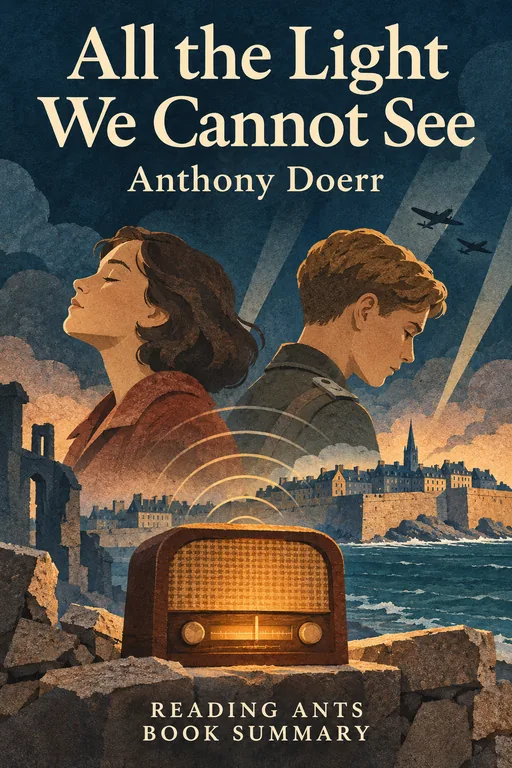
All the Light We Cannot See
A blind French girl and a gifted German boy, on opposite sides of the Second World War, are drawn toward each other by a radio broadcast, and their paths cross in the besieged city of Saint-Malo.
Overview
All the Light We Cannot See, by the American writer Anthony Doerr, was published in 2014 and won the Pulitzer Prize for Fiction in 2015. The novel alternates between two young people whose lives are shaped by the war. Marie-Laure LeBlanc is a blind French girl who flees Paris with her father in 1940. Werner Pfennig is an orphaned German boy with an extraordinary talent for radios, who is recruited into the German army. The story is told in very short chapters that jump back and forth in time, from their childhoods in the 1930s, through the war, to the bombing of Saint-Malo in August 1944. It is a story about light, sound, technology and the small acts of kindness that survive in dark times.
Main Characters
- Marie-Laure LeBlanc: a curious, resilient blind girl who loves books and the sea.
- Werner Pfennig: an orphan with a gift for radio and engineering.
- Daniel LeBlanc: Marie-Laure’s father, a locksmith at the Museum of Natural History in Paris.
- Étienne LeBlanc: Marie-Laure’s great-uncle in Saint-Malo, who has not left his house in decades.
- Madame Manec: Étienne’s housekeeper, who joins the Resistance.
- Jutta Pfennig: Werner’s younger sister.
- Frederick: Werner’s gentle, bird-loving friend at the military academy.
- Reinhold von Rumpel: a German sergeant-major hunting for a legendary jewel.
Full Summary
Two Children
In the 1930s, Marie-Laure lives in Paris with her father, who builds her a detailed wooden model of their neighborhood so she can learn to find her way around by touch. She goes blind at six and loves to read novels in braille, especially Twenty Thousand Leagues Under the Sea. In a German mining town, Werner and his sister Jutta live in an orphanage. Werner repairs a broken radio, and the two secretly listen to a French scientist’s broadcasts about science for children.
The Sea of Flames
Marie-Laure’s father works at the Museum of Natural History, where a famous gem called the Sea of Flames is kept. According to legend, the stone carries a curse: its owner will live forever, but will bring misfortune to everyone they love. As German troops approach Paris in 1940, the museum’s director gives the real diamond and three replicas to four different keepers, one of whom is Marie-Laure’s father, Daniel, to be sent in different directions. No one knows which is real, not even Daniel.
Daniel and Marie-Laure flee to Saint-Malo, a walled city on the coast of Brittany, where they live with Étienne, who is traumatized from the First World War. Daniel builds a model of Saint-Malo for his daughter and is later arrested by the Germans.
Werner and the Academy
Werner’s talent with radios earns him a place at a brutal Nazi school, the National Political Institute of Education. There he befriends Frederick, a sensitive boy who loves birds, and who is bullied cruelly. After a horrific act of violence against Frederick, Werner is sent to the army. His skill allows him to track and locate illegal radio transmitters, which often means that the people operating them are killed.
Saint-Malo
In Saint-Malo, Madame Manec secretly works for the Resistance. After she dies, Marie-Laure and Étienne carry on, using a hidden radio in the attic to transmit coded messages by reading passages from books. Marie-Laure learns the layout of the city, and she keeps the real Sea of Flames hidden in the model house.
A German sergeant, von Rumpel, dying of cancer and obsessed with the diamond, tracks it to Saint-Malo. Werner, in the army, is stationed in the city. When he picks up a broadcast in which a girl reads a story, he links it to the science programs he loved as a child, which were made years earlier by her great-uncle Étienne and her grandfather.
August 1944
American forces bomb Saint-Malo for days. Werner is trapped in a cellar of a hotel with a fellow soldier. Marie-Laure is alone in her great-uncle’s house when von Rumpel arrives. Werner, rescued, makes his way to the house and finds Marie-Laure, saving her from von Rumpel, whom he kills. As they flee, Marie-Laure drops the diamond into a sea-filled grotto, giving the stone back to the sea and ending the legend of its curse. Werner gives her food and takes her to safety, and they share a brief moment of kindness.
Aftermath
Werner is captured and dies when he steps on a landmine. Marie-Laure never sees her father again; she learns that he died in captivity. Years later, Werner’s sister Jutta traces Marie-Laure, and the two women meet, giving Werner’s story a last link with hers. Marie-Laure later becomes a scientist who studies mollusks at the Museum of Natural History. In 2014, she is an elderly woman, with a grandson, to whom she tells her story. Though the war took many people from her, she has kept a memory of one light in the dark.
Why It Matters
All the Light We Cannot See won the Pulitzer Prize for Fiction in 2015 and spent more than two hundred weeks on the New York Times bestseller list, selling over fifteen million copies worldwide. It was adapted into a limited television series in 2023.
The novel is admired for its poetic style and its treatment of the war from the perspective of two young people, one of them on the German side, whose choices are shaped by circumstance. It emphasizes that ordinary people on all sides suffered, and it shows how technology, such as the radio, can be used both to connect and to destroy. It has been widely used in schools and book clubs.
Key Takeaways
- War affects ordinary people. Both Marie-Laure and Werner are caught in events beyond their control.
- Kindness can survive in dark times. Small acts of care matter most.
- Technology can help or harm. The radio connects people but also helps find victims.
- Everyone has hidden light. Both children show intelligence and courage.
- Legends of curses lose their hold when we refuse them. Marie-Laure gives up the diamond and does not let its legend rule her life.
What We Can Learn
The novel encourages us to see people in wartime as individuals rather than symbols. Werner is on the wrong side, but he is also a child who loved science, and he is forced into decisions that haunt him.
It also teaches the value of curiosity and learning. Marie-Laure, despite her blindness, learns to navigate through touch and sound, and Werner finds meaning in science. Both show that a determined mind can find a way.
Finally, the novel highlights the importance of small moral choices, such as sharing food, staying silent or speaking out. In difficult times, these choices define who we are.
Criticism and Counterpoints
Some critics find the very short chapters and constant jumping in time distracting, and say the prose can be overly lyrical. Others feel that the novel’s depiction of the German side, particularly the sympathy shown for Werner, may risk downplaying responsibility for Nazi crimes. Supporters argue that it shows how young people were manipulated.
A few readers also find the diamond subplot and the coincidences that bring Werner and Marie-Laure together somewhat contrived. A few historians have noted small inaccuracies in details of Saint-Malo’s bombing. Many readers, nevertheless, love the book’s emotional power.
Who Should Read It
This novel suits teens and adults who like historical fiction and beautiful writing. It contains wartime violence but is not graphic. Readers who enjoyed The Book Thief will likely enjoy it.
Want the whole book?
A summary is a taste, not the meal. Here is where to find the full book.
You reached the end 🎉
Nicely done. Mark this one as read, and we will suggest what to read next.
Read this next
The Book Thief
Markus Zusak
Death narrates how a foster child in Nazi Germany steals books, learns the power of words and forms loving bonds that war eventually destroys.
🎒 Young Adult
The Nightingale
Kristin Hannah
Two French sisters, the cautious Vianne and the rebellious Isabelle, take very different paths during the German occupation of France in World War II, one protecting her child and Jewish children at home, the other guiding Allied pilots over the Pyrenees.
✨ Modern Fiction
The Boy in the Striped Pyjamas
John Boyne
The nine-year-old son of a Nazi commandant befriends a Jewish boy on the other side of a camp fence, without understanding where he is, and their innocent friendship ends in tragedy.
🧸 Children's Books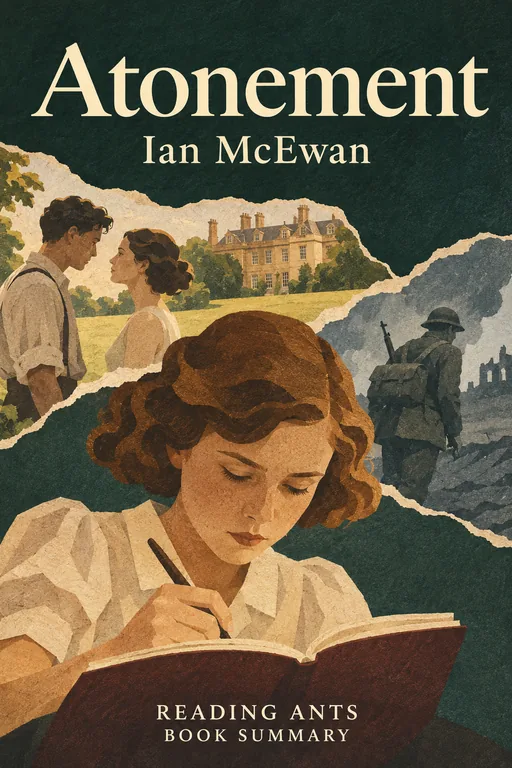
Atonement
Ian McEwan
A thirteen-year-old girl with a vivid imagination makes a false accusation that destroys a young couple's lives, and spends the rest of her own life trying to make up for it.
✨ Modern Fiction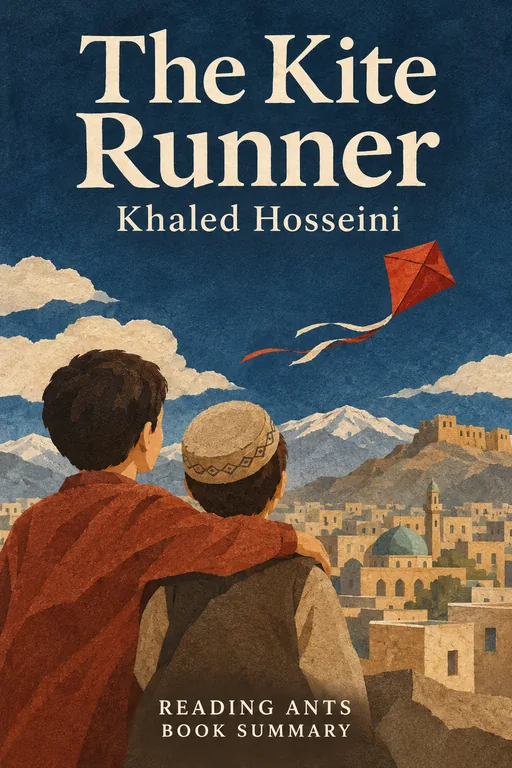
The Kite Runner
Khaled Hosseini
A wealthy boy in Kabul betrays his loyal best friend on the day of a kite tournament, and decades later, after fleeing to America, he returns to a Taliban-ruled Afghanistan to try to make things right.
✨ Modern Fiction
The Bluest Eye
Toni Morrison
In 1940s Ohio, a poor Black girl named Pecola Breedlove, who believes that she is ugly, prays for blue eyes, and the community's failure to protect her leads to tragedy.
✨ Modern FictionWant something different?
Pick another topic and we will show you three books to start with.