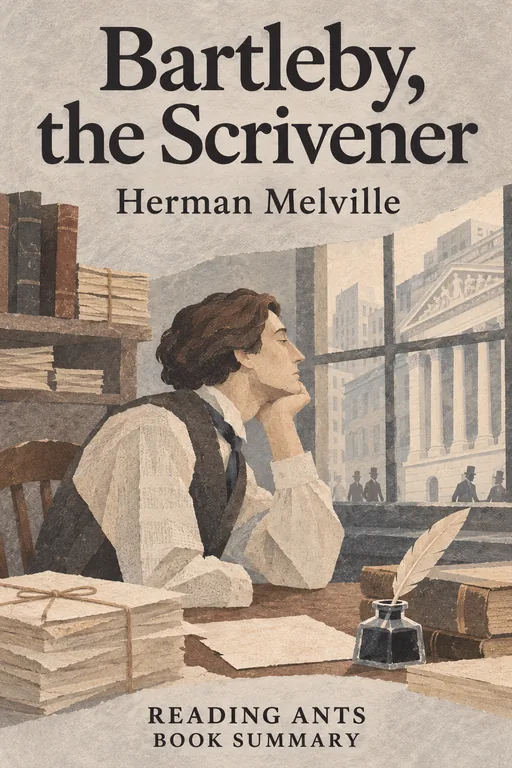
Bartleby, the Scrivener
A Wall Street lawyer hires a quiet copyist who, one day, begins to answer every request with the polite refusal that he would prefer not to, and the lawyer's kindness and bafflement fail to save him.
Overview
Bartleby, the Scrivener: A Story of Wall Street is a short story by Herman Melville, first published anonymously in 1853, in a magazine. It is told by a lawyer who describes himself as a safe and prudent man, and who is puzzled by his strangest employee. The story is funny at first, but becomes sad and troubling, and is often read as a picture of alienation, passive resistance, or the dehumanizing effects of work. It has been interpreted in many ways, and is among the most discussed short stories in American literature.
Main Characters
- The narrator: an elderly lawyer, comfortable, careful and kind, who tells the story.
- Bartleby: a thin, pale, silent copyist, who works with an eerie diligence until he stops.
- Turkey: an older clerk, who works well in the morning but becomes careless and flushed after noon.
- Nippers: a young clerk, who is ambitious, nervous and irritable in the mornings.
- Ginger Nut: the office boy, who fetches cakes for the staff.
- The landlord and new tenants: people who complain about Bartleby after the lawyer moves.
- The grub-man: a man in the prison who is paid to provide food for inmates, whom the narrator asks to feed Bartleby.
Full Summary
The lawyer and his office
The narrator is a lawyer with an office on Wall Street, in New York, in the days before typewriters, when documents had to be copied by hand. He employs two scriveners, Turkey and Nippers, each of whom has a fault, and a boy, Ginger Nut. When business grows, he advertises for another copyist. A young man appears, pale and respectable, who gives the name Bartleby. The lawyer hires him and puts him at a desk by a window that faces a brick wall.
The refusal
At first, Bartleby copies a great deal, without complaint, though without any cheer. On the third day, when the lawyer asks him to help to check a document, Bartleby replies, quietly, that he would prefer not to. The lawyer is astonished, but, being a mild man, he lets it pass. Soon Bartleby refuses other tasks in the same way, using the same phrase, and the other clerks begin to repeat it. The lawyer finds that he cannot be angry, and cannot understand why.
A man who stays
The lawyer discovers that Bartleby never leaves the office, and that he is living there at night, with no home, no friends and almost no food. On a Sunday visit, he finds his employee’s few belongings. The lawyer feels pity, and then dread, at the discovery of a life of such loneliness. Later, Bartleby ceases to copy at all, and stands for hours looking at the wall. The lawyer tries to reason with him, to bribe him, and to ask him to leave, but Bartleby only gives his usual reply.
Moving away
Unable to dismiss Bartleby, the lawyer decides to move his office to another building, leaving his copyist behind. But the new tenants find Bartleby in the stairway, and the landlord appears to complain. The lawyer, who feels uneasy, tries to find a way to help. He offers to let Bartleby live at his own house, but Bartleby declines. At last, the landlord has him removed by the police, and he is sent to the city prison, the Tombs, as a vagrant.
In the Tombs
The lawyer visits Bartleby in the prison, and finds him in a yard, standing by a wall. Bartleby says that he knows him, and does not wish to talk. The lawyer pays the prison’s grub-man to give him good food, but Bartleby refuses to eat. On a later visit, the lawyer finds him curled up, dead, against the wall of the yard. The story shows that the lawyer’s decency, though real, was not enough, and that his help came too late, if it could have been given at all.
The dead letters
At the end, the narrator mentions a rumor that he has heard, that Bartleby had once worked in the Dead Letter Office in Washington, sorting letters that had never been delivered, and then burned. This hint offers a possible explanation for his despair, as a man surrounded by messages that never reach anyone. The story ends on a note of sorrow, as the lawyer reflects on the loneliness of human beings, and the helplessness of those who try to help.
Why It Matters
Bartleby, the Scrivener has had a great influence on modern literature, and is often seen as a forerunner of writers such as Kafka and Beckett, who also dealt with isolation and absurdity. Its central phrase has become a famous symbol of passive resistance, and has been taken up by philosophers and political thinkers, as a form of refusal that cannot easily be answered. The story has also been read as a critique of the capitalist workplace and of a society that does not know what to do with those who stop taking part. It continues to inspire adaptations and essays.
Key Takeaways
- Quiet refusal can be powerful. Bartleby’s phrase disarms the lawyer.
- Kindness has limits. The narrator’s pity does not save Bartleby.
- Work can be dehumanizing. Copying text without end empties life.
- Isolation can destroy. Bartleby has no human connection.
- We cannot always understand others. The lawyer never learns the reason.
What We Can Learn
You can learn from this story to notice people who are withdrawn or struggling, and to ask whether we are doing enough for them, and not simply what is convenient. It also invites you to think about what makes work meaningful, and about what happens when people feel that they are only cogs in a machine. The story shows that the answers to human suffering are not always simple, and that sympathy needs to be matched by action. Consider talking with someone who seems alone.
Criticism and Counterpoints
Some readers find the story frustrating, because Bartleby is never explained, and because the narrator’s reaction seems more about his own comfort than about the clerk’s welfare. Others feel that the dead-letter explanation is too neat, or that the story is a hasty allegory. Interpretations vary widely, from a study of depression to a political parable, and some critics warn against reading too much into a text that is deliberately open. The humor in the early part and the sadness of the later part may seem to clash. Still, many consider it a masterpiece.
Who Should Read It
This book is for readers from about fourteen who enjoy short, thought-provoking fiction. It takes less than an hour to read. Those who like it may enjoy Kafka’s The Metamorphosis, or Melville’s Moby-Dick.
Want the whole book?
A summary is a taste, not the meal. Here is where to find the full book.
You reached the end 🎉
Nicely done. Mark this one as read, and we will suggest what to read next.
Read this next

Moby-Dick
Herman Melville
A young sailor joins a whaling voyage and discovers that its captain is obsessed with hunting down the giant white whale that bit off his leg, a quest for revenge that leads the whole crew to destruction.
📜 Classics
The Metamorphosis
Franz Kafka
A hardworking traveling salesman wakes one morning to find himself transformed into a monstrous insect, and his family's love for him slowly turns to disgust and neglect.
🌍 World Literature
The Stranger
Albert Camus
An emotionally detached office worker kills a man on an Algerian beach and discovers that society condemns him as much for refusing its expected feelings as for the murder itself.
🌍 World Literature
Notes from Underground
Fyodor Dostoevsky
A bitter, lonely former clerk who lives in a squalid underground existence writes an angry confession about his own spite, his contempt for the world and a humiliating episode from his past.
🌍 World Literature
The Overcoat
Nikolai Gogol
A poor, humble clerk in St. Petersburg, who is mocked by his colleagues, saves for years to buy a new overcoat, which brings him joy and then brings his ruin, and his ghost takes a strange revenge.
🌍 World Literature
Pride and Prejudice
Jane Austen
Quick-witted Elizabeth Bennet and the proud, wealthy Mr. Darcy badly misjudge each other, and only by facing their own faults do they find their way to love.
📜 ClassicsWant something different?
Pick another topic and we will show you three books to start with.