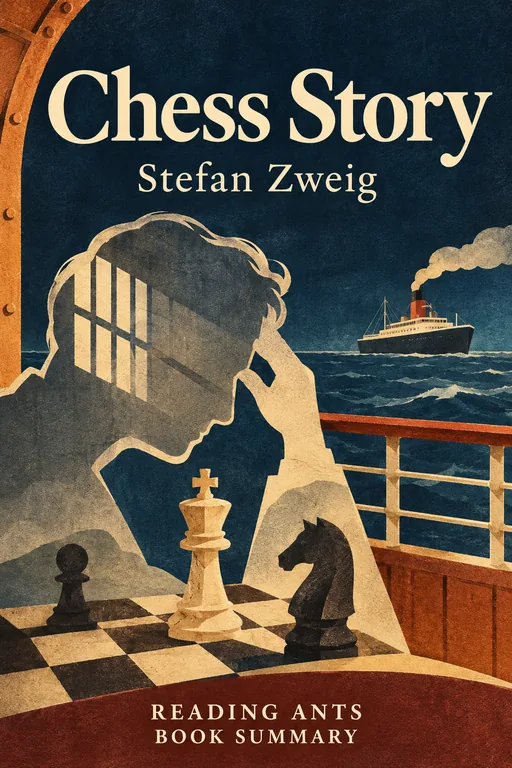
Chess Story
Original title: Schachnovelle
On a ship crossing the ocean, a chess match between a cold champion and a mysterious passenger reveals how a man survived Nazi isolation by playing games in his mind, at a terrible cost.
Overview
Chess Story, also known as The Royal Game, is a novella by the Austrian writer Stefan Zweig, who finished it in the early 1940s. It was published in 1942, soon after his death. It is set on a passenger ship traveling from New York to Buenos Aires, in the years of the Second World War, and it is told by a narrator who is a fellow passenger. Zweig, a Jewish writer who fled from the Nazis, wrote it while in exile. The story is short and gripping, and asks what happens to a mind that is locked away from the world.
Main Characters
- Mirko Czentovic: the reigning world chess champion, a rough, dull man who excels only at chess.
- Dr. B: an Austrian passenger who, once imprisoned by the Gestapo, learned chess in a very unusual way.
- McConnor: a rich Scottish-American passenger, who wants to play against the champion.
- The narrator: a curious passenger, who tells what he sees and hears.
Full Summary
The Champion on Board
The narrator learns that the world chess champion, Mirko Czentovic, is on the ship. He is the son of a poor boatman, and he had been regarded as a slow-witted boy, but it was discovered that he had a gift for chess. He rose to the top of the game without any education or charm. He is vain, greedy and cold, and plays only for money.
McConnor, a rich passenger, persuades Czentovic to play a game against the passengers, who consult together, for a fee. The champion wins easily.
The Stranger
During the second game, a quiet passenger steps in and advises the group on a clever move, and the game ends in a draw. The man is Dr. B, an Austrian who says that he has not sat down at a chessboard for twenty-five years. The passengers are amazed.
Later, Dr. B tells the narrator his story. He had been a lawyer in Vienna, who managed money for the old aristocracy, and who was arrested by the Gestapo after the Nazi takeover, as they wanted him to give up information about the hidden fortunes of his clients.
Isolation
Instead of putting him in prison, the Nazis held Dr. B in a hotel room, with no contact with anyone, no books and nothing to do. Over the weeks, he was driven to the edge of madness by the emptiness, and questioned repeatedly. He was left with only his thoughts, which spun around and around.
One day, he managed to steal a book from a coat pocket. To his disappointment, it was a collection of famous chess games. But it gave him something to occupy his mind.
The Game in the Head
Dr. B memorized the games in the book, and then began to play against himself in his mind, as both white and black. For months, he played endlessly, and the game became an obsession. He split his mind into two opponents, which led to a state of mental illness, with fever and violent behavior.
He was finally taken to a hospital, where a doctor helped to get him released and warned him never to play chess again. He left Austria and went into exile.
The Match
Dr. B is persuaded by McConnor to play against Czentovic, though he is afraid that he may relapse. He wants to see if he can play a real game against a real opponent. He wins the first game, and Czentovic, who is irritated, asks for another.
In the second game, Czentovic uses a slow, deliberate style, and takes longer and longer between moves. Dr. B grows nervous and agitated, and begins to speak wildly, as though in a trance. He starts to plan a series of moves ahead, as he used to do in his cell. At one point he announces a check that does not fit the actual board, which shows that he is playing an imagined game.
The End
The narrator notices that Dr. B is slipping back into madness, and, just in time, warns him. Dr. B stops, apologizes and gives up the game. He walks away, ashamed, leaving the champion the winner. He says that he will never play chess again.
The narrator reflects that Dr. B has escaped from the Nazis, but that part of him is still locked in that room.
Why It Matters
Chess Story is generally seen as Zweig’s masterpiece, and it was his last major work. Zweig was one of the most widely read writers in the world in the 1920s and 1930s, and his death in exile in Brazil, in 1942, was seen as a tragic sign of the destruction of European culture. The novella is also read as a study of the psychology of tyranny and isolation, and as a story about the dangers of obsession. It has been adapted for the stage and for film several times, and is more widely read today than in the past.
Key Takeaways
- Isolation can break the mind. Dr. B shows how a person can be tortured without a hand being laid on him.
- Obsession can protect and destroy. The game saves him and then threatens him.
- Intelligence is not the same as wisdom. Czentovic is brilliant at chess but dull in all else.
- Evil can be quiet. The Nazis’ cruelty is cold and bureaucratic.
- Survivors carry scars. Dr. B’s freedom does not erase his past.
What We Can Learn
The story shows how important human contact is to our well-being, and how much we need conversation, work and variety. In times when we are alone for long periods, it is good to keep connected with others.
It also warns about the risk of becoming obsessed with one thing, such as a game, a screen or a goal, at the cost of everything else. Balance is a form of protection. Finally, the novella invites us to treat survivors of hardship with patience and care, as their wounds may not be visible.
Criticism and Counterpoints
Some critics say that the story is too schematic, with the mechanical champion and the sensitive victim as clear opposites. Others feel that the narrator’s role is passive, and that the frame story slows down the drama. The portrayal of Czentovic as a simple peasant who is only good at one thing is also considered a stereotype by some readers. Chess experts have also pointed out that some of the details of the games are unrealistic.
Who Should Read It
This book is for readers aged thirteen and up who like short, powerful stories. It can be read in an afternoon. You do not need to know how to play chess, as the story is about the mind and not about the moves. It is a good introduction to Zweig.
Want the whole book?
A summary is a taste, not the meal. Here is where to find the full book.
You reached the end 🎉
Nicely done. Mark this one as read, and we will suggest what to read next.
Read this next
The Metamorphosis
Franz Kafka
A hardworking traveling salesman wakes one morning to find himself transformed into a monstrous insect, and his family's love for him slowly turns to disgust and neglect.
🌍 World Literature
The Trial
Franz Kafka
A respectable senior bank officer is arrested one morning for a crime nobody will name, and is dragged through a vast, senseless legal system that he can neither understand nor escape.
🌍 World Literature
Nineteen Eighty-Four
George Orwell
In a future Britain ruled by an all-seeing Party, one man secretly rebels by keeping a diary and falling in love, and discovers just how completely a totalitarian state can crush the human mind.
📜 Classics
The Reader
Bernhard Schlink
A man looks back at his teenage love affair with an older woman, and then at the trial that reveals her terrible past and a secret she cannot bear to share.
🌍 World Literature
Night
Elie Wiesel
Elie Wiesel tells, in short and searing pages, how as a teenager he was taken from his hometown of Sighet to Auschwitz and Buchenwald, lost his family and watched his faith and childhood break apart.
👤 Real Lives
The Little Prince
Antoine de Saint-Exupery
A pilot stranded in the desert meets a small boy from a tiny planet, who teaches him that the most important things in life, like love and friendship, can only be seen with the heart.
🌍 World LiteratureWant something different?
Pick another topic and we will show you three books to start with.