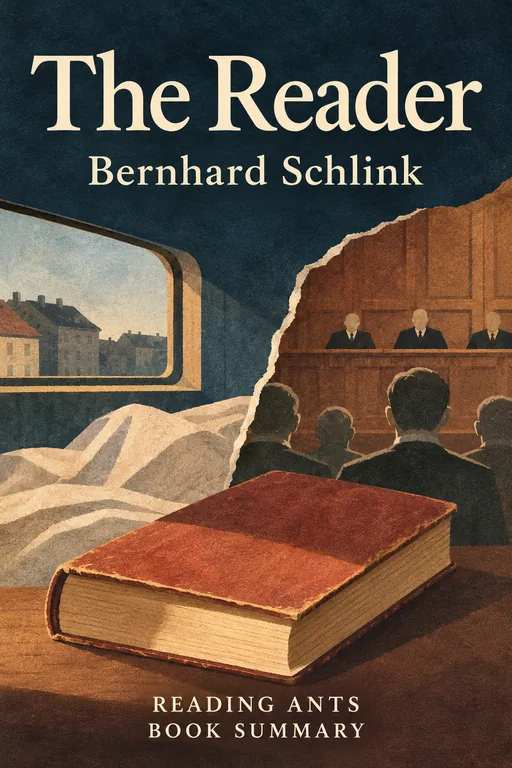
The Reader
Original title: Der Vorleser
A man looks back at his teenage love affair with an older woman, and then at the trial that reveals her terrible past and a secret she cannot bear to share.
Overview
The Reader is a short novel by the German writer Bernhard Schlink, published in 1995. It is told by Michael Berg, who looks back on his life, from his boyhood in West Germany in the 1950s to the 1990s. The story is divided into three parts, which move from a love affair, to a trial, to the long aftermath. It is about guilt, shame and the way that a later generation of Germans faced the crimes of their parents’ generation. The book contains an adult-teen sexual relationship and difficult subjects, and it is meant for mature readers.
Main Characters
- Michael Berg: the narrator, a student, and later a legal historian.
- Hanna Schmitz: a tram conductor in her thirties, who becomes Michael’s lover.
- The survivors: women who testify at the trial about the crimes of the camp guards.
- Michael’s family and professor: figures who show the different ways that Germans responded to the past.
Full Summary
Hanna
Michael is fifteen when he falls ill on the street, and is helped by Hanna, a woman of thirty-six. After he recovers, he visits her to thank her, and they begin a secret affair. It is intense and, for Michael, life-changing.
Hanna asks Michael to read to her before they make love, and he reads her classic works, such as stories and novels. They share baths, bike rides and conversations, though she is often moody, and she can be cold and demanding.
Gone
One day, Hanna disappears from the city. Michael is hurt and confused, and he blames himself. For many years, he cannot make a stable relationship, as the experience has marked him.
He studies law at the university, and he is a member of a seminar that attends a trial of former guards of a Nazi concentration camp, held in the 1960s.
The Trial
At the trial, Michael is shocked to see Hanna among the accused. She has been charged in connection with the deaths of many women, who were locked in a burning church during a march at the end of the war. She had been a guard.
In the courtroom, Hanna answers honestly, but she does not defend herself well. The others blame her, and say she was the leader. Accused of writing the report, she admits to it rather than provide a sample of her handwriting, and Michael suddenly realizes why she was always asking to be read to: she cannot read or write.
The Silence
Michael understands that Hanna is more ashamed of being illiterate than of being found guilty of the crime. If she told the truth, it might reduce her sentence, because she could not have written the report that put her at fault. But she will not say it.
Michael is torn. He wonders whether to tell the judge, but he also feels a bond to her and does not know how to approach it. In the end, he does not speak up, and Hanna is sentenced to life in prison.
Tapes
Years later, Michael is a legal historian and has a failed marriage behind him. He begins to record himself reading books onto tapes, and he sends them to Hanna in prison. Over time, she uses the tapes to teach herself to read and write, and she sends him short notes. But he never writes back or visits.
When she is about to be released, after many years, he is asked to help her. He finally visits her, and finds her much older. The meeting is awkward, and he cannot give her the closeness she hopes for.
The Last Gift
Soon afterward, Hanna takes her own life, on the day she is to be freed. She leaves a note asking Michael to give her savings to one of the survivors of the church fire. Michael visits the survivor, a woman in New York, who refuses to accept the money as forgiveness, and suggests that he donate it instead; he gives it, in Hanna’s name, to a Jewish charity that fights illiteracy.
Michael finally decides to write down his own story, as an attempt to come to terms with it.
Why It Matters
The Reader was an international bestseller, translated into dozens of languages, and it was one of the first German novels to become a success in the United States. It was made into a film in 2008, for which Kate Winslet won an Academy Award. The book is a major part of the debate about how later generations should think about their parents’ guilt. It also asks whether understanding someone’s reasons is the same as forgiving them. Schlink, who is a law professor, uses a legal setting to explore moral questions.
Key Takeaways
- Shame can be stronger than reason. Hanna prefers prison to revealing she cannot read.
- Understanding is not excusing. Michael learns that he can understand Hanna without forgiving her crimes.
- Silence has consequences. Michael’s silence is a moral failure of its own.
- The past does not disappear. Each generation must face what came before.
- Reading is power. Literacy is bound up with dignity and freedom.
What We Can Learn
The book invites us to think about how we deal with guilt, ours and other people’s. It shows that we cannot simply love or hate a person: someone we care about can also have done terrible things. We should neither excuse nor deny wrongs, but face them honestly.
It also reminds us of the importance of reading and education, and of how shame can lead people to hide their needs. We can all be more kind to those who struggle with things that others find easy. Finally, the book asks what we owe to the victims of history, and how to honor their memory.
Criticism and Counterpoints
Some critics argue that the book’s focus on Hanna’s illiteracy makes her too sympathetic, or that it uses the illiteracy to explain her crimes, which is misleading. Others object that the story puts a German perpetrator at the center and gives less room to the victims. The sexual relationship between a teenager and an adult woman is seen by some as uncomfortable, and by others as treated without enough criticism. Still, the book has been praised for its clear, spare style.
Who Should Read It
This book is for mature readers who like short, serious novels about moral questions and history. It is easy to read in a few days but hard to forget. Anyone who is sensitive to the themes of abuse, war crimes or suicide should take care.
Want the whole book?
A summary is a taste, not the meal. Here is where to find the full book.
You reached the end 🎉
Nicely done. Mark this one as read, and we will suggest what to read next.
Read this next
The Book Thief
Markus Zusak
Death narrates how a foster child in Nazi Germany steals books, learns the power of words and forms loving bonds that war eventually destroys.
🎒 Young Adult
Night
Elie Wiesel
Elie Wiesel tells, in short and searing pages, how as a teenager he was taken from his hometown of Sighet to Auschwitz and Buchenwald, lost his family and watched his faith and childhood break apart.
👤 Real Lives
Atonement
Ian McEwan
A thirteen-year-old girl with a vivid imagination makes a false accusation that destroys a young couple's lives, and spends the rest of her own life trying to make up for it.
✨ Modern Fiction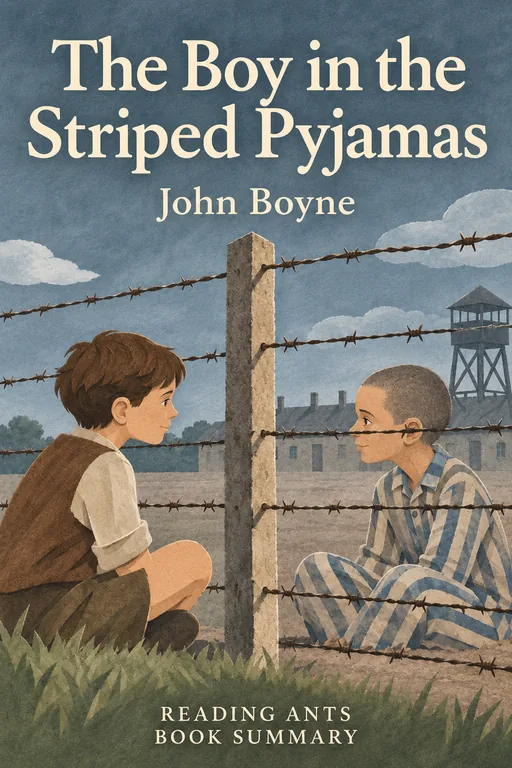
The Boy in the Striped Pyjamas
John Boyne
The nine-year-old son of a Nazi commandant befriends a Jewish boy on the other side of a camp fence, without understanding where he is, and their innocent friendship ends in tragedy.
🧸 Children's Books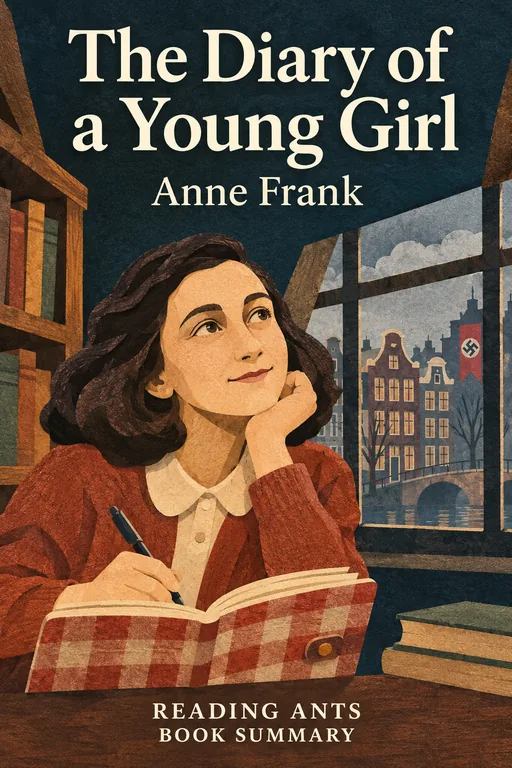
The Diary of a Young Girl
Anne Frank
A Jewish teenage girl hiding from the Nazis in a secret apartment in Amsterdam records two years of fear, family quarrels, first love and big dreams in a diary that became one of the most famous books in the world.
👤 Real Lives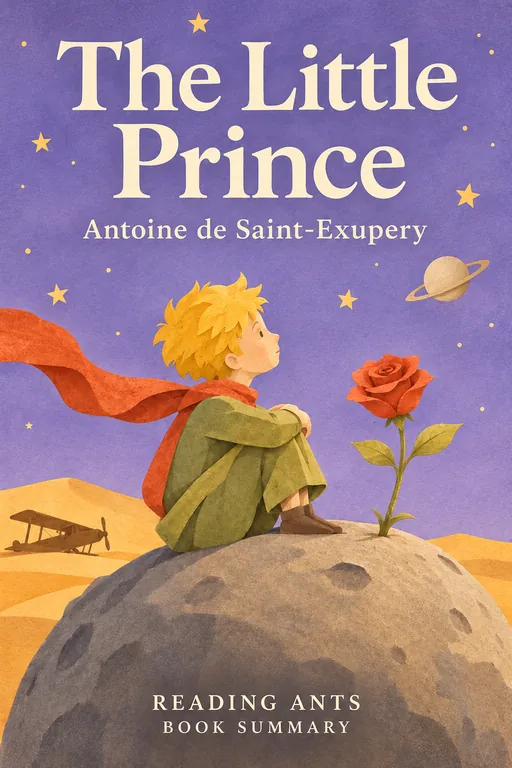
The Little Prince
Antoine de Saint-Exupery
A pilot stranded in the desert meets a small boy from a tiny planet, who teaches him that the most important things in life, like love and friendship, can only be seen with the heart.
🌍 World LiteratureWant something different?
Pick another topic and we will show you three books to start with.