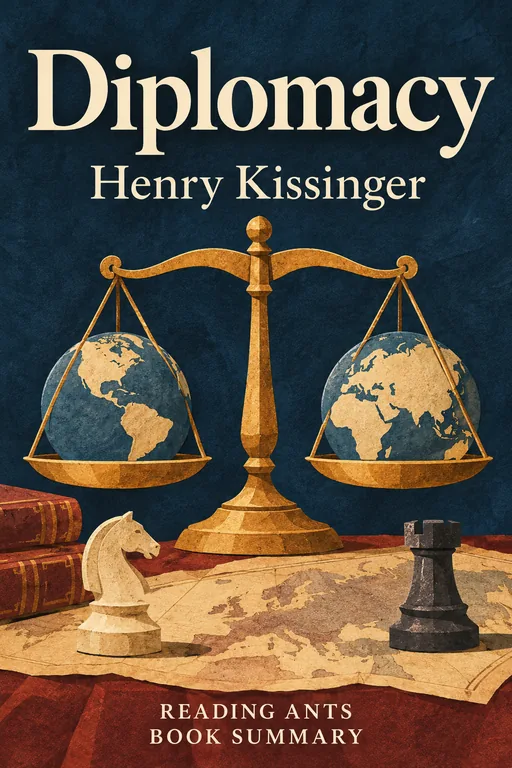
Diplomacy
Former US Secretary of State Henry Kissinger surveys the history of international relations from Cardinal Richelieu to the end of the Cold War, arguing that stable peace depends on a balance of power and on leaders who combine realism with vision.
Overview
Diplomacy was published in 1994 by Henry Kissinger, who had been a professor at Harvard and then national security adviser and Secretary of State under Presidents Nixon and Ford, and a Nobel Peace Prize winner for his part in the 1973 Vietnam peace negotiations, a prize that was controversial. The book is a long account of how states have dealt with one another over about four centuries, with portraits of statesmen such as Richelieu, Metternich, Bismarck, Theodore Roosevelt, Woodrow Wilson and Franklin Roosevelt. Kissinger writes as a practitioner and a historian, and favors the realist tradition.
Full Summary
1. The balance of power and raison d’etat
The idea: Kissinger begins with the idea that international order depends on a balance of power among states. He describes how, in seventeenth-century Europe, the French cardinal Richelieu put the interests of the state above religious loyalties, founding the principle of raison d’etat. Over time, the principle of a balance among competing states, so that none could dominate, became the guiding idea of European diplomacy. He sees it as a way to keep peace without relying on good will.
In real life: A group in which no one person can dominate often makes more careful decisions.
2. The concert of Europe and Bismarck
The idea: After the Napoleonic Wars, the statesmen who met at the Congress of Vienna, especially the Austrian Metternich and the British Castlereagh, built a system of cooperation among the great powers that kept peace for decades. Kissinger describes this as a legitimate order, accepted by the main actors. Later, the German chancellor Bismarck used skillful diplomacy to unify Germany and to maintain a complex set of alliances, but after his time, the system became rigid and led to war.
In real life: A set of rules works when everyone sees it as fair enough to keep.
3. America’s idealism: Wilson and Roosevelt
The idea: Kissinger contrasts the European approach with the American tradition, which has tended to be more idealistic, with a belief that democracy and law can replace power politics. He discusses Theodore Roosevelt, who understood the balance of power, and Woodrow Wilson, who proposed a League of Nations based on collective security. Franklin Roosevelt, he says, led a reluctant America into the war and tried to build a postwar order on cooperation among the great powers, an effort Kissinger regards as having idealistic weaknesses.
In real life: A leader may hope that goodwill will keep order, while another relies on strength.
4. The Cold War and containment
The idea: After the Second World War, the world was divided between the United States and the Soviet Union. Kissinger describes the strategy of containment, the idea of resisting Soviet expansion, associated with George Kennan and Harry Truman, and the debates about how to apply it. He discusses nuclear weapons and the threat of mutual destruction, which made direct war too dangerous, and the proxy conflicts in places such as Korea and Vietnam.
In real life: Two rivals who both have the power to destroy each other may be forced to be careful.
5. Opening to China and détente
The idea: Kissinger describes the changes of the early 1970s, when he and President Nixon sought a new approach. They opened relations with the People’s Republic of China, which had been isolated, and pursued détente, a lessening of tension, with the Soviet Union. The aim was to create a triangular relationship in which the United States had better relations with each of the others than they had with each other. He presents these steps as an example of realism in action.
In real life: Sometimes talking to a rival can change the whole situation.
6. The end of the Cold War and a new world
The idea: The final chapters examine the collapse of the Soviet Union and the new world order. Kissinger discusses the role of Reagan and of Gorbachev, and the challenge facing the United States as the only superpower. He foresees a multipolar world, with several major powers, and the need to adapt the principles of the balance of power to a changed environment. He closes by arguing that the United States should lean less on Wilsonian idealism and more on a hard-headed definition of its vital interests and an understanding of power, while cautioning that realism is no cure-all.
In real life: After one big rivalry ends, new relationships have to be built.
Why It Matters
Diplomacy is a major work on the history and theory of international relations, written by a leading participant. It has been widely read by students and practitioners, and is a standard text for the realist view that emphasizes power and national interest. It shapes how many people understand modern statecraft, and the contrast between American and European traditions. It also provides an inside view of key decisions. Kissinger’s own record is highly controversial, and the book is an important primary source for understanding his thinking and the era he helped to shape.
Key Takeaways
- Balance of power sustains peace. No single state should dominate.
- Legitimacy supports order. Systems last when they are accepted.
- Idealism and realism must be balanced. Neither is sufficient alone.
- Leaders matter. Individual statesmen shaped history.
- Diplomacy requires adaptability. Strategies must change as conditions and rivals change.
What We Can Learn
You can use the book to think about conflict at any scale. In a dispute, ask what each side’s interests are, and whether an arrangement can be found that all can accept. Notice the difference between wanting to be right and wanting to reach a workable solution. Learn about the history of other countries to understand their perspectives. At the same time, read critically, and consider the viewpoints of those who criticize realism for neglecting human rights and moral questions, and who criticize Kissinger’s actions in places such as Cambodia, Chile and East Timor.
Criticism and Counterpoints
Critics say that Kissinger’s focus on great powers and the balance of power overlooks the interests and rights of smaller countries and the role of values and ideas. His own policies, such as support for authoritarian regimes, the bombing of Cambodia and actions in Chile and Bangladesh, have been strongly criticized, and some readers see the book as an attempt to justify them. Historians note that it presents a selective account that supports his thesis, and the historian Ernest May faulted it for inaccuracies, such as the claim that European statesmen did not know the idea of self-determination before Wilson. Others consider it a brilliant, though partial, work.
Who Should Read It
This book is for readers interested in history, politics and foreign policy. It is very long and detailed, and assumes some background knowledge. Those who want a short introduction might begin with a shorter book on international relations, and read Kissinger with a critical eye.
Want the whole book?
A summary is a taste, not the meal. Here is where to find the full book.
You reached the end 🎉
Nicely done. Mark this one as read, and we will suggest what to read next.
Read this next
The Clash of Civilizations
Samuel P. Huntington
Samuel Huntington argues that, after the Cold War, the main source of conflict in the world will be cultural and religious differences between large civilizations, instead of political ideology or economics.
🏛️ History
The Guns of August
Barbara W. Tuchman
Barbara Tuchman gives a gripping account of the first month of the First World War in 1914, showing how plans, pride and misjudgment led the great powers into a conflict that none was able to stop.
🏛️ History
On War
Carl von Clausewitz
Prussian officer Carl von Clausewitz argues that war is a continuation of politics by other means, that it is dominated by chance, friction and moral forces, and that it can never be reduced to a simple formula.
⚖️ Politics & Society
The Prince
Niccolo Machiavelli
A Renaissance diplomat advises rulers to judge their actions by results rather than morality, arguing that a successful leader must sometimes be cunning and ruthless to win and keep power.
⚖️ Politics & Society
The End of History and the Last Man
Francis Fukuyama
Francis Fukuyama argues that the end of the Cold War suggests that liberal democracy may be the final stage of political development, and asks whether people who live in such a system will be satisfied or will long for new struggles.
🏛️ History
The Communist Manifesto
Karl Marx and Friedrich Engels
Marx and Engels declare that all history is the history of class struggle, that capitalism has created a working class that will overthrow it, and that communism will end class divisions.
⚖️ Politics & SocietyWant something different?
Pick another topic and we will show you three books to start with.