 Reading Ants
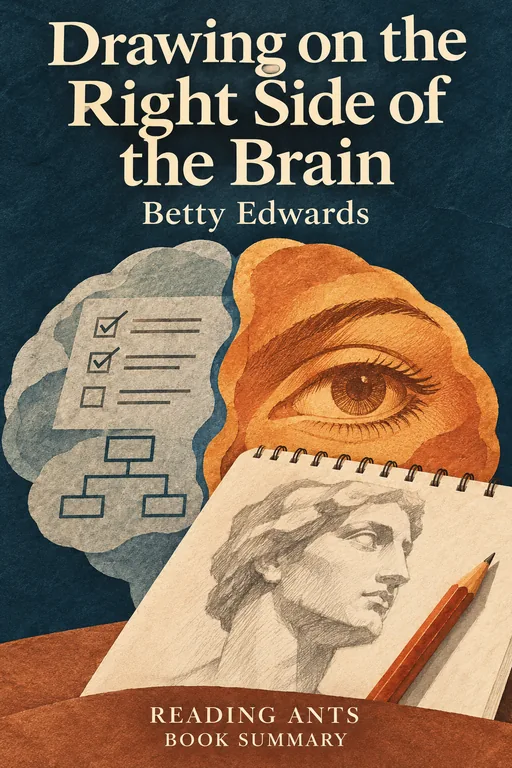
Drawing on the Right Side of the Brain
A practical course that teaches anyone to draw by learning to see things as they really are, and not as the mind assumes them to be.
Overview
Drawing on the Right Side of the Brain is a book by the American art teacher Betty Edwards, first published in 1979. It is a step-by-step course, with exercises, that aims to show that drawing is a skill that can be learned, and that most people can learn to draw with practice. Edwards bases her method on the idea that the brain has two modes of thinking, a verbal, logical one and a visual, perceptual one. The book has been used as a standard text in many art schools and has been translated into many languages.
Full Summary
1. Drawing is a skill of seeing
The idea: Edwards says that drawing is not mainly about hand skill, but about seeing. Most people draw badly because they draw what they think they see, such as a symbol of an eye or a tree, and not what is actually in front of them. To draw well, you have to learn to look at things in a fresh way.
From the book: She starts by asking readers to make “before” drawings, including a self-portrait, so that they can later compare them with drawings made after taking the course.
In real life: Try drawing your own hand without looking at the paper too much. You will notice details, such as wrinkles and curves, that you usually miss.
2. Two ways of thinking
The idea: Edwards introduces the idea of left-brain and right-brain modes. She calls one mode “L-mode,” which is verbal, analytical and sequential, and the other “R-mode,” which is visual, spatial and sees the whole. She says that drawing needs R-mode, and that the key is to get the verbal mode to step aside.
From the book: She bases the two modes partly on research on the two halves of the brain, especially the work of Roger Sperry, and uses them to explain why her exercises work. Her general rule is to give the brain a task that the verbal mode will turn down. On her website she says that the two modes are ways of knowing, wherever they may be located in the brain, so the model is a framework and not a settled map of the brain, and the exercises can help either way.
In real life: When you are absorbed in a hobby, such as sketching or music, and time seems to pass without notice, you are in a state like what Edwards calls R-mode.
3. Upside-down drawing
The idea: One of the best-known exercises is to copy a line drawing, turned upside down. According to Edwards, since the image does not look familiar, the verbal mode does not recognize it and stops interfering. The drawer simply follows the lines and shapes, and often creates a better copy.
From the book: Edwards uses a drawing by Picasso of the composer Stravinsky, which students copy upside down, and many are surprised at how well they do.
In real life: If you are stuck while drawing a face or a shape, turn your reference photo upside down. It becomes a set of lines, and the drawing often improves.
4. Contour drawing
The idea: In pure contour drawing, you look at the edge of an object, not at the paper, and draw it slowly as your eye follows it. The result may look distorted, since the point of the exercise is the looking. You imagine that your pencil is touching the edge as your eye follows it. This builds close observation and the connection between eye and hand.
From the book: The exercise is done first with the hand, and later with other objects, and the results are often strange but expressive.
In real life: Drawing the outline of a leaf or a mug, slowly and looking mostly at the object, can calm your mind, as well as sharpen your eyes.
5. Negative space
The idea: Instead of drawing the object, you draw the spaces around and between objects. For example, to draw a chair, you focus on the shapes of the empty spaces between the legs and the back. These shapes are not named by the verbal mind, so they are easier to draw accurately.
From the book: Edwards shows how drawing negative spaces can help to get proportions and relationships right.
In real life: When you draw a plant on a windowsill, look at the shape of the window between the leaves. Draw that shape, and the plant often follows.
6. Five basic skills
The idea: She says that drawing involves five basic perceptual skills: the perception of edges, spaces, relationships (such as proportion and angles), light and shadow, and the whole (the “gestalt”). Once a person has learned these, they can draw almost anything.
From the book: The course is built around practicing each skill in turn, and then combining them, including in portrait drawing.
In real life: You can use the same steps to draw a landscape: look at edges (the horizon), spaces (the sky), relationships (how tall the tree is compared with the house), light and the whole scene.
Why It Matters
Drawing on the Right Side of the Brain is one of the most widely used art instruction books, and has been translated into many languages. It helped to change the idea that drawing is a gift that only a few people are born with, and it gave many adults the confidence to pick up a pencil. It has been used in art schools and in workshops, as a way to teach observation and creative thinking. The book has been revised, and a new edition, The New Drawing on the Right Side of the Brain, appeared in 1999. Edwards also wrote other books on drawing and creativity, such as Drawing on the Artist Within (1986) and Color (2004).
Key Takeaways
- Drawing can be learned. It is a set of skills, not only a talent.
- Seeing is the main skill. Drawing begins with looking.
- Quiet the inner narrator. Tricks like upside-down drawing help to do this.
- Edges and spaces matter. Looking at shapes in a new way improves accuracy.
- Practice builds confidence. Small exercises lead to visible progress.
What We Can Learn
The book shows that many skills that seem like talents can be learned if we break them into steps and practice. It also teaches us to look at the world with fresh eyes, which can bring pleasure and calm. Even if you never draw a masterpiece, the habit of paying attention can make everyday life more interesting.
It also suggests that we should be kind to ourselves as beginners, and not give up after a first failure. A little practice every day, even ten minutes, is better than a long session once in a while.
Criticism and Counterpoints
Neuroscientists have pointed out that the idea of a “right brain” and “left brain” that work separately is too simple, as both sides of the brain are involved in most tasks, including drawing. Edwards herself now describes the two modes as ways of knowing, wherever they are located in the brain. Some art teachers feel that the method is too focused on realistic drawing, and that it does not cover expression or imagination. Others say that the exercises are good, whatever their scientific explanation.
Who Should Read It
This book is for anyone who wants to learn to draw, from about ten years old, including adults who think that they cannot. It requires time, a pencil and paper. Those who are looking for advice about style or art history may want other books, but beginners will find it a friendly guide.
Want the whole book?
A summary is a taste, not the meal. Here is where to find the full book.
You reached the end 🎉
Nicely done. Mark this one as read, and we will suggest what to read next.
Read this next
Understanding Comics: The Invisible Art
Scott McCloud
A book that is itself a comic, which explains how comics work, and why this form of storytelling deserves to be taken seriously.
🎨 Arts & Creativity
Ways of Seeing
John Berger
A short, famous book that shows how what we see in art is shaped by what we know and believe, and by who owns, copies and sells images.
🎨 Arts & Creativity
The Creative Act: A Way of Being
Rick Rubin
Rubin presents creativity as a receptive way of living in which attention, experimentation and disciplined refinement help artists bring possible work into form.
🎨 Arts & Creativity
Bird by Bird: Some Instructions on Writing and Life
Anne Lamott
A warm, funny guide to writing, which says that you should start with small steps, allow yourself to write badly, and pay attention to life.
🎨 Arts & Creativity
The Story of Art
E. H. Gombrich
Gombrich traces major traditions of Western art by showing how artists inherited visual problems, revised conventions and learned to make images serve changing purposes.
🎨 Arts & Creativity
On Writing: A Memoir of the Craft
Stephen King
Stephen King combines a candid account of becoming a writer with practical advice about reading, drafting, revision and sustaining creative work through difficulty.
🎨 Arts & CreativityWant something different?
Pick another topic and we will show you three books to start with.