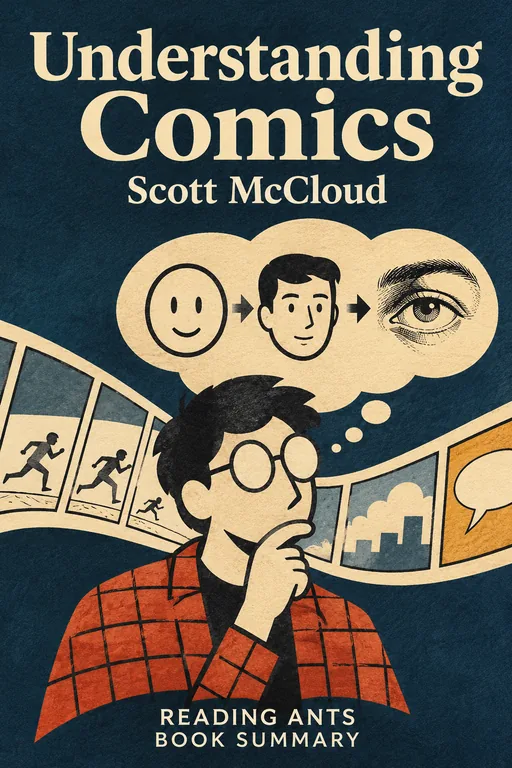
Understanding Comics: The Invisible Art
A book that is itself a comic, which explains how comics work, and why this form of storytelling deserves to be taken seriously.
Overview
Understanding Comics is a book by the American cartoonist Scott McCloud, published in 1993. It is written and drawn in comic form, with McCloud appearing as a cartoon guide who explains his ideas to the reader. The book looks at the history, vocabulary and techniques of comics, and asks questions such as: what is a comic, how do we read it, and why do simple drawings affect us so strongly? It was one of the first major works to treat comics as an art form, and it is still widely used by artists, teachers and readers.
Full Summary
1. What is a comic?
The idea: McCloud argues that comics should be defined broadly. He describes them as pictures and other images placed next to each other in a deliberate order, to convey information or to produce an aesthetic response in the viewer. By this idea, comics have a long history, including ancient Egyptian paintings and medieval tapestries, and not just newspaper strips and superhero books.
From the book: He shows examples from different times and places, to show that the idea of putting images in sequence is very old and widespread.
In real life: Instructions that come with furniture, safety signs on a plane, and a series of photos on a phone can all be seen as a kind of comic, because they use images in order to communicate.
2. The power of simple faces
The idea: McCloud says that a very simple drawing of a face, such as a circle with two dots and a line, can be more powerful than a realistic one. This is because we can see ourselves in it. A cartoon face leaves out most details, so it is “empty” in a sense, and the reader can fill it with their own identity and feelings.
From the book: He draws a scale from a realistic photo to an abstract icon, and shows how our response changes along it.
In real life: Emoji work in the same way. A simple smiley is understood by everyone, and it can stand for many different feelings.
3. Closure: the space between panels
The idea: In a comic, the reader must imagine what happens in the gap between two panels, which is called the gutter. McCloud calls this mental act “closure.” It is the heart of how comics work, because the reader becomes an active partner in the story.
From the book: He uses examples to show how an artist can create surprise, action or horror by choosing what to show and what to leave out. He also lists different kinds of jumps from one panel to the next, from a tiny step in time to a complete change of scene.
In real life: When you see two photos of a person standing at a door and then sitting at a table, you imagine that they went in and sat down. Your mind fills in the missing steps.
4. Time and motion
The idea: Comics show time through space. The size and shape of panels, the number of them and the way they are arranged can make a moment seem fast or slow. A larger panel can give a moment more time, and showing a short action in many panels can slow it down, like slow motion, while using few panels can speed it up.
From the book: McCloud shows how artists use motion lines, moving backgrounds and repeated images to give a sense of movement.
In real life: A video-game or a film uses similar tricks. Think of how a scene may slow down for a dramatic moment, and speed up in a chase.
5. Line, emotion and style
The idea: The way a line is drawn can show feeling. Soft, round lines feel gentle, and sharp, jagged lines feel tense or angry. McCloud suggests that lines can carry feeling in a way that readers understand without being told, and that this is part of an artist’s voice.
From the book: He shows how different lines, curves and patterns can express different feelings.
In real life: Compare a child’s soft drawing of a house with a sharp, sketchy one. Each says something different, even though the subject is the same.
6. Words and pictures
The idea: Comics use both words and pictures, and they can combine in many ways. Sometimes the words carry more of the story, sometimes the pictures do, and sometimes the two share the work. McCloud describes different combinations of the two, and neither has to spell out everything that is happening.
From the book: He shows how a word balloon or a close-up can tell us about a character’s presence and inner feelings, even when the picture says little.
In real life: A photo caption on social media can change how we see the picture, from funny to sad, with just a few words.
7. The steps of making a comic
The idea: Toward the end, McCloud outlines the choices that a creator makes: the idea and purpose, the form, the idiom (the style or school of work), the structure, the craft and the surface (the finish). He encourages readers to see comics as a serious craft, with many decisions at every stage.
From the book: He emphasizes that comics can be about any subject, in any style, and that the form is still developing.
In real life: If you want to draw your own comic, you can start with a simple idea and a few panels, and then think about how to tell it clearly.
Why It Matters
Understanding Comics is considered a classic, and it has been translated into many languages. It helped to change the way that critics, teachers and the public think about comics, by giving a vocabulary for how they work. It has been used in classrooms, from schools to universities, and has encouraged many artists to begin creating. McCloud later wrote two more books on the subject, Reinventing Comics and Making Comics. The book is also admired as an example of how a comic can teach complex ideas. Many readers who had never thought about how comics work say that after reading it, they notice the choices that artists make on every page, and that they enjoy comics and graphic novels more as a result.
Key Takeaways
- Comics are a real art form. They have a long history and deep craft.
- Simple images connect. We identify with a plain cartoon face.
- Readers complete the story. Closure makes us active participants.
- Space can show time. Panel layout changes pacing.
- Style carries meaning. The line itself speaks.
What We Can Learn
The book teaches us to notice how images communicate, which is a useful skill in a world full of pictures, ads and screens. It also encourages us to respect forms of art that may be thought of as “low,” and to ask why we think so.
For those who want to make things, the book offers a clear introduction to the choices in visual storytelling. And it reminds us that our own imagination is an essential part of any story, since we fill in what is not shown.
Criticism and Counterpoints
Some critics say that McCloud’s definition of comics is too broad, or that it leaves out certain types of work. Others feel that the book is dated, since it was written in the early 1990s, before the growth of webcomics and graphic novels. The book’s examples are mainly from Western and Japanese comics, and the discussion of the history is brief. Still, it is widely seen as a groundbreaking work.
Who Should Read It
This book is for anyone who likes comics, drawing or storytelling, including readers aged ten and up. It is easy to read and full of pictures. Those who are looking for a detailed history of comics may want another book, but as an introduction, it is hard to beat.
Want the whole book?
A summary is a taste, not the meal. Here is where to find the full book.
You reached the end 🎉
Nicely done. Mark this one as read, and we will suggest what to read next.
Read this next
Ways of Seeing
John Berger
A short, famous book that shows how what we see in art is shaped by what we know and believe, and by who owns, copies and sells images.
🎨 Arts & Creativity
Maus
Art Spiegelman
Art Spiegelman draws his father's story of surviving Auschwitz, with Jews as mice and Nazis as cats, and also shows the difficult relationship between a son and a father marked by the past.
👤 Real Lives
Persepolis
Marjane Satrapi
In black-and-white comics, Marjane Satrapi tells of growing up in Iran during the Islamic Revolution and the Iran-Iraq war, then living alone in Europe and returning home, searching for where she belongs.
👤 Real Lives
Drawing on the Right Side of the Brain
Betty Edwards
A practical course that teaches anyone to draw by learning to see things as they really are, and not as the mind assumes them to be.
🎨 Arts & Creativity
The Design of Everyday Things
Don Norman
When people struggle to use a door, a stove or a website, the fault usually lies with the design, not the person, and good design makes the right action obvious and mistakes easy to recover from.
💼 Business
The Story of Art
E. H. Gombrich
Gombrich traces major traditions of Western art by showing how artists inherited visual problems, revised conventions and learned to make images serve changing purposes.
🎨 Arts & CreativityWant something different?
Pick another topic and we will show you three books to start with.