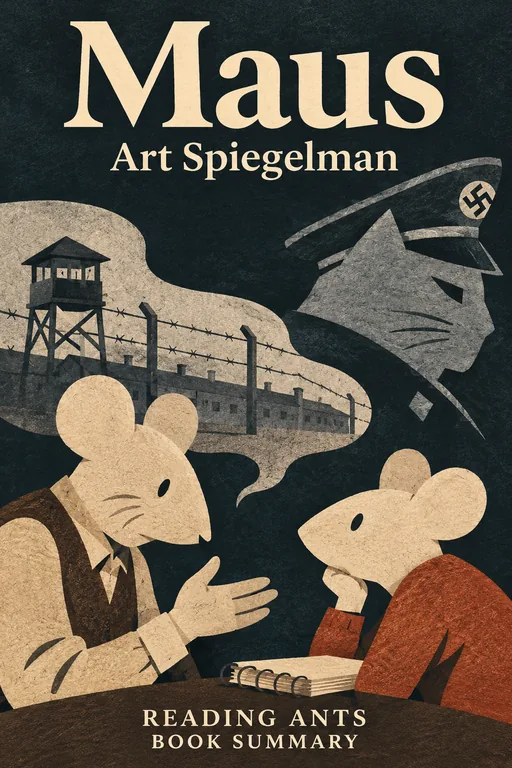
Maus
Art Spiegelman draws his father's story of surviving Auschwitz, with Jews as mice and Nazis as cats, and also shows the difficult relationship between a son and a father marked by the past.
Overview
Maus is a graphic memoir by the American cartoonist Art Spiegelman. The first part, My Father Bleeds History, appeared in 1986, and the second, And Here My Troubles Began, in 1991; they are often published together. In 1992 it received a special Pulitzer Prize. The book tells two stories at once: the wartime experience of Spiegelman’s father, Vladek, a Polish Jew who survived the Holocaust, and the author’s interviews with Vladek in New York decades later, as he tries to understand his father and himself. Spiegelman draws different nations as animals: Jews as mice, Germans as cats, Poles as pigs and Americans as dogs.
Full Summary
1. The son and the old man
The idea: The book opens in the present day, when Art visits his elderly father, Vladek, in Rego Park, Queens. Vladek is difficult, stingy, nagging and sometimes charming. Art, who has a strained relationship with him, asks him to tell his story for a comic. Art’s mother, Anja, who also survived the camps, took her own life in 1968, and the loss casts a shadow over them. Throughout the book, the story jumps between the present, where Art struggles with his father, and the past that Vladek describes.
In real life: Children of survivors often grow up with a heavy emotional inheritance, even if their parents rarely speak about it.
2. Before the war and the first years
The idea: Vladek tells of his life in Poland before the war: he was a young businessman in textile manufacturing in Sosnowiec, and met and married Anja, who came from a wealthy family. They had a baby son, Richieu. When the Germans invaded Poland in 1939, life changed. Jews lost their businesses and were forced into ghettos, with restrictions that grew steadily harsher. Vladek recounts how he used his wits to find food and bribes, and how the family tried to stay together and later hide.
In real life: Rules that remove rights step by step can leave people confused about how bad things are going to get.
3. Hiding and betrayal
The idea: As deportations begin, Vladek and Anja try to survive by hiding in cellars, attics and friends’ homes. They are sheltered by some, betrayed by others. Their young son Richieu is sent to a relative for safety but dies after the family there poisons the children to avoid capture, a loss that haunts Vladek and Art, who grew up with the ghost of a brother he never met. Eventually the couple is caught, and they are sent to Auschwitz, as the story moves to the camp.
In real life: Decisions made in terror, even by loving people, can leave a lifetime of grief.
4. Auschwitz
The idea: In the camp, Vladek and Anja are separated, he in the men’s camp and she in Birkenau, and the book shows the brutality, hunger and fear of daily life. Vladek survives through a series of lucky breaks, practical skills, and the help of a few people, using his talent for languages and repairs to gain small advantages. He also recalls bribes, hidden food and cruelty, as well as kindness. He is not portrayed as a saint, but as a human being trying to live.
In real life: Survival often depended on luck and small acts of help, and survivors sometimes felt guilt for living when others did not.
5. Liberation and the aftermath
The idea: Toward the end of the war, as the Germans evacuate camps, Vladek endures a march and a harsh journey to another camp, and is later freed. He finds Anja alive after a long search, and they eventually move to the United States. The book follows how Vladek’s experiences changed him: he saves everything, from string to food, and fears waste. Art sees how these habits make daily life with him hard, and shows his own frustrations honestly.
In real life: Experiences of extreme scarcity can shape habits for the rest of a person’s life.
6. Guilt, memory and the ending
The idea: In the final sections, Art deals with the success of the first volume, the pressure and his sense of guilt about turning his father’s suffering into a book. He shows himself as a cartoonist overwhelmed by attention and uncertain whether he has the right to tell the story. He also learns that Vladek burned Anja’s diaries after her death, which enrages him and shows how hard it is to recover the past. Vladek, in his old age, is ill, and in the last scene, he mistakes Art for Richieu and asks him to stop talking, because he is tired. The book closes with a grave marker bearing the names and dates of Vladek and Anja, and a sense of unfinished grief.
In real life: Telling a family’s painful story can bring understanding, but it can also bring guilt and complicated feelings.
Why It Matters
Maus is widely viewed as one of the most important graphic novels ever made. It helped convince many readers that comics could deal with serious history and complex emotions, and it made the Holocaust accessible to new generations through its form. It is used in many schools and universities.
The book has also drawn attention for being challenged. In 2022, a school board in Tennessee removed it from an eighth-grade curriculum, citing nudity and language, which triggered a national debate about censorship and led to a surge in sales.
Key Takeaways
- Comics can carry great weight. Images can tell serious stories.
- Survivors are human. Vladek is flawed and complex.
- Trauma passes down. Children inherit the pain of their parents.
- Telling is hard. Art struggles with guilt about telling it.
- Memory needs care. Preserving history takes honesty.
What We Can Learn
The book teaches that history is made of individual lives. Seeing Vladek and Anja as specific people makes the numbers of the Holocaust feel real, and shows how families carry such events for generations.
It also teaches us to look at difficult relationships with honesty. Art does not hide his anger or his father’s faults, and in doing so he shows a more truthful picture.
Finally, it reminds us to ask the older generation for their stories while we can. Many survivors and elders have memories that are in danger of being lost.
Criticism and Counterpoints
Some critics have questioned the use of animals for racial and national groups, arguing that it may seem to simplify or to reinforce stereotypes, though Spiegelman has explained that he used the device to show how those in power treated people as categories. Others have objected to the depiction of some Poles as pigs, which felt unfair to Poles who helped Jews.
Some readers have also criticized the portrayal of Vladek as being unflattering, and a few objected to depicting such a subject in comic form. The book has been banned or challenged in some places because of its imagery and language. Still, scholars widely regard it as a landmark.
Who Should Read It
This book suits teenagers and adults. It contains images of violence, death and suicide, though drawn in simple black-and-white. It is a powerful introduction to the Holocaust and works well for discussion.
Want the whole book?
A summary is a taste, not the meal. Here is where to find the full book.
You reached the end 🎉
Nicely done. Mark this one as read, and we will suggest what to read next.
Read this next
Night
Elie Wiesel
Elie Wiesel tells, in short and searing pages, how as a teenager he was taken from his hometown of Sighet to Auschwitz and Buchenwald, lost his family and watched his faith and childhood break apart.
👤 Real Lives
Persepolis
Marjane Satrapi
In black-and-white comics, Marjane Satrapi tells of growing up in Iran during the Islamic Revolution and the Iran-Iraq war, then living alone in Europe and returning home, searching for where she belongs.
👤 Real Lives
The Diary of a Young Girl
Anne Frank
A Jewish teenage girl hiding from the Nazis in a secret apartment in Amsterdam records two years of fear, family quarrels, first love and big dreams in a diary that became one of the most famous books in the world.
👤 Real Lives
If This Is a Man
Primo Levi
Primo Levi, an Italian Jewish chemist, describes with clarity and restraint his eleven months as a prisoner in the Auschwitz camp, and asks what it means to remain human when everything is taken from you.
👤 Real Lives
Man's Search for Meaning
Viktor E. Frankl
A psychiatrist who survived the Nazi concentration camps explains that even in the worst suffering, people can choose their attitude, and that finding a reason to live is what gives us the strength to endure.
👤 Real Lives
Long Walk to Freedom
Nelson Mandela
Nelson Mandela tells his own story, from a village childhood to twenty-seven years in prison to becoming South Africa's first democratically elected president, and shows how patience, courage and forgiveness helped end apartheid.
👤 Real LivesWant something different?
Pick another topic and we will show you three books to start with.