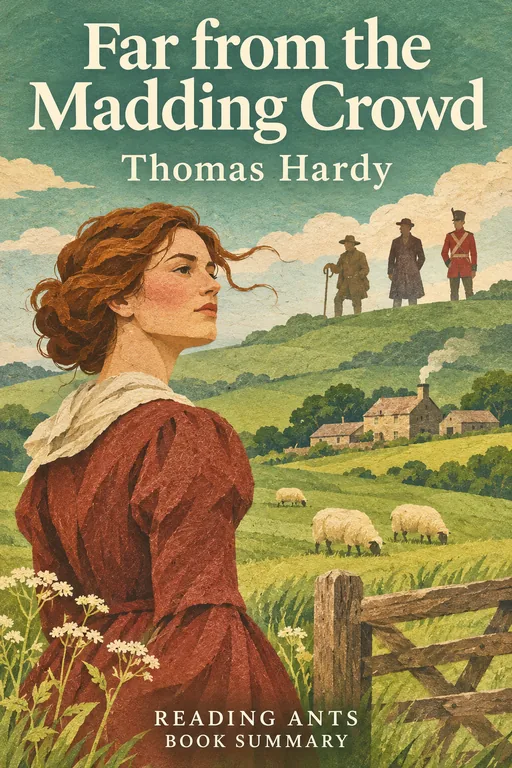
Far from the Madding Crowd
An independent young woman inherits a farm in rural Wessex and is courted by three very different men, a steady shepherd, a lonely landowner and a dashing soldier, with consequences that bring both heartbreak and, in the end, a quiet happiness.
Overview
Far from the Madding Crowd is a novel by Thomas Hardy, published in 1874, and it was his first major success. Set in the fictional county of Wessex in southwest England, it tells the story of Bathsheba Everdene, a spirited and proud woman who runs her own farm at a time when this was unusual for women. The book mixes love story, rural comedy and tragedy, with vivid descriptions of fields, sheep and weather. It shows Hardy’s interest in fate, chance and the way that impulsive actions can have lasting results.
Main Characters
- Bathsheba Everdene: a beautiful, headstrong young woman who becomes a farm owner.
- Gabriel Oak: a patient, honest shepherd, who loves her faithfully.
- William Boldwood: a wealthy, reserved farmer, who becomes obsessed with her.
- Sergeant Francis Troy: a handsome, reckless soldier, who is charming but irresponsible.
- Fanny Robin: a poor servant girl, who was once Troy’s lover.
- Liddy Smallbury: Bathsheba’s maid and companion.
- Joseph Poorgrass and the farm workers: the humorous chorus of rural labor.
Full Summary
Gabriel Oak and a refusal
Gabriel Oak is a young sheep farmer who has just taken a lease on his own farm. He meets Bathsheba Everdene, a lively young woman who lives with her aunt, and he falls in love with her. He proposes marriage, but she says that she is too independent and does not love him enough. Soon after, a young sheepdog that he is training drives his entire flock over a cliff, and Gabriel is ruined. He goes to look for work, and, by chance, finds himself helping to save a burning farm, which turns out to belong to Bathsheba, who has inherited it.
A valentine’s joke
Bathsheba hires Gabriel as a shepherd, and settles into running the farm. For a lark, she sends an anonymous valentine to William Boldwood, a solitary and dignified neighbor, who has never shown an interest in women. The joke has serious results: Boldwood becomes fascinated and, in time, obsessed with her. He asks her to marry him, and she does not say yes, but feels guilty, and she hints that she may consider it. Gabriel, who has learned to put aside his feelings, tells her that she is acting thoughtlessly, and she dismisses him in anger.
The soldier
Bathsheba meets Sergeant Troy, a dashing cavalry soldier, who flatters her with his sword display, and she is swept off her feet. She does not know that he had been engaged to a poor servant, Fanny Robin, who ran away to find him and who, on the day of their wedding, went by mistake to the wrong church, so that Troy abandoned her in anger. Bathsheba secretly marries Troy, ignoring warnings. Boldwood is furious and heartbroken. Gabriel, though hurt, stays on and keeps the farm safe, even saving it from ruin in a storm.
Fanny’s death
Troy turns out to be a poor husband, who gambles and drinks, and neglects the farm. Fanny Robin, who has had Troy’s child, struggles on foot toward the Casterbridge workhouse, and dies there, together with her baby. When her coffin is brought to Bathsheba’s house, the truth is revealed, and Troy is shaken. He places flowers on her grave, and then he disappears, and it is believed that he has drowned while swimming in the sea. Bathsheba is left a widow, and, in her grief, she is more humble.
Boldwood’s obsession
Boldwood, who believes that Troy is dead, renews his pressure on Bathsheba, and she, guilty and fearful, eventually gives a hesitant promise that she will marry him when the time has passed. At a Christmas party at his house, Troy reappears, alive, and claims his wife. Boldwood, driven out of his mind by jealousy and humiliation, shoots Troy dead, and gives himself up. He is condemned, but his sentence is later reduced to imprisonment, since he is thought to have been unbalanced. Bathsheba is stunned, and she retreats from the world, ashamed of her part in the tragedy.
Gabriel and Bathsheba
In the aftermath, Gabriel, who has stood by her through all, gives notice that he will stop managing her farm and is thinking of leaving England, so he avoids her. Bathsheba, hurt and realizing how much she needs him, goes to his cottage to talk. Their friendship, built on years of honest work and trust, turns into love. They marry quietly, with little fuss, and without the show of earlier courtships. The novel closes with the picture of a marriage based on mutual respect, and with a sense that real happiness can be found in steady companionship, not in passion alone.
Why It Matters
Far from the Madding Crowd established Hardy as a leading novelist, and it introduced the world of Wessex, which he would explore in his later books. Its heroine, Bathsheba, was unusual for the time, as an independent woman who runs her own business, and who makes mistakes and learns from them. The novel is praised for its landscape writing, its humor in the scenes with the farm workers, and its balance of romance and tragedy. It has been adapted for film and television several times, and it remains a favorite for readers who like classic rural fiction.
Key Takeaways
- Impulsive acts have consequences. A valentine’s joke changes several lives.
- Steady love lasts. Gabriel’s loyalty is rewarded in the end.
- Passion can blind. Bathsheba is dazzled by Troy and Boldwood by her.
- Independence has costs and rewards. Bathsheba learns humility, not weakness.
- Fate and chance matter. Small accidents, like a wrong church, alter lives.
What We Can Learn
You can learn from Bathsheba that independence and pride are valuable, but that carelessness with other people’s feelings can cause real harm. The story shows that glamour and excitement are poor guides to a good partner, and that reliability and honest friendship are worth more. It also warns about obsession, as in Boldwood’s case, and about the danger of letting jealousy take over. If you read it, notice how Hardy uses the countryside and the seasons to reflect people’s moods, and how the workers’ humor offers relief.
Criticism and Counterpoints
Some readers find the plot melodramatic, with its coincidences, such as the wrong church, and the sudden reappearance of Troy. Others feel that Gabriel Oak is too perfect and patient, and that Bathsheba’s change of heart at the end is hastily handled. Some modern critics question whether the book treats its heroine as truly independent, since she seems to be punished for her pride and to end by settling down. A few readers also find the rustic dialect and long descriptions slow. But many admire its vivid sense of place and its characters.
Who Should Read It
This book is for readers from about fourteen who enjoy classic novels, romance and rural settings. It is more accessible than some of Hardy’s darker works, such as Jude the Obscure. Readers who like it may go on to Tess of the d’Urbervilles.
Want the whole book?
A summary is a taste, not the meal. Here is where to find the full book.
You reached the end 🎉
Nicely done. Mark this one as read, and we will suggest what to read next.
Read this next
Tess of the d'Urbervilles
Thomas Hardy
A poor country girl named Tess Durbeyfield is wronged by one man and abandoned by another, and her struggle to live honestly against harsh social rules ends in tragedy.
📜 Classics
Jane Eyre
Charlotte Bronte
A poor, plain but fiercely independent orphan becomes a governess, falls in love with her brooding employer, discovers his terrible secret, and refuses to give up her self-respect even for love.
📜 Classics
Wuthering Heights
Emily Bronte
On the wild Yorkshire moors, an orphan named Heathcliff falls into a fierce, all-consuming love with Catherine Earnshaw, and when she marries another man, his bitterness drives a revenge that poisons two families for a generation.
📜 Classics
Middlemarch
George Eliot
In a provincial English town around 1830, several ambitious people, above all the idealistic Dorothea Brooke and the gifted doctor Tertius Lydgate, make marriages and choices that fall short of their dreams.
📜 Classics
Silas Marner
George Eliot
A lonely weaver, wronged by his friends and turned into a miser, finds his life transformed when a golden-haired toddler wanders into his cottage on a snowy night, after his gold has been stolen.
📜 Classics
Pride and Prejudice
Jane Austen
Quick-witted Elizabeth Bennet and the proud, wealthy Mr. Darcy badly misjudge each other, and only by facing their own faults do they find their way to love.
📜 ClassicsWant something different?
Pick another topic and we will show you three books to start with.