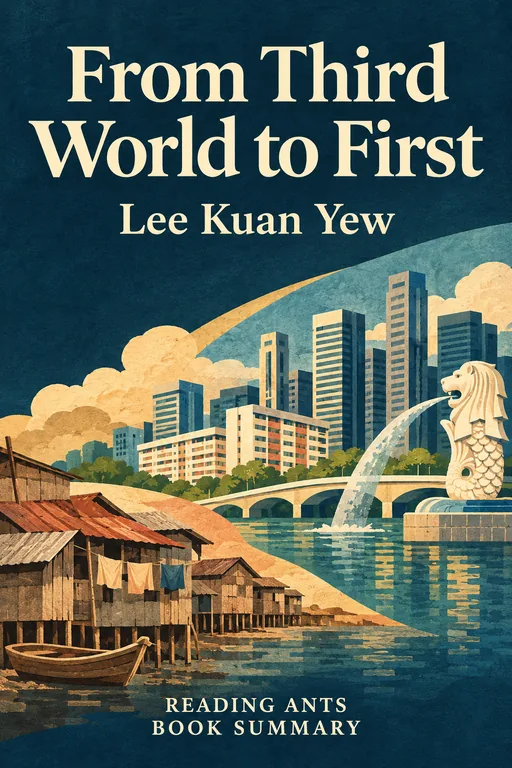
From Third World to First
Lee Kuan Yew, Singapore's first prime minister, explains how a tiny, poor island with no resources was turned within about thirty years into a clean, wealthy and orderly city-state, and what choices he thinks made the difference.
Overview
From Third World to First: The Singapore Story, 1965-2000 was published in 2000 by Lee Kuan Yew, who led Singapore as prime minister from 1959 to 1990. It is the second volume of his memoirs, and it picks up the story at the moment Singapore became independent in 1965, after being expelled from a union with Malaysia. The island had few natural resources and faced a hostile region. Lee describes the decisions about the economy, education, housing, defense and government that he and his team made. He writes in a direct, practical tone, and does not claim modesty.
Full Summary
A Sudden Independence
In August 1965, Singapore left the Malaysian federation, after racial strife and political disagreements, including over the place of the Chinese majority in Singapore and the Malay majority in Malaysia. Lee was visibly moved at the televised press conference where he announced the separation, because he had worked hard to keep the union together. Singapore was left with a small population, no hinterland, a water supply that depended heavily on Malaysia, a minimal army and a mix of Chinese, Malay and Indian peoples, some of whom had recently fought each other in riots.
Defense, Unity and Water
Lee’s first tasks were to ensure survival. He built a defense force based on national service, and sought help in training from Israel, among others. The British military withdrawal made the need urgent. He worked to create a shared national identity in a society of different groups, with policies such as making English the language of administration and school, while teaching children their mother tongues. The question of water, much of it bought from Malaysia, was a constant worry, and he describes the long efforts to secure more supplies and to find new sources of water.
Attracting Business
Since Singapore had no natural resources, Lee decided that its people and location would be its assets. His government welcomed foreign companies, offering stable government, good infrastructure, clear rules and a disciplined workforce. He relied on the advice of a Dutch economist, Albert Winsemius, traveled to meet business leaders, and sought out American and European firms. Over the years, factories and offices were set up, and the economy grew very rapidly. The government also built an airport, a port and a telecom network that were efficient and reliable. Lee credits colleagues such as Goh Keng Swee, who guided economic planning, and S. Rajaratnam, who led foreign policy, with much of the success.
Honest Government and Strict Rules
Lee argues that a clean government is essential to development. His government paid officials well and punished corruption severely. It also made strict laws against crime and vandalism, and used harsh penalties, which he defends as necessary for order. He describes the use of detention without trial against some political opponents and the control of the press. The book is open about these measures, claiming they were needed to keep the country stable, though critics disagree.
Housing, Greenery and Education
The government moved many residents from crowded slums into new public housing, and later helped families to buy their apartments, which gave them a stake in the nation’s success. Lee also emphasized planting trees and cleaning the city, so that it would look orderly and attract visitors. He put great emphasis on education, and on selecting and training able people for the civil service. He wanted Singaporeans to value hard work, savings and thrift, and expanded a compulsory savings scheme, the Central Provident Fund, which had begun in the 1950s, using it especially to help families buy homes.
Looking Outward and Passing the Torch
A large part of the book is about foreign relations. Lee reflects on relationships with neighbors, such as Malaysia and Indonesia, and with larger powers, including the United States and China, and he draws portraits of the leaders he met. He argues that a small country must be useful to others and keep friends. He also describes the renewal of the cabinet and the transition of leadership to a younger generation, and his thoughts on the lessons he has learned.
Why It Matters
Singapore’s rise is one of the most striking economic stories of the twentieth century, and Lee’s memoir is the main first-hand account of how it was done. The book has been read by many leaders, officials and scholars, who were interested in his model of a one-party-dominated state with a market economy and an effective civil service. It has also been used in discussions about the relationship between democracy and development. Whether one admires or criticizes the model, the book offers a rare look at the thinking of a leader who ran a country for a generation, and who focused on practical results.
Key Takeaways
- Small states must be clever. Singapore used its location and its people as assets.
- Clean government attracts investment. Low corruption helped economic growth.
- Education and housing build stability. Investing in citizens created loyalty.
- Unity requires effort. Policies were used to build one nation from many groups.
- Trade-offs exist. Order and prosperity came with limits on political freedom.
What We Can Learn
The book invites us to think about the choices that a society makes, and what it gives up in return. You can learn from its emphasis on practical goals, discipline and the long view, as well as from the way a small country made friends and attracted partners. At the same time, ask hard questions about freedom of speech, the rule of law and fairness. Compare Lee’s approach with those of other leaders, and notice that no model fits every country. Reading memoirs by leaders also reminds us to ask what they leave out.
Criticism and Counterpoints
Critics say that the book presents a flattering view of its author, and that it minimizes the costs of his methods, including limits on the press, the jailing of opponents without trial, and the use of the courts against critics. Others say that Singapore’s success owed much to unique conditions, such as its position as a trading port and the help of foreign investment, and that it cannot be copied by large and diverse countries. Some economists argue that other countries have grown without such restrictions. Supporters reply that the results speak for themselves.
Who Should Read It
This book is for readers interested in politics, economics and how countries develop. It is long and sometimes dry, and its focus is on government and policy. Those who want a critical account of Singapore should read other sources alongside it.
Want the whole book?
A summary is a taste, not the meal. Here is where to find the full book.
You reached the end 🎉
Nicely done. Mark this one as read, and we will suggest what to read next.
Read this next
Long Walk to Freedom
Nelson Mandela
Nelson Mandela tells his own story, from a village childhood to twenty-seven years in prison to becoming South Africa's first democratically elected president, and shows how patience, courage and forgiveness helped end apartheid.
👤 Real Lives
Why Nations Fail
Daron Acemoglu and James A. Robinson
Nations become rich or stay poor mainly because of their institutions: countries that share power and reward ordinary people's effort prosper, while those run by narrow elites for their own benefit stay poor.
💰 Money & Economics
Development as Freedom
Amartya Sen
Amartya Sen argues that development should be judged not by national income alone, but by the real freedoms people have to live lives they value, such as being healthy, educated and able to take part in public life.
💰 Money & Economics
The End of History and the Last Man
Francis Fukuyama
Francis Fukuyama argues that the end of the Cold War suggests that liberal democracy may be the final stage of political development, and asks whether people who live in such a system will be satisfied or will long for new struggles.
🏛️ History
Banker to the Poor
Muhammad Yunus
Muhammad Yunus tells how he began lending tiny sums to poor villagers in Bangladesh, built the Grameen Bank on the idea that the poor are creditworthy, and argues that credit is a basic human right.
💰 Money & Economics
Man's Search for Meaning
Viktor E. Frankl
A psychiatrist who survived the Nazi concentration camps explains that even in the worst suffering, people can choose their attitude, and that finding a reason to live is what gives us the strength to endure.
👤 Real LivesWant something different?
Pick another topic and we will show you three books to start with.