 Reading Ants
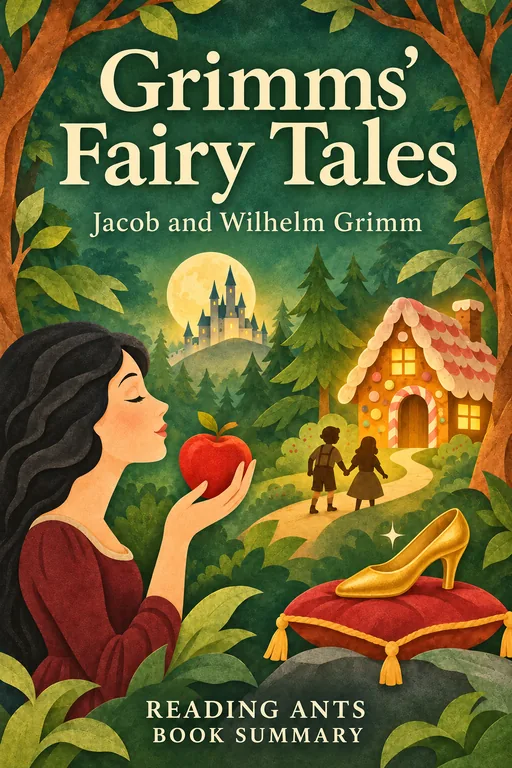
Grimms' Fairy Tales
Original title: Grimms Märchen
Two German brothers collected the folk tales told by ordinary people, from Cinderella and Snow White to Hansel and Gretel, preserving stories of clever children, wicked witches and magical rewards that are now loved all over the world.
Overview
Children’s and Household Tales, known in English as Grimms’ Fairy Tales, was first published in 1812 by the brothers Jacob and Wilhelm Grimm, two German scholars who studied language and folklore. They wanted to preserve the stories that ordinary people had passed down by word of mouth for generations, and they gathered tales from friends, family members and village storytellers. Over several editions, the collection grew to about two hundred stories. Many were darker and stranger than the versions most children know today. Wilhelm, in particular, revised the tales to make them more suitable for children. The collection includes many of the most famous stories in the world.
Main Characters
- Hansel and Gretel: a brother and sister lost in the forest.
- Little Red Cap (Little Red Riding Hood): a girl who meets a wolf on the way to her grandmother’s house.
- Snow White: a kind princess hated by her jealous stepmother.
- Cinderella (Aschenputtel): a mistreated girl helped by magic birds.
- Rapunzel: a girl with long golden hair locked in a tower.
- Rumpelstiltskin: a strange little man who spins straw into gold.
- The Frog King: a prince under a spell.
- Witches, wolves, wicked stepmothers and talking animals: who appear in many tales.
Full Summary
Hansel and Gretel
A poor woodcutter’s family is starving, and the children’s stepmother persuades him to leave Hansel and Gretel in the forest. The first time, Hansel drops white pebbles that shine in the moonlight, and they find their way home. The second time, he drops breadcrumbs, which the birds eat. Lost, the children find a house made of bread, cake and sugar. It belongs to a witch who captures children to eat them. She locks Hansel in a cage to fatten him and makes Gretel do the housework. When the witch asks Gretel to climb into the oven to check if it’s hot, clever Gretel pretends not to understand, and when the witch shows her, Gretel pushes her in. The children escape with the witch’s treasure and return home, where the stepmother has died and their father welcomes them joyfully.
Little Red Cap
A little girl in a red cap walks through the woods to bring cake and wine to her sick grandmother. Her mother warns her not to leave the path, but a wolf persuades her to stop and pick flowers. Meanwhile, the wolf hurries to the grandmother’s house, swallows her, puts on her clothes and gets into bed. When Little Red Cap arrives, she notices how big the “grandmother’s” ears, eyes, hands and mouth are, and the wolf swallows her too. A passing huntsman hears the wolf snoring, cuts open its belly and frees the girl and her grandmother. Little Red Cap promises never to leave the path again.
Snow White
A queen wishes for a daughter as white as snow, as red as blood and as black as ebony, and has Snow White, but dies soon after. The king’s new wife owns a magic mirror that tells her who is fairest in the land. When it says Snow White is fairer, the jealous queen orders a huntsman to kill the girl, but he lets her escape. Snow White finds a cottage belonging to seven dwarfs, who let her stay if she keeps house for them.
The queen tries three times to kill her, with tight laces, a poisoned comb and finally a poisoned apple. The dwarfs, believing her dead, place her in a glass coffin. A prince sees her and asks to take the coffin, and when his servants stumble, the piece of apple falls from her throat, and Snow White wakes up. At their wedding, the wicked queen is punished.
Cinderella
After her mother dies, a girl is forced by her stepmother and two stepsisters to do the dirtiest work and sleep in the ashes, so they call her Aschenputtel, or Cinderella. She plants a hazel twig on her mother’s grave, waters it with her tears, and it grows into a tree where a little white bird grants her wishes. When the king holds a festival so that his son can choose a bride, the bird gives her beautiful gowns and golden slippers. The prince dances only with her, but each night she runs away. On the third night, she loses a golden slipper. The prince searches for the girl whose foot fits it. The stepsisters try to trick him, but birds reveal the truth, and the prince marries Cinderella.
Rapunzel and Rumpelstiltskin
In Rapunzel, a girl is taken by an enchantress and locked in a tower with no door. The enchantress climbs up using Rapunzel’s long golden hair. A prince discovers the secret and visits her, and when the enchantress finds out, she cuts off Rapunzel’s hair and banishes her, and the prince is blinded by thorns. After years of wandering, he hears Rapunzel singing, and her tears heal his eyes.
In Rumpelstiltskin, a miller boasts that his daughter can spin straw into gold, and the king locks her in a room full of straw. A strange little man spins it for her in exchange for her necklace, then her ring, and finally her promise to give him her first child. When she becomes queen and has a baby, he agrees to let her keep it if she can guess his name. Her messenger overhears him singing his name in the woods, and when she says “Rumpelstiltskin,” he flies into a rage and, in the familiar later Grimm text, tears himself apart (adapted versions are gentler, and he simply vanishes).
Other Favorites
The collection includes many other famous tales. In The Frog King, a princess promises friendship to a frog who rescues her golden ball, and the frog turns out to be an enchanted prince. In The Bremen Town Musicians, four old animals, a donkey, a dog, a cat and a rooster, set out to become musicians and scare away a band of robbers. In Little Briar Rose, better known as Sleeping Beauty, a princess pricks her finger and sleeps for a hundred years until a prince arrives. Across the stories, clever and kind characters are rewarded, and cruel or greedy ones are punished.
Why It Matters
Grimms’ Fairy Tales is one of the most influential books ever published, translated into well over a hundred languages. It is one of the best-known books in German literature and one of the most widely read collections of stories in the world. The Grimms’ work helped create the academic study of folklore, and their methods inspired collectors of folk tales all over the world.
The stories have shaped childhood for generations and inspired countless retellings, including Disney’s Snow White and the Seven Dwarfs and Tangled, which is based on Rapunzel. Disney’s Cinderella and Sleeping Beauty follow related tales, mainly the French versions by Charles Perrault. Psychologists, writers and scholars have studied them for what they reveal about human fears, hopes and the challenges of growing up.
Key Takeaways
- Cleverness and courage win. Gretel outwits the witch, and humble heroes overcome powerful enemies.
- Kindness is rewarded. Characters who help others often receive magical help in return.
- Wickedness is punished. Greedy, cruel and jealous characters come to bad ends.
- Growing up means facing danger. Children leave home, face fears and return stronger.
- Stories carry wisdom. Folk tales pass down lessons from generation to generation.
What We Can Learn
These tales teach children, and adults, that it’s possible to face scary situations with courage and cleverness. Gretel and Hansel are small and frightened, but they keep thinking and find a way out.
They also show the importance of listening to wise advice, as Little Red Cap learns when she leaves the path. At the same time, they reward kindness: helping a stranger, an animal or a friend can bring unexpected blessings.
Finally, reading fairy tales together can be a wonderful way for families to talk about feelings. Asking children how a character felt, or what they would have done, builds imagination and empathy.
Criticism and Counterpoints
Many of the original Grimm stories are violent and frightening. In some versions, Cinderella’s stepsisters cut off parts of their feet to fit the slipper and have their eyes pecked out by birds, and Snow White’s stepmother is forced to dance in red-hot iron shoes. Parents may prefer gentler retellings for young children, though some experts argue that fairy tales help children work through fears in a safe way.
Critics also point out that the tales often show women as passive victims or wicked stepmothers, valued mainly for beauty, and that some contain negative stereotypes, including anti-Jewish portrayals in a few stories. Scholars have also noted that the Grimms edited the tales significantly, so they are not pure, untouched folk stories.
Who Should Read It
These stories suit readers of every age. Young children enjoy simplified or illustrated versions read aloud, while older readers and adults may appreciate the original tales and their history. Parents can choose versions suited to their children’s sensitivity.
Want the whole book?
A summary is a taste, not the meal. Here is where to find the full book.
You reached the end 🎉
Nicely done. Mark this one as read, and we will suggest what to read next.
Read this next
Andersen's Fairy Tales
Hans Christian Andersen
A Danish storyteller wrote magical, funny and often heartbreaking tales, such as *The Little Mermaid*, *The Ugly Duckling* and *The Emperor's New Clothes*, that speak to children and adults about love, courage and being true to yourself.
🧸 Children's Books
Aesop's Fables
Aesop
A collection of very short stories, mostly about talking animals, each teaching a simple lesson about life, such as slow and steady wins the race, and don't cry wolf.
🧸 Children's Books
The Thousand and One Nights
Anonymous
A storyteller postpones her execution night after night with unfinished tales whose wonders, dangers and nested voices gradually challenge a king's murderous view of human nature.
🌍 World Literature
Alice's Adventures in Wonderland
Lewis Carroll
A curious girl follows a white rabbit down a hole into a crazy world where she keeps changing size, meets mad and marvelous creatures, and stands up to a furious Queen.
🧸 Children's Books
Peter Pan
J. M. Barrie
A magical boy who refuses to grow up flies three London children to Neverland, where they battle pirates led by the villainous Captain Hook, until Wendy realizes they must go home and grow up.
🧸 Children's Books
Charlotte's Web
E. B. White
A lonely pig named Wilbur learns he is going to be killed, and his clever friend Charlotte, a spider, comes up with an amazing plan to save his life.
🧸 Children's BooksWant something different?
Pick another topic and we will show you three books to start with.