 Reading Ants
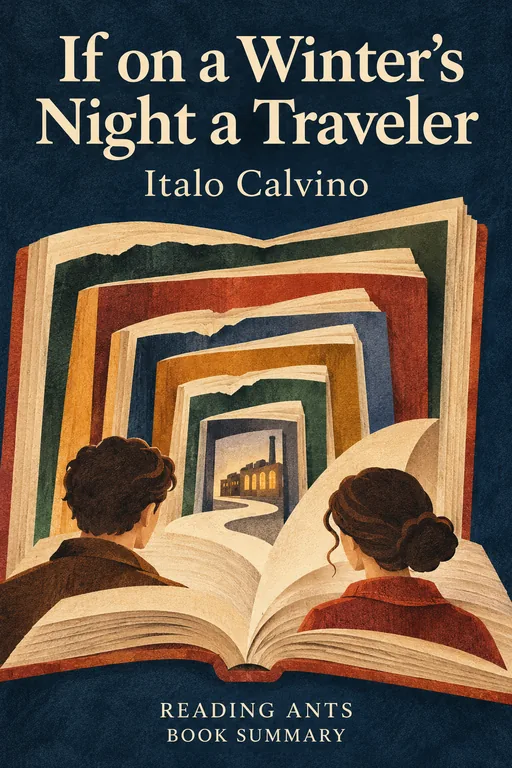
If on a Winter's Night a Traveler
Original title: Se una notte d'inverno un viaggiatore
A reader tries again and again to finish a novel, but each book breaks off after a few pages, leading him into a playful chase through the world of reading, writing and publishing.
Overview
If on a Winter’s Night a Traveler is a novel by the Italian writer Italo Calvino, published in 1979. It is unusual because it is addressed to “you,” the Reader, and it alternates between chapters about the Reader’s adventures and the first chapters of ten different novels. The book is a game about how stories work, and about what we do when we read. It is not a conventional plot, but the story that links the chapters is a funny and warm love story between two readers.
Main Characters
- You, the Reader: a man who buys the new Calvino novel and cannot get beyond the first chapter.
- Ludmilla, the Other Reader: a woman who loves to read, and who becomes the Reader’s love.
- Lotaria: Ludmilla’s sister, who reads books by computer, and who prefers analysis to pleasure.
- Ermes Marana: a mysterious translator and forger, who is sabotaging books.
- Silas Flannery: a famous novelist who is stuck in his work.
- Professor Uzzi-Tuzii: a scholar of a little-known language, who is eager to help.
Full Summary
You Begin to Read
The book begins by talking to you, the reader, about how to settle down to read If on a Winter’s Night a Traveler. You buy it in a bookshop, find a comfortable place and begin. The first chapter, about a man on a railway station, is exciting. But after a few pages, you find that the printing is faulty, and the same pages are repeated.
You go back to the bookshop to exchange it. The bookseller says that there was a mistake in the binding, and that the book you thought you were reading was actually a different book, by a Polish author.
Ludmilla
At the bookshop, you meet Ludmilla, who has also come to exchange her copy. She is a passionate reader, and you are attracted to her. You get a new copy of the second book, and you start reading it, but this also breaks off at an exciting point.
You and Ludmilla begin a search to find the rest of each novel. Each time you find a new book, the first chapter is gripping, but then something goes wrong, and the story is cut off.
Along the way, you visit a university where a professor of a little-known language tells you about a book that he cannot read to the end, and you meet other people who have their own plans. Every person you meet has a theory about what a book is, and about why we read it. Ludmilla, who loves to read for pleasure, says that she wants a story that carries her away, and she does not like readers who study too much.
The Ten Beginnings
Between the chapters of the frame story, you read the openings of ten different novels, in many styles: a story that begins in a railway station, a tale of intrigue, a story of obsession, a tale set in far-off lands and others. Each is written in a different voice, and each seems to begin a story that you want to follow.
Calvino uses these openings to show the different kinds of novels that readers love, and to play with the way that each one raises expectations.
The Conspiracy
Your search leads you to the world of publishing, translators, professors, and a conspiracy of forgers. Ermes Marana, a translator, has been creating false versions of books, and there are disputes over where a certain novel really comes from: is it written in Cimmerian, the language of an invented country, or in the language of its neighbor, Cimbria? Censorship and political manipulation of reading are part of the picture. A famous novelist, Silas Flannery, keeps a diary in which he reflects on writing. You follow the trail from a university to a publisher’s office and on to other places, and meet readers who each have a different attitude to books.
Some readers read for pleasure, some for study, and some in order to find meaning. Ludmilla likes to read in comfort, and not to think about the writers.
The Ending
In the end, none of the ten novels is completed. In a library, the Reader meets other readers who each describe a different way of reading, and the ten titles, put together, form a sentence of their own. In the last scene, you and Ludmilla are in bed, and you are married. She asks if you will turn off the light, and you answer that you are nearly finished with the book in your hands: Italo Calvino’s If on a Winter’s Night a Traveler, the very novel that we have been reading all along.
Why It Matters
Calvino is one of the most important Italian writers of the twentieth century, and this novel is among the best examples of postmodern fiction. It shows how a novel can play with its own form while still being moving and funny. It has influenced many later writers who experiment with structure and the reader’s role. It also celebrates the pleasure of reading, which is a rare theme in fiction. It is often assigned in university courses on literature and is loved by many readers who enjoy stories about stories. Calvino was also a collector of folk tales and a writer of fables, and this book shows how his love of tradition and his love of games can work together. It has been translated into dozens of languages, and its opening lines, which tell the reader to relax and forget everything else, are among the most famous in modern fiction.
Key Takeaways
- Reading is an act of creation. The reader helps to make the story.
- Beginnings are exciting. The pleasure of a first chapter is its own reward.
- Stories need endings. The search for completion drives the plot.
- Readers differ. There are many ways to enjoy a book.
- Play is serious. Games with form can reveal deep truths.
What We Can Learn
The book teaches us to be active readers. Instead of taking a story for granted, we can ask how it works and what it asks from us. It also reminds us of how much pleasure there is in simply reading, whether we are in a quiet room or on a train.
Another lesson is humility: no single reader sees everything in a book, and it is good to share our readings with others. Finally, the story shows that love can begin with a shared interest, and that friends who read together often find a deeper bond.
Criticism and Counterpoints
Some readers find the book too clever, and the constant interruptions frustrating. Others feel that the story is unsatisfying, since none of the ten novels are completed. The characters, especially Ludmilla, are sometimes seen as thin and idealized. The book’s experiments can feel intellectual and cold to readers who prefer traditional stories. Still, many find it very funny and inventive. It has also been said that the book is more of a puzzle than a story, and that readers who do not enjoy that kind of game may put it down. Others argue that the book’s central idea, that every reader is part of the work, is clearer in a short essay than in a whole novel.
Who Should Read It
This book is for readers who love books about books, and who enjoy puzzles. It is short and playful, though it may be confusing at first. Readers who want a traditional plot might find it frustrating, but those with a sense of humor and curiosity will enjoy it.
Want the whole book?
A summary is a taste, not the meal. Here is where to find the full book.
You reached the end 🎉
Nicely done. Mark this one as read, and we will suggest what to read next.
Read this next
Ficciones
Jorge Luis Borges
A collection of short, brilliant stories by Jorge Luis Borges that turn libraries, labyrinths, mirrors and dreams into puzzles about reality, time and infinity.
🌍 World Literature
The Neverending Story
Michael Ende
A lonely, bullied boy reads a magical book and discovers that he is part of the story, with the power to save a dying fantasy world, if he can avoid losing himself.
🌍 World Literature
Cloud Atlas
David Mitchell
Six nested stories, set from the nineteenth century to a far future, each discovered by the next narrator, show how the strong prey on the weak and how small acts of courage can echo through time.
✨ Modern Fiction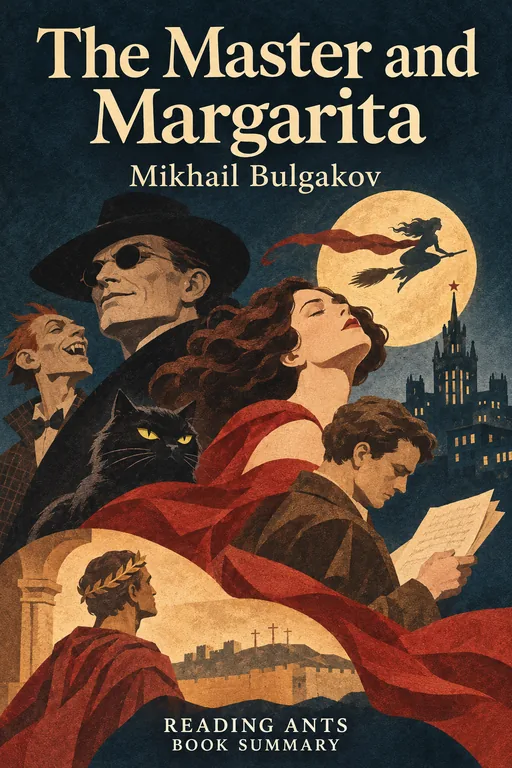
The Master and Margarita
Mikhail Bulgakov
The Devil arrives in 1930s Moscow with a cat, a fanged assistant and a naked witch, and turns the city upside down, while a persecuted writer and his devoted lover try to save a novel about Pontius Pilate from oblivion.
🌍 World Literature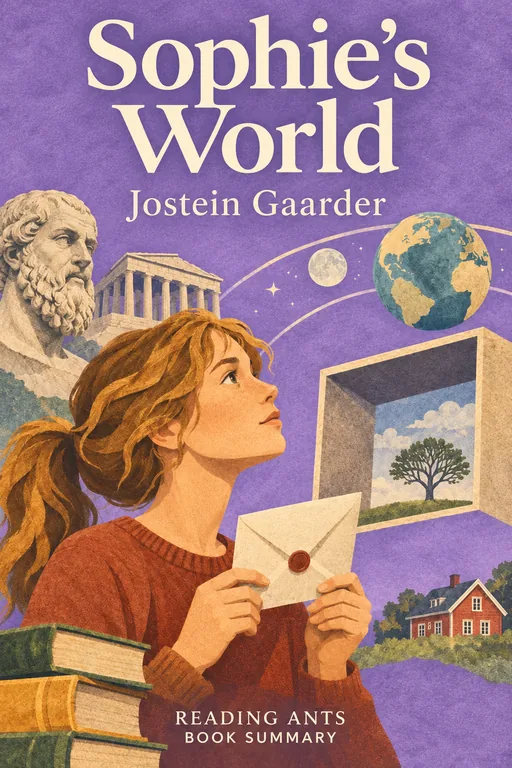
Sophie's World
Jostein Gaarder
A fourteen-year-old girl receives mysterious letters from a philosopher, and learns the history of Western thought while she begins to suspect that her own world is not what it seems.
🌍 World Literature
The Little Prince
Antoine de Saint-Exupery
A pilot stranded in the desert meets a small boy from a tiny planet, who teaches him that the most important things in life, like love and friendship, can only be seen with the heart.
🌍 World LiteratureWant something different?
Pick another topic and we will show you three books to start with.