 Reading Ants
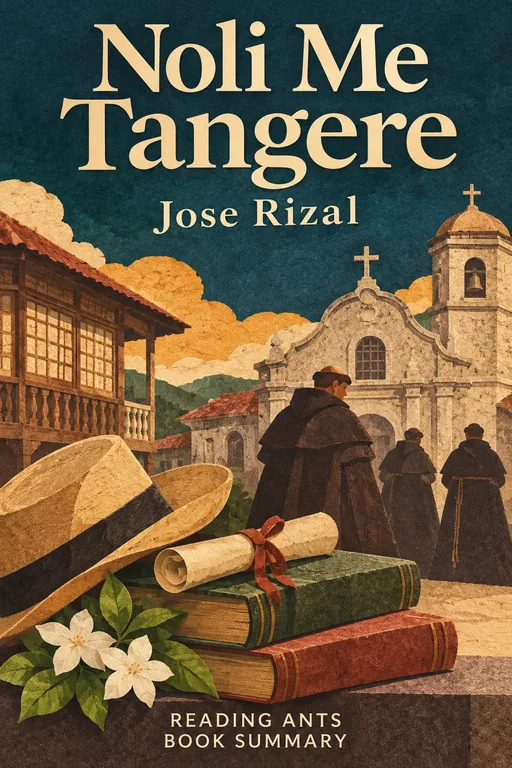
Noli Me Tangere
Original title: Noli me tángere
A young Filipino returns home from Europe full of hope for reform, and finds that the Spanish friars and officials who rule the islands will destroy anyone who threatens their power.
Overview
Noli Me Tangere (Latin for “Touch Me Not”) is a novel by the Filipino writer and national hero Jose Rizal, written in Spanish and published in Berlin in 1887. It is set in the Philippines in the 1880s, when the islands were a colony of Spain and the Catholic religious orders held great power. The story follows Juan Crisostomo Ibarra, who has been studying in Europe for seven years and who comes back to his town to find that his father has died in disgrace. The novel is a love story, a mystery and a sharp satire, and it helped to awaken Filipino national feeling.
Main Characters
- Crisostomo Ibarra: a wealthy, educated young man, who wishes to bring modern ideas and schools to his town.
- Maria Clara: his sweetheart, beautiful and devout, raised as the daughter of Captain Tiago, though her real father, as the novel reveals, is Padre Damaso.
- Padre Damaso: a proud, bullying friar who has long ruled the town.
- Padre Salvi: a quiet, scheming friar who has his own hidden desires.
- Elias: a mysterious boatman and fugitive, who becomes Ibarra’s friend and protector.
- Sisa: a poor, gentle mother who loses her mind after her sons are taken from her.
- Captain Tiago: a wealthy, cowardly man who wants to stay friends with the powerful.
- Dona Victorina and Dr. de Espadana: a social-climbing couple, who are objects of comedy.
Full Summary
The Homecoming
Captain Tiago holds a grand dinner in Manila to welcome Ibarra, who has been abroad for seven years. At the table, Padre Damaso insults the young man, and Ibarra, who is calm and polite, does not respond. Ibarra learns that his father, Don Rafael, a rich and independent man, has died in prison. He had been accused of a crime after he stood up for a boy who was being beaten by a tax collector.
Ibarra is reunited with Maria Clara, the girl he loved before he left. They renew their promise of marriage, and he travels to his home town of San Diego, to visit his father’s grave.
The Missing Grave
At the cemetery, Ibarra discovers that his father’s body is not where it should be. The gravedigger tells him that, on the orders of Padre Damaso, the corpse was dug up because the dead man was thought to be a heretic, and that it was thrown into a lake. Ibarra is shocked and angry, but he decides to carry on with his plans.
Meanwhile, the town is shown in all its life: the school, the church, the fiestas and the gossip. We meet Sisa, whose two young sons, Basilio and Crispin, serve as altar boys. Crispin is accused of stealing money and is beaten, and the boys’ tragedy leads to Sisa’s madness.
The School
Ibarra decides to build a modern school for the town, with the support of a wise old teacher. He holds a ceremony for the laying of the first stone. At the ceremony, an attempt is made on his life, but it fails thanks to Elias, a boatman who had already helped him once before, during a picnic on the lake.
Ibarra and Elias become friends. Elias, who is a fugitive and who has suffered at the hands of the authorities, tells Ibarra that the people need radical change, while Ibarra believes in gradual, peaceful reform.
The Fiesta and the Excommunication
At the lunch that follows the stone-laying ceremony, Padre Damaso insults the memory of Ibarra’s father in public, and Ibarra, who loses his patience, attacks the priest with a knife, but spares him when Maria Clara begs for mercy. For this, he is excommunicated, which means that he is cut off from the Church. Maria Clara, who is under pressure from her family and the clergy, and who is manipulated through letters connected to her mother and to Ibarra, is made to break the engagement.
Ibarra is then arrested after a revolt that was in fact arranged by his enemies, who have used his name to bring him down.
The Escape
Elias frees Ibarra from jail, and they flee together by boat on the lake. Pursued by guards, Elias leaps into the water, in order to draw the attention away from Ibarra, and he is shot. Ibarra escapes, while Elias, badly wounded, reaches the forest, where he dies. Elias, who has not seen the dawn of freedom, asks that those who see it will remember those who died in the night.
Maria Clara, who had been led to believe that Ibarra was dead, enters a convent. Padre Salvi, who wanted her for himself, remains a threat.
Sisa
Near the end of the book comes a sad scene, in which Sisa, who has gone mad, is found at last by her son Basilio, who has been searching for her. She does not recognize him at first, and then she dies of shock in the forest. Soon afterward the wounded Elias reaches the same place and dies nearby. Basilio is left alone, and the future is dark. The novel gives little hope for the moment, but it points to the need for a new generation to act.
Why It Matters
Noli Me Tangere is the most famous novel in Philippine history, and Rizal is regarded as the national hero. The book was banned by the Spanish authorities, and Rizal, who wrote a sequel, El Filibusterismo, was executed by the Spanish in 1896. The Philippine Revolution had already begun by the time of his death, which added to its force. Today the novel is taught in all Philippine schools, and it has been translated into many languages. It remains one of the best examples of how a novel can shape the political destiny of a people. Rizal was also a doctor, a poet and a painter, and he wrote the book as a young man, while studying in Europe, so that Filipinos and Spaniards alike could see what was happening in the colony.
Key Takeaways
- Abuse of power destroys society. The corrupt friars and officials harm the whole town.
- Education is a path to progress. Ibarra’s school is a symbol of hope.
- Reform and revolution conflict. Ibarra and Elias represent two possible paths.
- The poor suffer most. Sisa’s story is a picture of how injustice crushes the weak.
- Love is vulnerable to politics. Ibarra and Maria Clara are separated by forces beyond them.
What We Can Learn
The novel shows how important it is to speak up against abuse, even when it is dangerous. It encourages us to support education, and to value honest leaders who put the people first.
It also teaches us that good intentions are not enough: Ibarra’s trust in the system leaves him unprepared for its cruelty. We need to understand power as well as hope. Finally, the book reminds us to remember those who suffer in silence, like Sisa, and to treat them with compassion.
Criticism and Counterpoints
Some readers find the book’s style, with its many comic and satirical scenes and its large cast, hard to follow. The plot has melodramatic elements, and the character of Maria Clara is often seen as too passive. Others note that the book’s portrayal of the friars is very harsh, and that it was written to persuade, and not only to describe. Religious leaders in the past, and some today, argue that it is unfair to the Church. Many also feel that the novel is more admirable for its courage than for its form.
Who Should Read It
This book is for readers who like historical novels and who are interested in the history of colonialism, or in the Philippines. It is long, and some of the humor needs explanation. Those who want a fast plot may find it slow, but it is a landmark of world literature.
Want the whole book?
A summary is a taste, not the meal. Here is where to find the full book.
You reached the end 🎉
Nicely done. Mark this one as read, and we will suggest what to read next.
Read this next
The Count of Monte Cristo
Alexandre Dumas
A young sailor, betrayed by jealous rivals and thrown into a dungeon for fourteen years, escapes with the help of a fellow prisoner, finds a vast treasure and returns as a mysterious, powerful count to take elaborate revenge on those who ruined him.
🌍 World Literature
Les Miserables
Victor Hugo
A former convict, transformed by a single act of mercy, spends his life doing good while being hunted by a relentless police inspector, in a sweeping story of love, injustice and redemption in nineteenth-century France.
🌍 World Literature
Uncle Tom's Cabin
Harriet Beecher Stowe
A devout, gentle enslaved man named Tom is sold from owner to owner and finally dies at the hands of a brutal master, while other enslaved people try to escape, in a novel that shocked America into facing the cruelty of slavery.
📜 Classics
This Earth of Mankind
Pramoedya Ananta Toer
A bright young Javanese student in the Dutch East Indies falls in love with the daughter of a remarkable woman, and learns, through the law and the loss of his wife, how colonial rule denies dignity to the people it governs.
🌍 World Literature
The Red and the Black
Stendhal
A clever carpenter's son in France tries to rise through love, religion and ambition, and in the end his pride and passion destroy him.
🌍 World Literature
The Little Prince
Antoine de Saint-Exupery
A pilot stranded in the desert meets a small boy from a tiny planet, who teaches him that the most important things in life, like love and friendship, can only be seen with the heart.
🌍 World LiteratureWant something different?
Pick another topic and we will show you three books to start with.