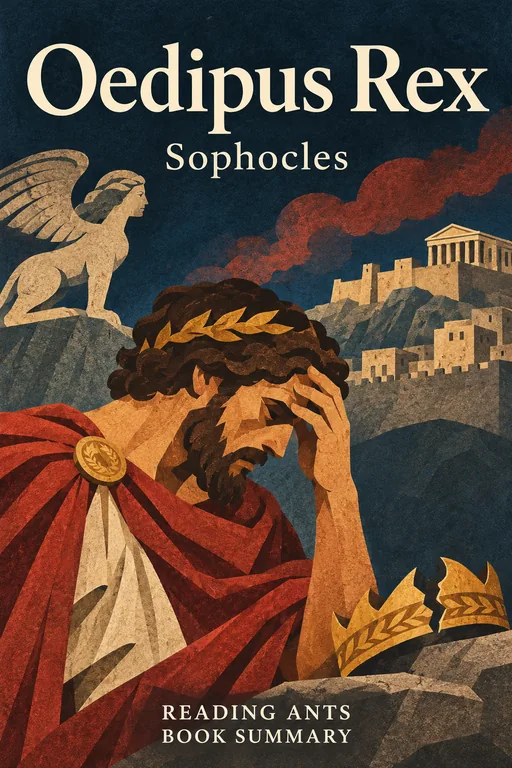
Oedipus Rex
Original title: Οιδίπους Τύραννος
A wise and respected king determined to save his city from a plague investigates an old murder, and discovers the horrifying truth that he himself fulfilled a prophecy by killing his father and marrying his mother.
Overview
Oedipus Rex, also called Oedipus the King or Oedipus Tyrannus, is a tragedy by the ancient Greek playwright Sophocles, first performed in Athens around 429 BCE. It is one of the most famous plays ever written. The story takes place in the city of Thebes, which is suffering from a deadly plague. King Oedipus, admired for having once saved the city by solving the riddle of the monstrous Sphinx, promises to find the cause. An oracle reveals that the plague will end only when the murderer of the former king, Laius, is found and punished. As Oedipus investigates, each new piece of information brings him closer to a terrible discovery. The play is a masterpiece of suspense, irony and tragedy, and Aristotle considered it the perfect example of tragedy.
Main Characters
- Oedipus: the intelligent, determined but proud king of Thebes.
- Jocasta: Oedipus’s wife, the queen and widow of the former king, Laius.
- Creon: Jocasta’s brother, a respected nobleman.
- Tiresias: a blind prophet who knows the truth.
- The messenger from Corinth: who brings news about Oedipus’s past.
- The shepherd: an old servant who holds the final secret.
- The Chorus: the elders of Thebes, who comment on the action.
Full Summary
A City in Crisis
The play opens with the people of Thebes begging King Oedipus for help. A plague is destroying crops, animals and children. Oedipus, who years earlier saved Thebes by answering the riddle of the Sphinx, has already sent his brother-in-law, Creon, to the oracle of Apollo at Delphi. Creon returns with the message: the plague is a punishment for the unsolved murder of King Laius, who ruled before Oedipus. The killer is living in Thebes and must be found and banished or killed.
Oedipus declares that he will find the murderer, and curses whoever is guilty, even if it is someone in his own household.
The Blind Prophet
Oedipus calls for Tiresias, the blind prophet. At first, Tiresias refuses to speak, saying the truth will only bring pain. Angered, Oedipus accuses him of being involved in the murder. Provoked, Tiresias tells him directly that Oedipus himself is the murderer he seeks, and hints that he is living in shame with those closest to him. Oedipus refuses to believe it and accuses Tiresias and Creon of plotting to overthrow him.
Jocasta’s Story
Queen Jocasta tries to calm Oedipus by telling him that prophecies can’t be trusted. Long ago, an oracle told Laius that he would be killed by his own son. To prevent this, they gave their baby to a servant to be left to die on a mountain with his ankles pinned together. Laius was later killed by robbers at a place where three roads meet, so the prophecy, she says, never came true.
Instead of comforting Oedipus, this terrifies him. He remembers that before arriving in Thebes, he killed an older man and his servants in a quarrel at a place where three roads meet. He sends for the only surviving witness of Laius’s death, a shepherd.
The Messenger from Corinth
Oedipus explains that he grew up in Corinth as the son of King Polybus and Queen Merope. As a young man, he heard a prophecy that he would kill his father and marry his mother, so he fled Corinth forever to avoid it. Just then, a messenger arrives from Corinth with news that King Polybus has died of old age. At first Oedipus is relieved, since he did not kill his father. But he still fears marrying his mother.
The messenger reassures him: Polybus and Merope were not his real parents. The messenger himself received Oedipus as a baby from a shepherd of Laius’s household, with his ankles pinned, and gave him to the childless king and queen of Corinth. The name Oedipus means “swollen foot.”
The Truth
Jocasta suddenly understands everything. She begs Oedipus to stop searching, but he refuses, and she rushes into the palace. The old shepherd is brought in. Under threat, he admits that the baby he saved was the child of Laius and Jocasta, and that he gave the baby away out of pity rather than leaving him to die.
The prophecy has come true. Oedipus has killed his father, Laius, at the crossroads, and married his own mother, Jocasta, with whom he has had four children. Crying out in horror, Oedipus runs into the palace.
The Fall
A servant reports what has happened inside. Jocasta has hanged herself. When Oedipus finds her, he takes the golden brooches from her dress and stabs out his own eyes, saying he can no longer bear to see the world or his children.
Blind and broken, Oedipus comes before the people. He asks Creon, who will now rule, to banish him and to care for his daughters, Antigone and Ismene. He embraces them and grieves for the shame they will carry. The Chorus ends the play with a warning: no one should be called happy until they have reached the end of their life without suffering.
Why It Matters
Oedipus Rex is one of the most influential plays in history. The philosopher Aristotle, in his Poetics, used it as his main example of the perfect tragedy, with its tight plot, dramatic irony and a hero brought down by a combination of fate and his own flaws. It has shaped theater for over two thousand years and is still performed and studied around the world.
In the twentieth century, the psychologist Sigmund Freud used the story to name the “Oedipus complex,” his theory about children’s feelings toward their parents, which made the play famous far beyond literature. The play is also often called the first detective story, because it follows an investigation in which the detective discovers that he is the criminal.
Key Takeaways
- We cannot escape fate. Oedipus’s efforts to avoid the prophecy lead him to fulfill it.
- Truth can be painful. Oedipus insists on knowing, even when it destroys him.
- Pride blinds us. Oedipus refuses to listen to warnings and accuses others.
- Seeing and knowing are different. The blind prophet sees the truth while Oedipus does not.
- Fortune can change suddenly. A great king can fall in a single day.
What We Can Learn
Oedipus Rex teaches us about the danger of pride and anger. Oedipus lashes out at those who try to warn him, accusing them of plotting against him. Listening carefully to uncomfortable truths, instead of attacking the messenger, is a sign of wisdom.
It also shows the value of honesty and courage. Oedipus could have stopped his investigation, but he keeps going, choosing truth over comfort. Facing difficult facts, even about ourselves, is hard but important.
Finally, the play reminds us to be humble about our own knowledge. Even the cleverest people can be blind to what is right in front of them.
Criticism and Counterpoints
Modern audiences may find the idea of an unavoidable fate hard to accept, since we tend to believe people shape their own destinies. Critics have long debated whether Oedipus is truly responsible for his downfall, or simply a victim of the gods, and whether his “tragic flaw” is pride, anger or simply his determination to know the truth.
The play’s shocking themes of incest and self-mutilation make it disturbing for some readers. Its formal Greek style, with long speeches and choral songs, can also feel unfamiliar. Nonetheless, its gripping plot and deep questions keep it alive on stages worldwide.
Who Should Read It
This short play suits older teens and adults interested in drama, mythology and philosophy. It can be read in one sitting, and watching a performance adds to its power. It pairs well with Sophocles’s Antigone, which follows Oedipus’s daughter.
Want the whole book?
A summary is a taste, not the meal. Here is where to find the full book.
You reached the end 🎉
Nicely done. Mark this one as read, and we will suggest what to read next.
Read this next
Antigone
Sophocles
When her uncle Creon, the king of Thebes, forbids the burial of her dead brother, Antigone defies him in the name of the gods' law, and the clash of two kinds of duty ends in tragedy for them both.
🎭 Epics, Drama & Poetry
Hamlet
William Shakespeare
A grieving prince of Denmark learns from his father's ghost that his uncle murdered the king to take the throne, and his struggle to decide whether and how to take revenge leads to madness and death.
🎭 Epics, Drama & PoetryMedea
Euripides
When her husband Jason abandons her for a princess, the sorceress Medea, an outsider in Corinth, takes terrible revenge, and kills her own children to destroy him.
🎭 Epics, Drama & Poetry
The Iliad
Homer
During the final year of the Trojan War, the great Greek warrior Achilles withdraws from battle in anger, and only the death of his dearest friend drives him back to fight, leading to terrible loss and a moment of shared human grief with his enemy.
🎭 Epics, Drama & Poetry
King Lear
William Shakespeare
An aging king divides his kingdom among his daughters based on how much they flatter him, banishes the one who truly loves him, and is driven to madness on a stormy heath as his family and kingdom collapse.
🎭 Epics, Drama & Poetry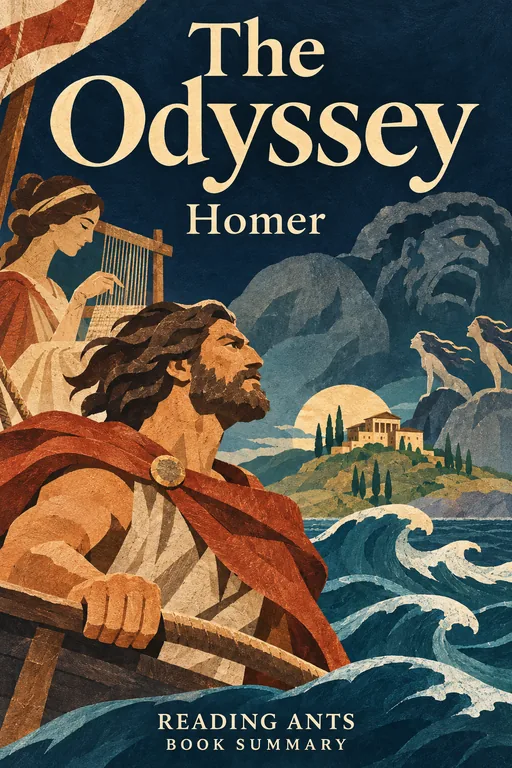
The Odyssey
Homer
After the Trojan War, the clever hero Odysseus struggles for ten years against monsters, gods and temptations to return home to his faithful wife and son, then must win back his house from the men trying to steal it.
🎭 Epics, Drama & PoetryWant something different?
Pick another topic and we will show you three books to start with.