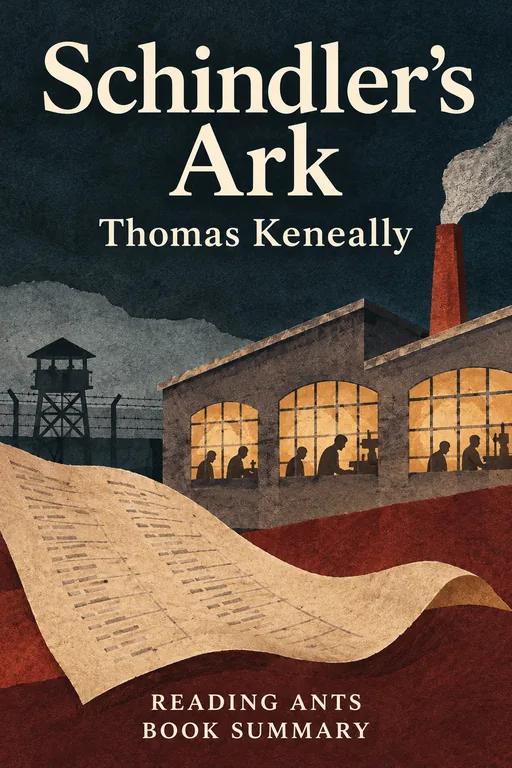
Schindler's Ark
The true story of Oskar Schindler, a charming German businessman and Nazi Party member, who used his factory to save more than a thousand Jews from death during the Holocaust.
Overview
Schindler’s Ark is a novel by the Australian author Thomas Keneally, published in 1982, which won the Booker Prize. It is based on the true story of Oskar Schindler, told to Keneally by one of the survivors, Leopold Page (Poldek Pfefferberg), who ran a shop in Beverly Hills and urged him to write it. Keneally presents it as a novel, because he uses fictional techniques, but it is closely based on interviews with survivors and on documents. It was published in the United States as Schindler’s List, and was the basis for Steven Spielberg’s 1993 film. The book portrays Schindler not as a saint, but as a complicated man.
Main Characters
- Oskar Schindler: a charming, flawed businessman who drinks, loves women and gradually becomes a rescuer.
- Itzhak Stern: Schindler’s Jewish accountant, who is quiet and clever, and helps to shape his decisions.
- Amon Goeth: the sadistic SS commandant of the Plaszów labor camp.
- Emilie Schindler: Oskar’s wife, who looks after the workers at the end.
- Poldek Pfefferberg (Leopold Page): a survivor on Schindler’s list who later persuaded Keneally to write the story.
- Helen Hirsch: Goeth’s Jewish housemaid, who is abused and sustained by Schindler’s help.
Full Summary
Schindler in Kraków
In 1939, after Germany invades Poland, Oskar Schindler, a Sudeten German with a reputation as a lover of wine and women, arrives in Kraków to seek his fortune. He takes over a factory that makes enamelware, using Jewish workers because they are cheap, and he meets Itzhak Stern, an accountant who helps him raise money. Schindler is a charming opportunist, and bribes SS officers. At first, he thinks only of profit.
The Ghetto
The Nazis force Kraków’s Jews into a walled ghetto, and later clear it. Schindler watches from a hillside as the SS conducts a brutal clearing of the ghetto, killing people in the streets, a sight that stays with him. He sees what is happening, and his attitude begins to change. He uses his influence to protect his workers, who are considered essential to the war effort, and he arranges extra food for them.
Stern, who sees Schindler’s growing sympathy, gently pushes him toward more daring acts. Their partnership is one of the book’s central relationships: the careful, quiet accountant and the bold, showy industrialist who each need the other.
Plaszów
The Jews are moved to the Plaszów labor camp, which is run by the brutal Amon Goeth, who shoots prisoners at random from his balcony. Schindler, who wins Goeth’s confidence by drinking with him and bribing him, persuades him to allow a sub-camp at his factory, so that his workers can be housed in better conditions. He protects them from beatings and from deportation, often at great risk, and the prisoners begin to see him as a protector.
The List
As the Soviet army approaches in 1944, the Nazis decide to close the camps and send the prisoners to Auschwitz. Schindler, who has spent much of his fortune on bribes, convinces the authorities to let him move his factory to Brünnlitz, in his native Moravia, and draws up, with help from Stern and other prisoners, a list of workers whom he claims to need. The people on the list are saved. Those who are left off are sent to the death camps. The list becomes a symbol of salvation.
Brünnlitz
At Brünnlitz, Schindler treats the workers well, in contrast to the conditions in other camps. Their factory is meant to make artillery shells, but it turns out few if any useful ones. A train of women intended for his factory is diverted to Auschwitz by mistake, and Schindler arranges, with diamonds as bribes, to get the women out. He also takes in a group of men found in a freight train, nearly frozen, and takes care of them. His wife Emilie looks after the sick.
Liberation
When Germany surrenders in May 1945, Schindler, as a Nazi Party member, must flee. The workers present him with a letter signed by many survivors, and a ring made from gold from a worker’s tooth, engraved with a Talmudic saying that whoever saves one life saves the world. Schindler, who is overwhelmed, says that he wishes he had done more. The survivors, some 1,200 people by the book’s count, go on to rebuild their lives, and many have descendants who are alive today.
Why It Matters
Schindler’s Ark won the Booker Prize, and its adaptation as Schindler’s List won seven Academy Awards, including Best Picture, and reached a worldwide audience. The book and the film helped to bring the Holocaust to a new generation, and made Schindler a symbol of moral courage. The stories of the survivors continue to be told.
It also raises questions about moral choice in the face of evil, and what ordinary people can do. Schindler is recognized as Righteous Among the Nations at Yad Vashem, and is buried on Mount Zion in Jerusalem.
The book is also admired as a model of how to tell a true story in a novelistic way, and Keneally’s research with survivors set a standard for later works of Holocaust narrative.
Key Takeaways
- One person can make a difference. Schindler saved over a thousand lives.
- Moral change can come late. Schindler began as an opportunist.
- Evil is organized and ordinary. The system of camps relied on many people.
- Courage often involves risk and sacrifice. Schindler gave up his fortune.
- Survivors’ stories matter. The book comes from their testimony.
What We Can Learn
The book shows that moral courage can come from unexpected people, and that we do not need to be perfect to do good. Schindler was a flawed man, but his willingness to act made a great difference.
It also teaches us the importance of testimony and memory, since the story was told because survivors insisted that it be recorded.
Finally, it suggests that even in the worst of times, small acts of decency can have large consequences.
It also shows that courage can be practical, using bribes, paperwork and charm to protect people, and that helping can be done in many ways.
Criticism and Counterpoints
Some critics argue that the book, like the film, focuses on a German rescuer and thus puts a non-Jewish hero at the center of a Jewish tragedy, and that the story is a rare exception that may give a false comfort. Others note that Keneally called the book a novel, but readers may take it as strict history, and some details are disputed by historians.
Some Holocaust scholars feel that the representation of Schindler is too heroic, and that his motives were mixed and his later life disappointing. The graphic violence is also hard for some readers. Still, it is widely respected.
Who Should Read It
This book suits mature readers. It describes killings and brutality in detail, and is emotionally demanding. It is a valuable read for those who wish to understand the Holocaust through a real story.
Want the whole book?
A summary is a taste, not the meal. Here is where to find the full book.
You reached the end 🎉
Nicely done. Mark this one as read, and we will suggest what to read next.
Read this next
Night
Elie Wiesel
Elie Wiesel tells, in short and searing pages, how as a teenager he was taken from his hometown of Sighet to Auschwitz and Buchenwald, lost his family and watched his faith and childhood break apart.
👤 Real Lives
The Diary of a Young Girl
Anne Frank
A Jewish teenage girl hiding from the Nazis in a secret apartment in Amsterdam records two years of fear, family quarrels, first love and big dreams in a diary that became one of the most famous books in the world.
👤 Real Lives
The Book Thief
Markus Zusak
Death narrates how a foster child in Nazi Germany steals books, learns the power of words and forms loving bonds that war eventually destroys.
🎒 Young Adult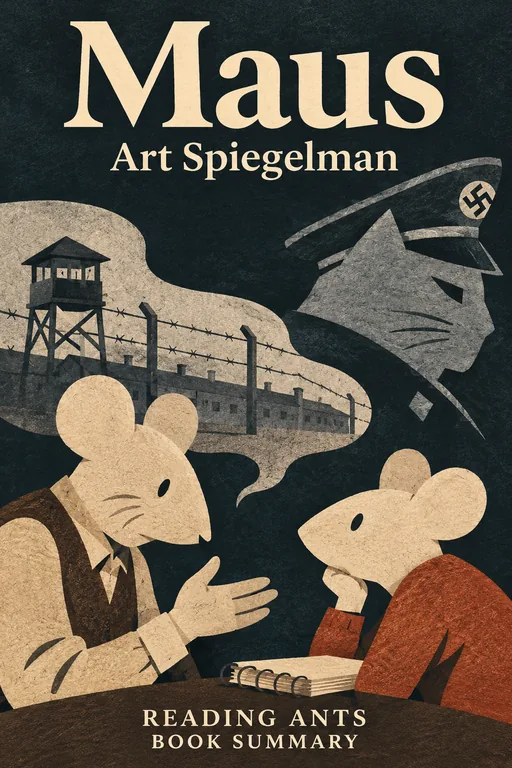
Maus
Art Spiegelman
Art Spiegelman draws his father's story of surviving Auschwitz, with Jews as mice and Nazis as cats, and also shows the difficult relationship between a son and a father marked by the past.
👤 Real Lives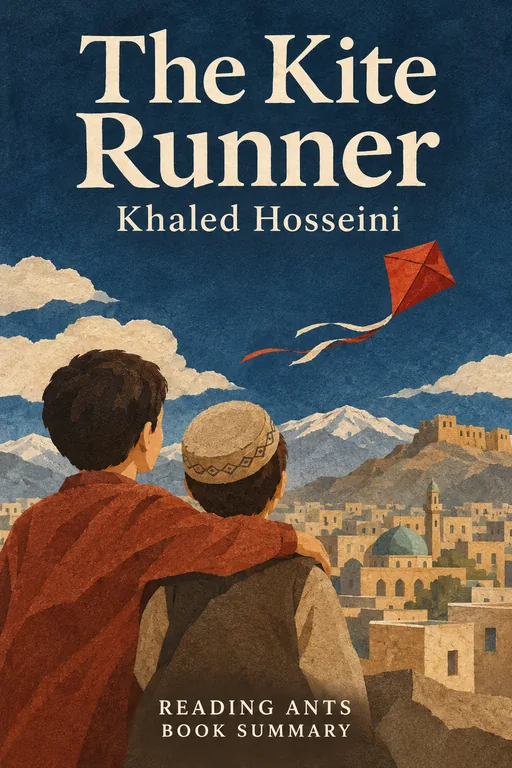
The Kite Runner
Khaled Hosseini
A wealthy boy in Kabul betrays his loyal best friend on the day of a kite tournament, and decades later, after fleeing to America, he returns to a Taliban-ruled Afghanistan to try to make things right.
✨ Modern Fiction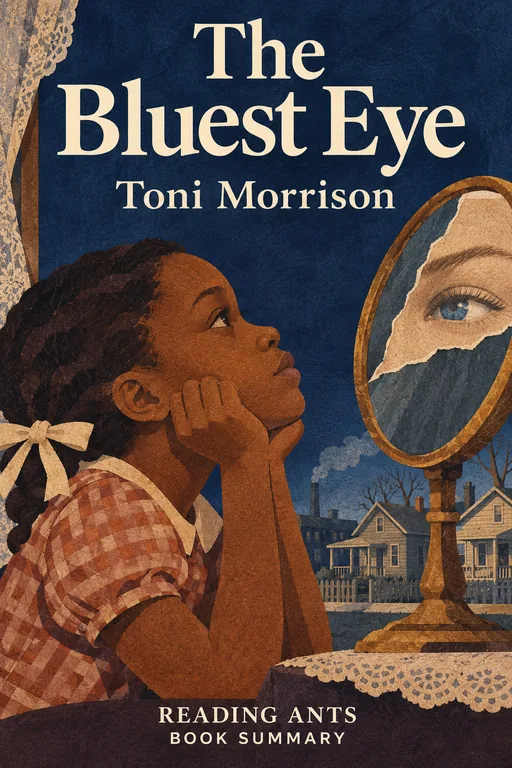
The Bluest Eye
Toni Morrison
In 1940s Ohio, a poor Black girl named Pecola Breedlove, who believes that she is ugly, prays for blue eyes, and the community's failure to protect her leads to tragedy.
✨ Modern FictionWant something different?
Pick another topic and we will show you three books to start with.