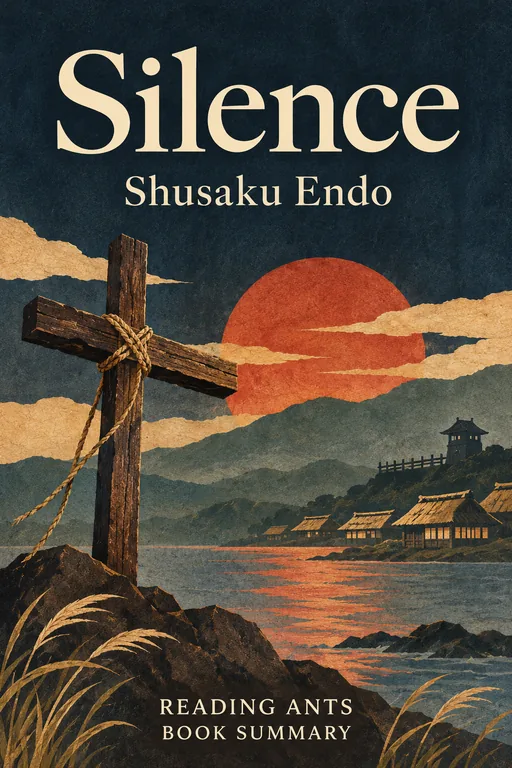
Silence
Original title: 沈黙
A young Portuguese priest travels to seventeenth-century Japan, where Christians are brutally persecuted, to find his missing teacher, and is forced to face the silence of God and the meaning of faith.
Overview
Silence is a novel by the Japanese Catholic writer Shusaku Endo, published in 1966. It is set in Japan in the 1630s, when the Tokugawa shogunate had banned Christianity and tortured believers in order to make them give up the faith. The story is told through letters and narration, and follows a Jesuit priest, Sebastião Rodrigues, who comes to Japan in secret. It is a deeply serious book about faith, doubt, courage and compassion, and it raises hard questions about what a believer should do when faced with suffering. It contains scenes of torture and death.
Main Characters
- Sebastião Rodrigues: a young Portuguese Jesuit priest, idealistic and devout.
- Francisco Garrpe: his companion, a priest who shares his mission.
- Father Cristóvão Ferreira: Rodrigues’s teacher, who is said to have given up his faith under torture.
- Kichijiro: a weak, cowardly Japanese man, who betrays the priests repeatedly and asks forgiveness.
- Inoue: the Japanese official in charge of persecuting Christians, clever and calm.
- The hidden Christians: poor villagers, who keep their faith in secret.
Full Summary
The Mission
In the seventeenth century, the Jesuits in Portugal receive news that Father Ferreira, a respected missionary in Japan, has renounced his faith. Rodrigues and Garrpe, his former pupils, cannot believe it, and they decide to go to Japan to find him. In Macau they meet a Japanese man, Kichijiro, who is a drunkard and a coward, and who agrees to guide them.
They land secretly in Japan, and are welcomed by a village of hidden Christians, who have been without priests for years. The villagers are poor, and they treat the priests with great reverence. Rodrigues is moved by their faith.
In Hiding
The priests live in a hut in the hills, and perform masses at night. The villagers risk their lives to hide them. Rodrigues starts to feel a sense of purpose. But the authorities are searching, and the villagers are afraid.
Officials come to the village and demand that some of the Christians show that they have given up their faith by trampling on a “fumie,” a carved image of Christ or Mary. Some refuse, and are taken away. Kichijiro, who had run away, is later seized by the officials, and, in exchange for money, he betrays the priests to them.
Capture
Rodrigues is captured, and imprisoned. Rodrigues is questioned by Inoue, who is polite and reasonable. Inoue does not torture the priest, and the guards even feed him well. Instead, Japanese Christians are put to death within his sight, and the interpreter makes it clear that they will go on suffering until he gives up his faith. One morning Rodrigues is brought to the shore and made to watch as Christians wrapped in straw mats are drowned. Garrpe, who has also been captured, dies there, plunging into the sea in a vain attempt to save them.
The method is cruel: the villagers are hung upside down in pits, and left to die slowly. Rodrigues at first mistakes the sound that he hears for snoring, and later learns that it is the groaning of Christians who have already apostatized, but who are left in the pit until he, too, gives in. Rodrigues prays for a sign from God, but hears only silence. He wonders whether God is there at all.
Ferreira
Rodrigues meets Ferreira, who is now living as a Japanese man, with a Japanese name and family, and who works for the government. Ferreira explains that he gave up his faith, not because of pain, but because he could not bear to hear the cries of the tortured Christians. He says, as his own argument, that the Japanese people cannot truly understand the Christian God, and that the faith has not taken root.
He tells Rodrigues that by stepping on the image of Christ, he can save the lives of the people who are suffering, and that this is an act of love.
The Fumie
On the morning of the final decision, Rodrigues hears the cries of those who are being tortured. He looks at the face on the fumie, which is worn by the feet of many who have trampled on it. He hears a voice, which says that it is all right to step, as Christ came into the world to share human pain, and not to ask for heroics.
Rodrigues steps on the image, and a cock crows in the distance, a sign of Peter’s betrayal. He is no longer a priest in the eyes of the world.
Afterward
Rodrigues lives in Japan under a new name, with a Japanese wife, as a clerk, and is made to help inspect imported goods for signs of Christianity. He is watched all the time. Kichijiro, who still follows him, asks him to hear his confession, and Rodrigues, who has felt deep contempt for the man, finally does.
The novel ends with a note that Rodrigues died in Japan and was buried according to Buddhist rites. Yet Endo suggests that, in his silence, he remained faithful in his own way.
Why It Matters
Silence is widely considered Endo’s masterpiece, and one of the great Christian novels of the twentieth century. It has been praised by writers such as Graham Greene, who was one of Endo’s admirers. The book was controversial among Catholics, as some felt that it excused apostasy, but others saw in it a deeper picture of divine compassion. Martin Scorsese made a film of the book in 2016, which he had wished to make for many years. The book also offers a rare Japanese perspective on Christianity, since Endo was himself a Japanese Catholic who often felt that his faith was a borrowed suit that did not quite fit, and who wrote to show how it might be made his own.
Key Takeaways
- Faith involves doubt. Rodrigues is troubled by God’s silence.
- Compassion may demand sacrifice of pride. Stepping on the image is an act of love.
- Weakness is part of being human. Kichijiro shows that the weak also need grace.
- Cultures shape belief. The book asks how faith can grow in a new land.
- Heroism has many forms. Martyrdom is not the only way to be faithful.
What We Can Learn
Silence shows that moral choices are often hard, and that there may be no clear right answer. It invites us to think carefully about what it means to be loyal to our principles, and what it means to care for other people.
It also encourages humility toward those who have failed or given in under pressure, since we do not know what we would do in their place. Finally, it reminds us that those who hold a different faith or culture deserve to be treated with respect and understanding.
Criticism and Counterpoints
Some readers find the book bleak and slow, with long passages of internal struggle. Some Christians have criticized the book’s treatment of apostasy, and its view that stepping on the image can be a form of love. Others find that the Japanese characters, such as the villagers, are shown mainly as victims, and that Inoue is not fully developed. Some historians also question some of the details of the period.
Who Should Read It
This book is for mature readers who are interested in religion, history and moral questions. It is not long, but it is heavy. Believers and nonbelievers alike may find it moving, though the scenes of torture can be upsetting.
Want the whole book?
A summary is a taste, not the meal. Here is where to find the full book.
You reached the end 🎉
Nicely done. Mark this one as read, and we will suggest what to read next.
Read this next
The Power and the Glory
Graham Greene
In a Mexican state where the government is trying to wipe out the Catholic Church, the last priest, a flawed, frightened and sinful man, is hunted by a zealous lieutenant, and finds a kind of courage and grace as he is pursued.
📜 Classics
The Brothers Karamazov
Fyodor Dostoevsky
When a vulgar, greedy landowner is murdered, his three very different sons, a passionate soldier, a rational intellectual and a gentle novice monk, are drawn into a mystery that is also a debate about faith, doubt, guilt and freedom.
🌍 World Literature
The Name of the Rose
Umberto Eco
A Franciscan friar investigates deaths in a medieval abbey, where the struggle to control books and laughter proves more dangerous than any supernatural curse.
🌍 World Literature
Heart of Darkness
Joseph Conrad
A sailor named Marlow tells his friends of a journey up the Congo River to find a mysterious ivory trader named Kurtz, and of the horror and moral darkness he finds at the end of it.
📜 Classics
Kokoro
Natsume Soseki
A young student befriends a quiet, haunted older man known as "Sensei," and learns, from a long letter, the secret of guilt and betrayal that has shadowed his life.
🌍 World Literature
The Little Prince
Antoine de Saint-Exupery
A pilot stranded in the desert meets a small boy from a tiny planet, who teaches him that the most important things in life, like love and friendship, can only be seen with the heart.
🌍 World LiteratureWant something different?
Pick another topic and we will show you three books to start with.