 Reading Ants
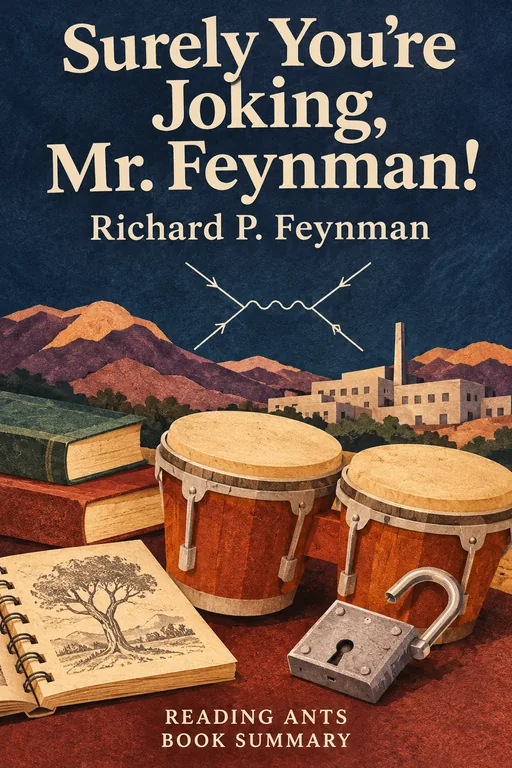
Surely You're Joking, Mr. Feynman!
Nobel Prize-winning physicist Richard Feynman tells funny stories from his life, showing a curious, playful and independent mind that loved solving puzzles and hated pretension.
Overview
Surely You’re Joking, Mr. Feynman!: Adventures of a Curious Character is a collection of anecdotes by Richard Feynman, one of the most famous American physicists of the twentieth century, told to his friend Ralph Leighton, who wrote them down. It was published in 1985. Feynman worked on the atomic bomb at Los Alamos during World War II, taught at Cornell and Caltech and won the Nobel Prize in Physics in 1965 for his work on quantum electrodynamics. The book is not about physics formulas but about his adventures: picking locks, playing the bongo drums, studying art, traveling and teaching. It became a bestseller and made Feynman a hero to many young people.
Full Summary
1. A curious boy from Far Rockaway
The idea: Feynman starts with his childhood in New York, where his father taught him to be curious by encouraging him to think about the world. He recalls how his father showed him that knowing the name of a bird in many languages does not mean you know anything about the bird, and that real understanding is about what the bird does. As a boy, he fixed radios, learned how things worked and solved puzzles, a habit that stayed with him all his life. This lesson about names and knowledge became a theme of his life.
In real life: Memorizing definitions is different from understanding an idea well enough to use it.
2. Los Alamos and the art of cracking safes
The idea: Feynman joined the Manhattan Project at Los Alamos, New Mexico, to help develop the atomic bomb. He tells of playing pranks on the military security, such as figuring out how to open locked filing cabinets with secret documents by guessing combinations, and leaving notes for the owners to reveal weaknesses in their security. He describes the sense of urgency, the brilliance of colleagues and the strange life in a secret town, and also his deep grief when his first wife died of illness during that time.
In real life: Testing a system’s weak spots, as Feynman did with locks, is a way to improve security.
3. Learning from everything: art, drums and languages
The idea: Feynman was fascinated by many things besides physics. He took up drawing and eventually sold some of his art, he learned to play the bongo drums and played them in public performances, and he studied Portuguese and tried to learn Japanese. In each case, he threw himself into it with enthusiasm and humor. He suggests that curiosity should not be confined to one field and that doing something just for fun can be a source of joy and ideas.
In real life: Hobbies unrelated to our work can refresh our minds and lead to unexpected insights.
4. Teaching in Brazil
The idea: During a year in Brazil, Feynman taught physics and was shocked at how students could recite textbooks without understanding the actual phenomena. They could repeat the definition of a term but could not apply it to real situations. He gave a talk criticizing the method of rote learning, which upset some officials. He used the experience to argue that real learning means connecting ideas to observation and experience, not memorizing.
In real life: A student who can solve a problem in a new situation understands more than one who only knows the textbook answer.
5. Scientists, authorities and honesty
The idea: Feynman repeatedly shows an irreverent attitude toward authority and pretension. He was unimpressed by titles and honors and refused to take some of them, and disliked fancy talk. When he won the Nobel Prize, he was more bothered by the attention than pleased. He stresses that a scientist should be honest with himself, doubt his own results and tell the whole truth, including facts that might hurt his theory. This integrity is the backbone of his approach.
In real life: Admitting uncertainty and checking one’s own mistakes builds trust, in science and everyday life.
6. Play, puzzles and a way of living
The idea: The final chapter, “Cargo Cult Science,” is a graduation talk in which Feynman argues that scientists must be scrupulously honest and above all avoid fooling themselves. Elsewhere in the book, he describes working on a physics problem inspired by watching a plate wobble in a cafeteria, which he says ended up contributing to his Nobel-winning work. He emphasizes that he did physics for fun, not for prizes. His life shows how curiosity, play and independence can lead to deep understanding.
In real life: Following a small curiosity, such as why a spinning plate wobbles, can open large questions.
Why It Matters
The book introduced many readers to the personality behind modern physics and has inspired countless students, scientists and engineers with its message that science is fun and that curiosity is valuable. It has been translated into many languages and remains popular.
Its sequel, What Do You Care What Other People Think?, includes Feynman’s role in the investigation of the Challenger disaster. Together they have helped establish Feynman as a symbol of honest, joyful science. Teachers often use its chapter on learning in Brazil to discuss the difference between memorizing and understanding, and its stories are a common gift to students who are thinking about a career in physics or engineering.
Key Takeaways
- Curiosity drives learning. Ask how things work.
- Understanding beats memorizing. Know ideas, not just names.
- Play helps thinking. Fun can lead to insight.
- Be honest with yourself. Doubt your own conclusions.
- Don’t be impressed by pomp. Judge ideas and people on their merits, not their titles.
What We Can Learn
The book teaches the difference between knowing the name of something and knowing the thing. When we study, we can test ourselves by trying to explain an idea simply, in our own words.
It also encourages us to follow our interests, even when they are not obviously useful. Feynman’s hobbies and pranks show that creativity is nourished by variety.
Finally, it reminds us that science requires honesty and humility. Being willing to say “I don’t know” and to check our own work is the mark of a good thinker.
Criticism and Counterpoints
Some readers and scholars have criticized the book’s stories as self-promoting, and noted that Feynman’s account is told entirely from his point of view and that some stories were polished or exaggerated. Others have objected to his attitudes toward women, as described in some anecdotes, such as his stories about picking up women in bars, which many find sexist and which reflect the era.
Colleagues who knew him sometimes said that his portrayal of himself as a casual prankster underplayed his hard work and seriousness. The book also contains little about his actual physics. Still, many readers find it entertaining and inspiring.
Who Should Read It
This book suits teenagers and adults. The stories are short and humorous, and you can read them in any order. A few anecdotes include outdated attitudes about women that may need discussion.
Want the whole book?
A summary is a taste, not the meal. Here is where to find the full book.
You reached the end 🎉
Nicely done. Mark this one as read, and we will suggest what to read next.
Read this next
A Short History of Nearly Everything
Bill Bryson
Bill Bryson sets out to understand how we know what we know about the universe, the Earth and life, and tells the story through the odd, brilliant and sometimes unlucky people who figured it out.
🏛️ History
Cosmos
Carl Sagan
Carl Sagan takes readers on a journey from the Earth to the edge of the universe, blending astronomy, history and philosophy to show how humanity came to understand the cosmos and our place in it.
🔬 Science
Steve Jobs
Walter Isaacson
The authorized biography of Apple's co-founder follows a brilliant, demanding and often cruel perfectionist whose focus on beautiful design transformed computers, music, phones and animated movies.
💼 Business
A Brief History of Time
Stephen Hawking
One of the world's greatest physicists explains, with almost no math, what we know about the origin, structure and fate of the universe, from the Big Bang to black holes and the nature of time itself.
🔬 Science
On the Origin of Species
Charles Darwin
All living things are related and have slowly changed over immense periods of time, shaped by natural selection, the process by which individuals better suited to their environment survive and pass on their traits.
🔬 Science
Silent Spring
Rachel Carson
The careless spraying of powerful chemical pesticides like DDT was poisoning birds, fish, soil, water and people, and humans must learn to live with nature instead of waging war on it.
🔬 ScienceWant something different?
Pick another topic and we will show you three books to start with.