 Reading Ants
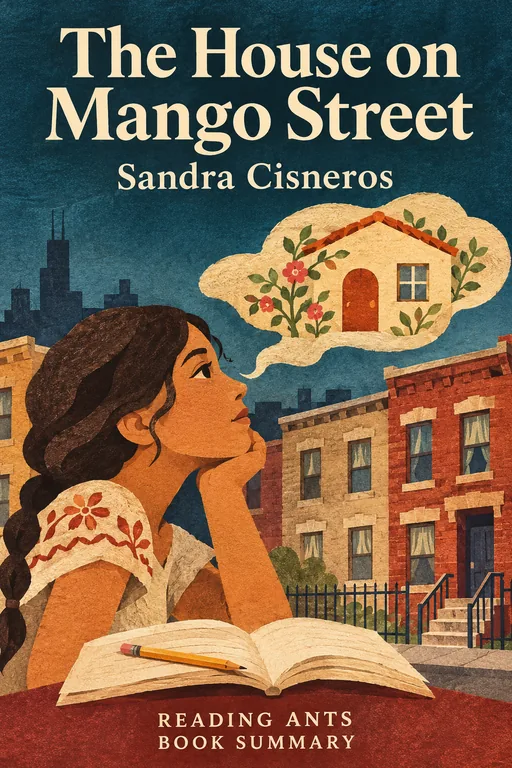
The House on Mango Street
In a series of short, poetic vignettes, a Mexican American girl named Esperanza grows up in a poor Chicago neighborhood, dreams of a house of her own, and finds that writing is her way out and her way back.
Overview
The House on Mango Street is a short novel in vignettes by Sandra Cisneros, published in 1984. It has forty-four very short chapters, some less than a page, written in simple, lyrical language that reads like prose poetry. It is narrated by Esperanza Cordero, a young Latina girl in Chicago’s Humboldt Park, a poor Latino neighborhood. Cisneros has said that the book grew out of her own experience growing up as the only girl among six brothers, and from her wish to find her voice as a writer. The book has sold millions of copies and is widely taught in schools.
Main Characters
- Esperanza Cordero: the narrator, a thoughtful, observant girl who wants to leave Mango Street.
- Nenny: her younger sister.
- Lucy and Rachel: two sisters from Texas who become her friends.
- Sally: a pretty friend who is beaten by her father and marries young.
- Marin: an older girl who waits on the corner for boys.
- Alicia: a young woman who studies at the university and tends to household duties.
- Mamacita, Rafaela and Minerva: neighbors trapped in their homes.
- The three sisters: three mysterious old women who give Esperanza advice about her future.
Full Summary
The House
The book begins with Esperanza’s family moving to the house on Mango Street, after years of moving from one rented apartment to another. Her parents had promised a house with running water, and a yard, but this one is small and red, with crumbling bricks, tiny windows and a basement that no one wants to use. She remembers a nun from school who told her that she lives in a poor place, and she feels ashamed. She says that she wants a real house, one that she can point to, and not a house like this.
The Neighborhood
Through short sketches, Esperanza introduces the people on her street. There is Cathy, the self-styled queen of cats, and Lucy and Rachel, two sisters from Texas who share clothes and gossip. Marin sells cosmetics and dreams of a man who will take her away. Mamacita never learned English and sits at the window, homesick, and is distressed when her baby begins to sing along to an English-language commercial. Alicia, whose mother has died, takes on the household chores while she studies at the university. The portraits show women who are limited by language, poverty and men.
The vignettes are short and vivid. In one, she writes about the different kinds of hair in her family, comparing her mother’s to rosettes and candy circles. Cisneros uses tiny images to capture a family’s warmth.
Growing Up
As she grows, Esperanza begins to notice her changing body, and the way that men look at her. She gets a pair of high-heeled shoes and enjoys the attention, but learns the danger when an older man at her first job grabs and kisses her. In a later, painful vignette, she is assaulted at a carnival after Sally leaves her to go off with a boy, and no one comes when she calls for help. She describes how she felt broken. These stories are told simply and without explicit detail, and they show how girls learn to be afraid.
Friends and Sisters
Sally, a pretty girl whose father beats her, is Esperanza’s closest friend for a while, though their friendship turns sour when Sally begins to see boys. Sally eventually marries young, to a man who does not let her look out of the window. Esperanza sees how marriage can become a trap, and refuses to follow the pattern. She recalls the image of women who lean on their windowsills, resting their sadness on an elbow.
The Three Sisters
Esperanza meets three old sisters who are said to have magical powers. They tell her that she will always be Mango Street, that she cannot forget where she is from, and that when she leaves she must come back for the ones who cannot leave. She is reminded that her life will be tied to her community, and she makes a promise to herself.
Writing and Leaving
In the last chapter, Esperanza says that she has been writing stories, and that writing frees her from the house, and that someday she will leave Mango Street. She says that she will not forget it, and that she will return for those who cannot get out. The house on Mango Street, she realizes, will always be part of her, but she can decide who she will be.
Why It Matters
The House on Mango Street is one of the most widely read books in American schools, and an important work of Chicana literature. It gave voice to the experiences of Mexican American girls, and showed that a young woman’s story, told in simple language, could be powerful. It has sold over six million copies and has been translated into many languages.
It has encouraged many young writers, particularly from immigrant and minority backgrounds, to tell their own stories, and has been a staple of reading lists.
It is one of the best-known books for young readers about growing up between cultures, and teachers often pair it with writing exercises, since its short chapters invite students to write their own vignettes.
Key Takeaways
- A home is more than a house. Esperanza wants a place of her own.
- Poverty and gender limit opportunities. Many women are trapped.
- Writing is liberation. Esperanza finds her voice.
- Community shapes identity. She cannot forget where she comes from.
- Girls face dangers. The book shows how fear enters childhood.
What We Can Learn
The book shows that small, ordinary stories can reveal big truths. Esperanza’s observations of her neighbors invite us to see people in our own communities with attention and respect.
It also teaches that one can value one’s origins and still dream of change. Esperanza does not reject Mango Street, but wants to take its stories with her.
Finally, it encourages us to use our voices, and to write down our experiences.
It also encourages us to take our own memories seriously as material for stories, and to notice the sounds and textures of the places where we have lived.
Criticism and Counterpoints
Some critics have found the book too simple or slight, and its vignettes uneven. Others object that it treats men mostly as threats and women as victims, and that its portrait of the Latino neighborhood is bleak. In some places, it has been challenged because of the assault and a few mature themes, and for its portrayal of Latino men.
Some also note that the book’s format can feel fragmentary, and that Esperanza’s escape is imagined, not shown. Still, it remains widely loved.
Who Should Read It
This book suits readers from about thirteen up to adults. It is short, and chapters can be read separately. It touches on abuse and poverty in a gentle way, and invites discussion.
Want the whole book?
A summary is a taste, not the meal. Here is where to find the full book.
You reached the end 🎉
Nicely done. Mark this one as read, and we will suggest what to read next.
Read this next
I Know Why the Caged Bird Sings
Maya Angelou
Maya Angelou tells of her childhood and youth in the segregated South and in California, a story of pain, silence and discovery in which words and books help her find her voice.
👤 Real Lives
Persepolis
Marjane Satrapi
In black-and-white comics, Marjane Satrapi tells of growing up in Iran during the Islamic Revolution and the Iran-Iraq war, then living alone in Europe and returning home, searching for where she belongs.
👤 Real Lives
The Bluest Eye
Toni Morrison
In 1940s Ohio, a poor Black girl named Pecola Breedlove, who believes that she is ugly, prays for blue eyes, and the community's failure to protect her leads to tragedy.
✨ Modern Fiction
Their Eyes Were Watching God
Zora Neale Hurston
Janie Crawford tells her best friend the story of her three marriages, as she moves from a girl taught to find security to a woman who finds love and her own voice in the Florida of the early twentieth century.
📜 Classics
A Room of One's Own
Virginia Woolf
Virginia Woolf argues that a woman needs money and a room of her own, meaning independence and privacy, in order to write fiction, and explains why women writers have been held back through history.
⚖️ Politics & Society
The Kite Runner
Khaled Hosseini
A wealthy boy in Kabul betrays his loyal best friend on the day of a kite tournament, and decades later, after fleeing to America, he returns to a Taliban-ruled Afghanistan to try to make things right.
✨ Modern FictionWant something different?
Pick another topic and we will show you three books to start with.