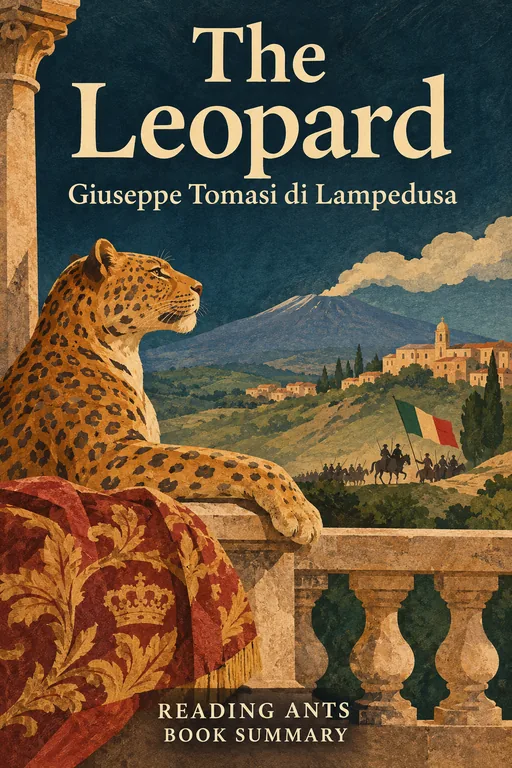
The Leopard
Original title: Il Gattopardo
As Italy is unified and the old order fades, a proud Sicilian prince watches his world change and decides, with grace and sadness, to accept it.
Overview
The Leopard is a novel by the Italian writer Giuseppe Tomasi di Lampedusa, published in 1958, after his death. It is set in Sicily, from 1860 to 1910, during the time of the Risorgimento, when the island and the rest of Italy were joined into a single kingdom. The hero, Don Fabrizio Corbera, Prince of Salina, is a nobleman who sees that his class is passing away. The book is about change, power, love and death, and it is admired for its beautiful descriptions of the Sicilian landscape. It is both a historical novel and a deep personal portrait.
Main Characters
- Don Fabrizio, Prince of Salina: a tall, strong, intelligent nobleman whose family crest, a leopard, gives the book its title.
- Tancredi Falconeri: his lively, charming nephew, who joins the rebels and then fights alongside Garibaldi’s volunteers.
- Angelica Sedara: the beautiful, wealthy daughter of a new-rich mayor.
- Don Calogero Sedara: Angelica’s father, a clever, ambitious landowner who has become rich and powerful in the turmoil of the revolution.
- Concetta: the Prince’s shy, proud daughter, who loves Tancredi.
- Father Pirrone: the family’s Jesuit priest and confidant.
- Bendico: the Prince’s big, loyal Great Dane.
Full Summary
The Garibaldini Arrive
In May 1860, Garibaldi and his volunteers, “the Redshirts,” land in Sicily to drive out the Bourbon king. The novel opens as the Prince leads his wife, children and household in the evening Rosary at their villa near Palermo, as he does every day. Afterward he walks in the garden, where a month earlier the household had found the body of a young royal soldier, wounded in a skirmish with rebels, who had crawled there to die. Later that day a newspaper and a letter bring the news of the landing. The Prince’s frightened brother-in-law offers him a berth on a British warship, and the Prince only laughs.
Don Fabrizio is not a revolutionary, but he is a realist. He sees that the old order is weak, and he knows that his own class cannot stop what is coming.
Tancredi
His nephew Tancredi, whom he loves like a son, is a handsome and lively young man, who tells him that he is leaving to join the rebels in the hills against the Bourbon king. The young man says that, if things are to stay the same, then everything must change. Don Fabrizio understands that Tancredi will use the change to protect his own interests. Tancredi goes on to fight alongside Garibaldi’s men and is wounded in the battle for Palermo.
In August, the Prince takes his family on their annual trip to their country estate in Donnafugata, and Tancredi, now a captain on leave, rides with them. They travel for days by carriage across the dry, sunburned landscape, and arrive to a welcome of bells, a town band and the local officials.
Donnafugata
At Donnafugata, the Prince meets the local mayor, Don Calogero Sedara, a self-made man who is shrewd and well-off. Sedara’s daughter, Angelica, is young and very beautiful. At the first dinner she attends at the palace, Tancredi falls under her spell, and the Prince’s daughter Concetta, who loves Tancredi, sees it and is hurt.
Some weeks later, Tancredi writes from the army and asks his uncle to request Angelica’s hand from her father on his behalf. The Prince knows that Concetta will be left out. But he also sees that Tancredi, who has little money, needs the wealth of the Sedara family. He agrees, and he arranges the marriage with a mix of regret and pragmatism.
The Offer
After the match is settled, an official named Chevalley arrives from the north, sent by the new government, and offers the Prince a seat in the new Senate of Italy. Don Fabrizio refuses, telling him that he belongs to the old order, that Sicily and its people are too old and too tired to change, and that he does not wish to take part in the new politics.
He explains that Sicilians do not want to be improved, because they believe they are already perfect, and he doubts that the government in Turin understands them. He suggests Don Calogero Sedara for the Senate instead. The official leaves troubled and sympathetic.
The Ball
The next major scene is a grand ball at a Palermo palace, two years later. Angelica is the star of the evening. Tired and irritated by the crowd, the Prince slips away to a quiet library, where a painting of a deathbed makes him think about his own death. Tancredi and Angelica find him there, and Angelica asks him for a dance. He leads her in a waltz so gracefully that the other couples stop to watch, and for a moment he feels young again. At dawn he lets his family drive home without him and walks alone through the streets, looking at the last stars.
The Prince’s Death
Years later, Don Fabrizio lies dying in a hotel in Palermo, after a tiring journey home from Naples, where a doctor had examined him. His family is around him. He thinks about his life and counts up the few moments of true happiness that he has had. A beautiful young woman in a traveling dress seems to appear among the mourners, the figure he has always longed for, as if she has come to fetch him.
A last chapter jumps to 1910, when three of his daughters, all unmarried and now old women, still live in the family villa. A Cardinal visits to inspect their private chapel and leaves his secretary to examine the holy relics, and only five of the many relics turn out to be genuine. Concetta, who rules the house, then orders the moth-eaten stuffed body of the Prince’s old dog, Bendico, to be thrown away. It is tossed from the window, and the old era is finally over.
Why It Matters
The Leopard is one of the most admired Italian novels of the twentieth century. It was rejected by publishers during the author’s lifetime, and he died without knowing that it would be a great success. It won the Strega Prize in 1959 and was made into a famous film in 1963 by Luchino Visconti. The book is often cited as a sharp study of how elites survive political change, and the phrase about changing so that nothing changes has become a popular way to describe such moments. It is also loved as a work of beautiful, sad prose.
Key Takeaways
- Change is inevitable. The Prince knows that his world is ending.
- Elites adapt to survive. Tancredi shows how to join the new order to keep power.
- Wealth shifts. Old money gives way to new money and marriage links them.
- Aging brings wisdom and sadness. The Prince reflects on life and death.
- Beauty is fleeting. The book dwells on beauty because it is passing.
What We Can Learn
The Leopard shows us how to face change with dignity, even when it hurts. The Prince does not fight the future, but he does not pretend that it is good for him either. It is a model of honesty about loss.
The book also reminds us to look closely at how institutions and people adapt to protect themselves, and to ask what really changes, and what stays the same. Finally, it invites us to enjoy beauty and small pleasures, as the Prince does with his garden, while we have them.
Criticism and Counterpoints
Some readers find the book slow, with long descriptions and little action. Others criticize its view of Sicilians as being unwilling to change, which can seem fatalistic or even insulting. The Prince’s attitude to the poor is aristocratic, and the political views of the author were conservative. Some critics also feel that the book’s structure, with its jumps in time, makes the story uneven. In its own time, some left-wing writers attacked it for looking back with fondness at an aristocratic world, and for giving little space to the farmers and workers whose lives were most affected by the changes. Others have said that its tone is too sad and passive, and that it treats history as something that happens to people and not something that they can shape.
Who Should Read It
This book is for readers who enjoy rich, literary novels with a sense of history and place. It is short compared with many classics. Those who want fast plots might find it quiet, but fans of Tolstoy and other historical writers will find it beautiful.
Want the whole book?
A summary is a taste, not the meal. Here is where to find the full book.
You reached the end 🎉
Nicely done. Mark this one as read, and we will suggest what to read next.
Read this next

War and Peace
Leo Tolstoy
Five aristocratic Russian families are swept through the Napoleonic Wars, and through love, loss and searching, three of their young members discover what makes a life meaningful.
🌍 World Literature
Anna Karenina
Leo Tolstoy
In imperial Russia, a married aristocrat falls passionately in love with a dashing officer and loses her place in society, while a thoughtful landowner seeks a meaningful life through love, work and faith.
🌍 World Literature
The Remains of the Day
Kazuo Ishiguro
An elderly English butler on a road trip across the countryside looks back on his life of strict duty and gradually realizes how much he gave up, including love, in service of a master who may not have deserved his loyalty.
✨ Modern FictionThe Age of Innocence
Edith Wharton
In the rigid high society of 1870s New York, a lawyer, Newland Archer, engaged to a perfect young woman, falls in love with her exiled cousin, and must choose between passion and duty.
📜 Classics
The Red and the Black
Stendhal
A clever carpenter's son in France tries to rise through love, religion and ambition, and in the end his pride and passion destroy him.
🌍 World Literature
The Little Prince
Antoine de Saint-Exupery
A pilot stranded in the desert meets a small boy from a tiny planet, who teaches him that the most important things in life, like love and friendship, can only be seen with the heart.
🌍 World LiteratureWant something different?
Pick another topic and we will show you three books to start with.