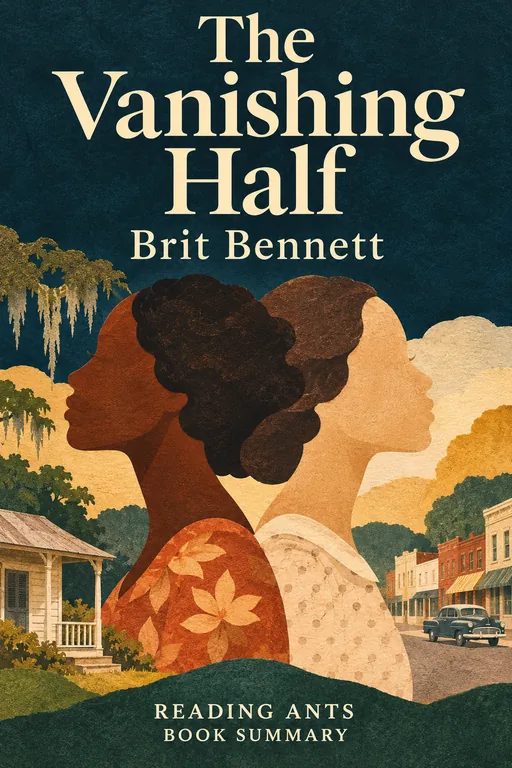
The Vanishing Half
Twin sisters from a small Black Louisiana town run away together at sixteen, but one later returns home while the other disappears into a life as a white woman, and their daughters' lives become entangled across the decades.
Overview
The Vanishing Half is a novel by Brit Bennett, published in 2020, which was a huge bestseller and was named one of the best books of the year by many critics. It begins in the fictional town of Mallard, Louisiana, founded by a formerly enslaved man who wanted a community of light-skinned Black people who would, over generations, become lighter. The story spans from the 1950s to the 1990s, and moves between the lives of the twins, Desiree and Stella Vignes, and their daughters. It is a story about race, identity, family secrets and the choice of who to become.
Main Characters
- Desiree Vignes: the more adventurous twin, who marries a very dark-skinned man and later returns to Mallard.
- Stella Vignes: the quieter twin, who passes as white and cuts off her family.
- Jude Winston: Desiree’s dark-skinned daughter, who is bullied but grows into a confident medical student.
- Kennedy: Stella’s blonde, privileged daughter.
- Early Jones: a bounty hunter first hired by Sam to find Desiree, who later helps her search for her sister and becomes her partner.
- Reese: a transgender man and Jude’s partner.
- Blake and Loretta: Stella’s husband and a neighbor.
Full Summary
Mallard
In 1954, Desiree and Stella Vignes, light-skinned identical twins, leave Mallard to start a new life in New Orleans. The town’s founder, Alphonse Decuir, dreamed of a town for light-skinned Black people, and the girls grew up with the pride and pain of that history. Their father was lynched in front of them, and their mother is proud and bitter. They hope to escape its narrow world, and find jobs in the city.
Their mother, Adele, has no tolerance for those who forget the town’s history. The twins grow up in the shadow of their father’s death, and each develops a different view of how to survive: Desiree wants adventure, and Stella wants safety.
The Split
In New Orleans, Stella takes a job as a secretary, where, in a moment of impulse, she is mistaken for white, and decides to go along with it. She hides the truth from her employer, and begins a relationship with her boss, Blake. One day, she disappears, leaving Desiree behind. Desiree, who has married Sam Winston, a dark-skinned man, moves to Washington, D.C., and has a daughter, Jude. When Sam turns violent, Desiree flees with Jude, and goes back to Mallard in 1968.
Stella’s decision is made in an instant, but its effects last for years. She does not intend, at first, to abandon her sister, but, once she has stepped over the line, it becomes harder and harder to return. The novel treats her act with sympathy as well as criticism.
Jude
In Mallard, the people stare at Jude, who is so much darker than anyone else, and she is teased and mocked. She grows up resilient, and discovers that she is smart and strong. Meanwhile, Desiree, who has become a quiet, withdrawn woman, is haunted by the loss of her sister. Early Jones, a bounty hunter hired by Sam, finds Desiree, but protects her, and later helps in the search for Stella.
Stella
Stella has married Blake, a wealthy white man, and has a daughter, Kennedy. She lives in a Los Angeles suburb, in fear of being found out, and has told no one about her past. She is a model of a suburban housewife, and nervously guards the secret. When a Black family moves into the neighborhood, she is torn between sympathy and the urge to stay hidden; she befriends Loretta, but faces racist opposition from neighbors and her own husband. She is increasingly lonely and anxious.
Kennedy and Jude
Kennedy, a spoiled, aimless actress, grows up not knowing her mother’s origins. Jude goes to college in California, where she meets Reese, a trans man who becomes her romantic partner, and by chance meets Kennedy at a theater. Jude realizes that Kennedy is her cousin, tracks down her aunt Stella, and confronts her; Stella is terrified and refuses to admit who she is. The confrontation reveals her long-hidden secret.
Return
In the aftermath, Kennedy learns the truth about her mother’s background, which hurts her. Her relationship with Stella stays rocky, because Kennedy knows that her mother will never be fully truthful with her. Her acting career comes to an end, and she becomes a real estate agent. Meanwhile, Jude is in medical school, and she ends up with Reese, who is finally able to have his transition surgery. Desiree ends up with Early, and together they care for the twins’ mother, Adele, who has dementia.
The last chapters show the daughters, Jude and Kennedy, each at a point of choice: Jude moves toward the future she has been working for, and Kennedy begins to ask who she is. The book ends with a sense that history has been faced, if not healed.
Why It Matters
The Vanishing Half is one of the most acclaimed novels of recent years, and it spent months on the bestseller lists. It brought attention to the history of “passing,” or hiding one’s racial identity, a theme that has long been important in American literature, in works such as Nella Larsen’s Passing. HBO has acquired the rights for a limited series.
The book is also appreciated for its sensitive treatment of colorism and of trans identity, and for the way it asks whether identity is something that we inherit or that we choose.
Key Takeaways
- Identity can be chosen or imposed. Stella chooses to pass; Jude has her skin color held against her.
- Secrets cost relationships. Stella’s lie costs her family.
- Colorism is a force within communities. Mallard’s pride in lightness harms Jude.
- Family bonds can survive separation. The sisters find each other.
- Place shapes people. Mallard’s history marks the generations.
What We Can Learn
The novel invites us to think about the reasons why a person might hide who they are, and to see the pressure of a society that rewards some identities and punishes others. This can make us more compassionate toward those who feel forced to hide.
It also shows that discrimination can exist within a group, as when darker skin is looked down on, and encourages us to look at our own prejudices.
Finally, it reminds us that choosing to live as someone else has a price, and that we cannot fully escape our past or our family.
Criticism and Counterpoints
Some critics found that the novel’s coincidences, such as the twins’ daughters meeting by chance, are too convenient, and that the last section, with its quick reconciliations, is rushed. Others felt that the book tries to cover too much, including passing, colorism, transgender identity and family drama, and that some of its characters, like Reese, are not fully developed.
A few readers argued that the book’s portrayal of Black life is shaped for a general audience, or that the ending is too neat. Still, many appreciate its warmth.
Who Should Read It
This book suits mature teenagers and adults. It includes racial violence, abuse and discrimination, but is accessible and engaging. It is a good choice for book clubs.
It is a good choice for book groups, since it raises questions about identity and family.
Want the whole book?
A summary is a taste, not the meal. Here is where to find the full book.
You reached the end 🎉
Nicely done. Mark this one as read, and we will suggest what to read next.
Read this next
Beloved
Toni Morrison
A formerly enslaved woman living in Ohio after the Civil War is haunted by the ghost of the daughter she killed to save her from slavery, and by the painful memories she has tried to bury.
✨ Modern Fiction
The Bluest Eye
Toni Morrison
In 1940s Ohio, a poor Black girl named Pecola Breedlove, who believes that she is ugly, prays for blue eyes, and the community's failure to protect her leads to tragedy.
✨ Modern Fiction
Americanah
Chimamanda Ngozi Adichie
Ifemelu and Obinze, young lovers in Lagos, are separated when she goes to study in America and he struggles in London, and the novel follows their years apart and their return to Nigeria, looking at race, identity and love.
✨ Modern Fiction
Homegoing
Yaa Gyasi
Starting with two half-sisters in eighteenth-century Ghana who never meet, one married to a British slaver and one sold into slavery, this novel follows seven generations of each branch of their family, in Africa and America.
✨ Modern Fiction
The Kite Runner
Khaled Hosseini
A wealthy boy in Kabul betrays his loyal best friend on the day of a kite tournament, and decades later, after fleeing to America, he returns to a Taliban-ruled Afghanistan to try to make things right.
✨ Modern Fiction
Song of Solomon
Toni Morrison
Macon "Milkman" Dead, a self-absorbed young man from Michigan, goes south in search of a family treasure and finds instead his family's history, and learns to take responsibility and to fly.
✨ Modern FictionWant something different?
Pick another topic and we will show you three books to start with.