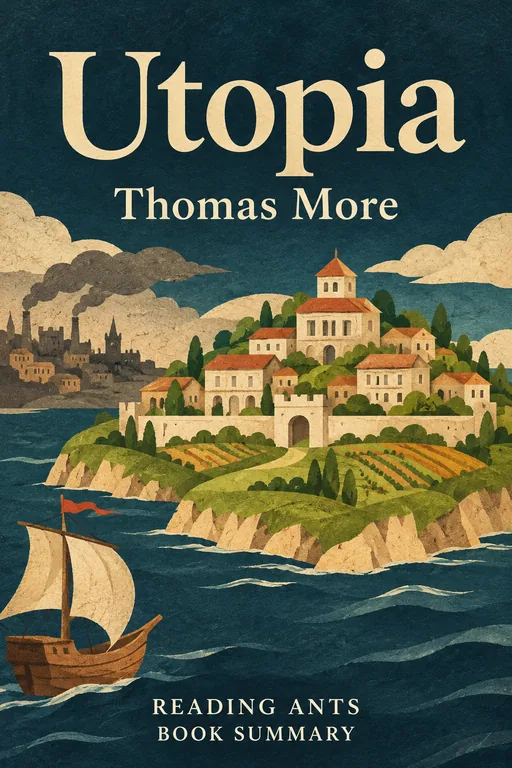
Utopia
Thomas More describes an imaginary island where property is shared, work is limited and the government is rational, in order to hold up a mirror to the greed and injustice of Europe, and leaves readers to wonder how serious he is.
Overview
Utopia was written in Latin by Thomas More, an English lawyer, statesman and humanist, and published in 1516. The title comes from Greek words, and means both “no place” and “good place.” The book has two parts. The first is a conversation about the problems of England and the role of advisers to kings. The second describes the island of Utopia, as told by a traveler named Raphael Hythloday, who claims to have lived there. More, who later became Lord Chancellor and was executed in 1535 for refusing to accept the king’s break with Rome, gave the world a new word and a new genre.
Main Characters
- Thomas More: appears in the book as a character, who meets the traveler and takes part in the debate.
- Raphael Hythloday: a widely traveled sailor and philosopher who describes the island of Utopia.
- Peter Giles: a friend of More, who introduces him to Hythloday.
- The Utopians: the people of the island, whose customs make up most of the book.
Full Summary
Problems of England
In the first book, More appears as a character who meets Hythloday in Antwerp. The two discuss the state of England, where, as Hythloday says, sheep farming has led landlords to enclose fields and drive off farmers, who then become beggars and thieves, and are hanged for it. He argues that harsh punishments do not solve the problem, and that the real cause is poverty. He criticizes the greed of the rich and the idleness of nobles and their retainers.
Should a wise man advise a king?
The characters debate whether a philosopher should serve a king. More argues that it is a duty to try to improve things from within, while Hythloday says that kings do not want good advice and that, at court, an honest adviser would be ignored or corrupted. He says that, as long as private property exists and money is the measure of all things, a just society is impossible. This discussion reflects More’s own dilemma, as he later entered the king’s service.
The island and its cities
In the second book, Hythloday describes Utopia, an island with fifty-four cities that are almost identical, each laid out in a regular plan, with streets, gardens and houses of the same type. The people live in households, and exchange their houses by lot every ten years. The governing is done by officials who are elected, with a prince chosen for life, and a system of councils. The orderliness of the island is a striking contrast to the disorder of Europe.
No private property
The central feature of Utopia is that there is no private property. Goods are stored in warehouses, and everyone takes what they need, without payment. Gold and silver are held in contempt, and used for chamber pots and chains for slaves, so that no one will be tempted to value them. Hythloday says that the abolition of money removes the causes of greed, crime and conflict, and that this alone makes the commonwealth happy.
Work, education and daily life
All Utopians work, in farming and a trade, but only for six hours a day, and use the rest of their time for learning, music and recreation. There is no idleness, since everyone, including officials and scholars, contributes. They value pleasure of a simple kind, health and the use of reason. Education is for all, including women, and there is religious tolerance. Their attitudes toward war, which they consider a bestial activity, though they fight when needed, are also described.
Strange customs and the closing doubt
Utopian customs include some that seem harsh or odd to modern readers: couples can see each other naked before marriage, to avoid deception; adultery is punished by slavery; the use of slaves, who are mostly convicted criminals or foreigners condemned to die elsewhere, is accepted; and euthanasia is allowed for the incurably ill, with their consent. At the end, the character More says that many of the customs seem absurd, though there are things he wishes might be adopted in his country. He leaves open whether the vision is a serious proposal or a satire.
Why It Matters
Utopia gave its name to a whole tradition of imagining ideal societies, and to the word “utopian.” It influenced later writers of imagined societies, such as Francis Bacon, and its opposite, “dystopia,” is now used for imagined places of great suffering that warn against such visions. The book is a major text of Renaissance humanism, and continues to be debated by scholars. Its critique of poverty, greed and punishment is still relevant, and its ambiguity, a mixture of earnest reform and irony, invites readers to think about what kind of society they want and what price they would pay for it.
Key Takeaways
- Society’s problems have social causes. Poverty often leads to crime.
- Property and greed are central issues. More saw them as sources of injustice.
- Work and leisure can be balanced. Shorter hours would allow for learning.
- Imagined societies are mirrors. They help us to see our own flaws.
- Ideals can have costs. Perfect orderliness may limit freedom.
What We Can Learn
You can use the book to ask what you would change in your society, and why. Think about the causes of problems such as crime and poverty, and whether punishments are an effective response. Imagine your own ideal community, and consider its drawbacks. Remember that those who propose perfect societies may overlook the value of individual freedom and difference. And enjoy the humor and irony in the book, which suggests that More was not always serious, and invites you to read critically.
Criticism and Counterpoints
Scholars debate how to read the book. Some say that More was proposing a model, a form of communism. Others say that it is a satire, and the joke is on Hythloday, whose name means something like “expert in nonsense” in Greek, and that More, as a devout Catholic, would not have endorsed some of these ideas. Critics point out the illiberal features, such as the strict regulation of life, the lack of privacy, the slavery and the intolerance of atheists. These make it a precursor of totalitarian visions as well as of social reform.
Who Should Read It
This book is for readers interested in political thought, history and literature. It is short and lively, and can be read in a few hours in a modern translation. Those who like to compare ideas will enjoy reading it alongside Plato’s Republic and later utopian and dystopian works.
Want the whole book?
A summary is a taste, not the meal. Here is where to find the full book.
You reached the end 🎉
Nicely done. Mark this one as read, and we will suggest what to read next.
Read this next
The Republic
Plato
Plato, through the character of Socrates, asks what justice is and imagines an ideal city, arguing that a just person and a just state are ruled by wisdom, with reason guiding the whole.
🕊️ Philosophy & Religion
The Prince
Niccolo Machiavelli
A Renaissance diplomat advises rulers to judge their actions by results rather than morality, arguing that a successful leader must sometimes be cunning and ruthless to win and keep power.
⚖️ Politics & Society
Leviathan
Thomas Hobbes
Thomas Hobbes argues that without a strong government people would live in constant fear and conflict, and that they should therefore agree to give up some of their freedom to a sovereign power that keeps the peace.
🕊️ Philosophy & Religion
The Social Contract
Jean-Jacques Rousseau
Rousseau asks how people can live together under laws and still be free, and argues that legitimate government rests on an agreement in which citizens obey only the "general will" that they make together.
🕊️ Philosophy & Religion
Brave New World
Aldous Huxley
In a future world where people are made in factories, programmed for their roles and kept happy with drugs and entertainment, a man raised outside the system discovers that this perfect comfort comes at the cost of everything that makes us human.
📜 Classics
The Little Prince
Antoine de Saint-Exupery
A pilot stranded in the desert meets a small boy from a tiny planet, who teaches him that the most important things in life, like love and friendship, can only be seen with the heart.
🌍 World LiteratureWant something different?
Pick another topic and we will show you three books to start with.