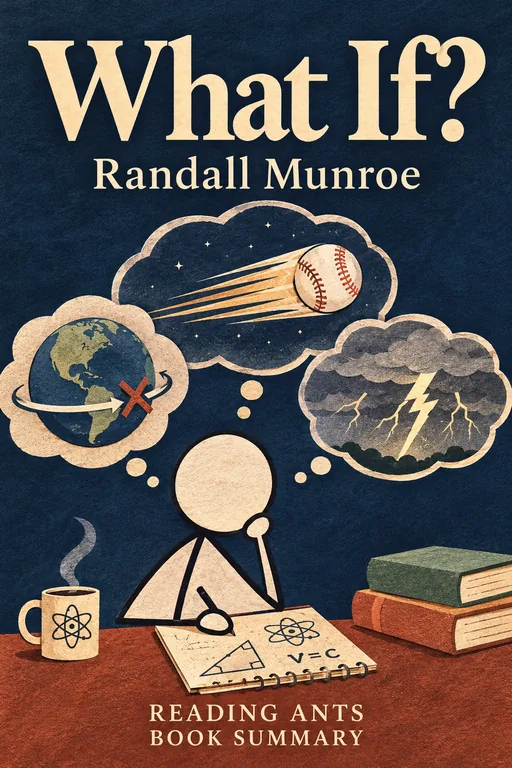
What If?
Randall Munroe takes strange and sometimes alarming hypothetical questions from readers, such as what would happen if you tried to hit a baseball pitched at nearly the speed of light, and answers them with real science, math and stick-figure cartoons.
Overview
What If? Serious Scientific Answers to Absurd Hypothetical Questions was written by Randall Munroe, a former NASA roboticist who draws the popular web comic xkcd, and published in 2014. The book grew from a series of answers on his website, where readers sent in questions such as what would happen if the Earth stopped spinning, or how much of the Earth’s surface is lit by lightning at a given moment. Munroe, who has a background in physics, picks the most interesting ones and works out the answers using careful calculations and real data, while adding jokes and drawings. Each chapter takes a silly question seriously, and in doing so teaches real science. It became a bestseller and has a follow-up volume.
Full Summary
1. The relativistic baseball
The idea: The book’s most famous chapter asks what would happen if a pitcher threw a baseball at ninety percent of the speed of light toward a batter. Munroe works through the physics step by step. The ball would collide with air molecules so fast that they would undergo nuclear fusion, and the baseball would be surrounded by a huge fireball, destroying the batter, the stadium and probably a large part of the surrounding city. Munroe describes this in a dry, funny tone, showing how an ordinary object becomes extraordinary at extreme speed.
In real life: The chapter illustrates that very high speeds can turn familiar objects into powerful forces, which is why spacecraft need special shielding.
2. Small questions with surprising answers
The idea: Not all questions involve disaster. One asks what would happen if everyone on Earth jumped at once, and Munroe shows that the planet would barely notice, because humans are so small compared with the planet. The comic punchline lies in the logistics: gathering everyone in one place, and the chaos of dispersing afterward. Another asks how long it would take to drain the oceans. Many answers show a pattern: our intuition about large numbers is often wrong, and calculations can reveal the true scale of things.
In real life: Doing quick estimates, such as how many people could fit into a given area, helps us judge claims about big numbers.
3. Using real data and units
The idea: In many chapters, Munroe uses unusual comparisons to help readers grasp scale. He draws on real data and sources, and explains what he assumes. He is also honest about uncertainty, and sometimes admits that an answer is only a rough estimate. The result is that readers learn how to think quantitatively, as scientists do.
In real life: Converting a large number into something familiar, like the size of a city, makes it easier to understand.
4. Why some experiments are dangerous
The idea: Many of the hypothetical scenarios involve extreme heat, radiation, pressure or speed, and Munroe emphasizes that they are not to be tried. For example, one chapter considers what would happen if you were in a pool of spent nuclear fuel, and he explains the safety measures used in the real world. He uses these examples to teach about physics and safety, and to show that science also means understanding limits.
In real life: Learning about the hazards of radiation or high pressure helps explain why laboratories and workplaces have strict rules.
5. Short answers and strange mail
The idea: Interspersed with the long chapters are short answers to quick questions, and a section of “weird and worrying” questions from his inbox that he treats as comic interludes. This shows both Munroe’s playful sense of humor and his responsibility. The short answers show that a good question, even a silly one, can be a starting point for learning something real.
In real life: Asking “what if” is a good habit for students, because it can lead to experiments, books and careers.
6. Curiosity as a skill
The idea: The book’s underlying message is that curiosity and the willingness to calculate can be fun. Munroe encourages readers to ask their own questions and to try working them out. He shows that you do not need a laboratory to explore the world, only a notebook, some knowledge and imagination. In this way, the book is as much about how to think as about specific facts.
In real life: Many readers are inspired to look up the numbers behind their own questions, from how much water a tree drinks to how long it would take to walk around the Earth.
Why It Matters
What If? spent months on bestseller lists and was widely loved by students and teachers for making physics funny and approachable. It showed that science communication can be playful and still accurate, and helped create a following for similar books by Munroe, such as Thing Explainer, which describes complicated things using only the thousand most common English words.
Many readers say it was the book that made them interested in science, and it is often recommended to curious young people who enjoy puzzles.
It is also used by teachers who want to show students how estimation, units and basic physics can be applied to questions they care about, and by parents who want a book that the whole family can enjoy together.
Key Takeaways
- Any question can start a science lesson. Even silly ones teach real physics.
- Do the math. Calculations reveal the scale of things.
- Be honest about uncertainty. Rough estimates are still useful.
- Humor helps learning. Fun makes facts memorable.
- Stay curious. Asking “what if” is a habit worth keeping.
What We Can Learn
The book teaches that curiosity is the starting point of science. When we wonder about something, we can try to find numbers, check facts and reason out an answer, instead of just guessing.
It also demonstrates how to break a big problem into small steps. Munroe takes huge scenarios and builds up the answer from simple parts, a skill that is useful in many areas of life.
Finally, it reminds us that learning can be fun. Enjoying a subject, laughing at a joke and appreciating a clever drawing do not make the science less serious.
Criticism and Counterpoints
Some readers, especially those looking for deeper explanations, find that the book is light and that some answers are simplified or skip over details. Physicists have occasionally pointed out small errors or approximations, and a few found some scenarios unrealistic. The humor, which relies on stick figures and dry jokes, is not to everyone’s taste.
The book also assumes some familiarity with units and large numbers, which can be a challenge for younger readers. A few critics note that some disaster scenarios could feel dark. Overall, however, most reviewers consider it a delightful and surprisingly educational read.
Who Should Read It
This book suits readers from about age ten up to adults who enjoy science and humor. Chapters are short and can be read in any order. It is a good book for sharing with family.
Want the whole book?
A summary is a taste, not the meal. Here is where to find the full book.
You reached the end 🎉
Nicely done. Mark this one as read, and we will suggest what to read next.
Read this next
Astrophysics for People in a Hurry
Neil deGrasse Tyson
Astrophysicist Neil deGrasse Tyson gives a fast, friendly tour of the biggest ideas in modern astronomy, from the Big Bang to dark matter and the search for other worlds, in a short book you can read in a few hours.
🔬 Science
Surely You're Joking, Mr. Feynman!
Richard P. Feynman
Nobel Prize-winning physicist Richard Feynman tells funny stories from his life, showing a curious, playful and independent mind that loved solving puzzles and hated pretension.
🔬 Science
A Short History of Nearly Everything
Bill Bryson
Bill Bryson sets out to understand how we know what we know about the universe, the Earth and life, and tells the story through the odd, brilliant and sometimes unlucky people who figured it out.
🏛️ History
A Brief History of Time
Stephen Hawking
One of the world's greatest physicists explains, with almost no math, what we know about the origin, structure and fate of the universe, from the Big Bang to black holes and the nature of time itself.
🔬 Science
On the Origin of Species
Charles Darwin
All living things are related and have slowly changed over immense periods of time, shaped by natural selection, the process by which individuals better suited to their environment survive and pass on their traits.
🔬 Science
Silent Spring
Rachel Carson
The careless spraying of powerful chemical pesticides like DDT was poisoning birds, fish, soil, water and people, and humans must learn to live with nature instead of waging war on it.
🔬 ScienceWant something different?
Pick another topic and we will show you three books to start with.