 Reading Ants
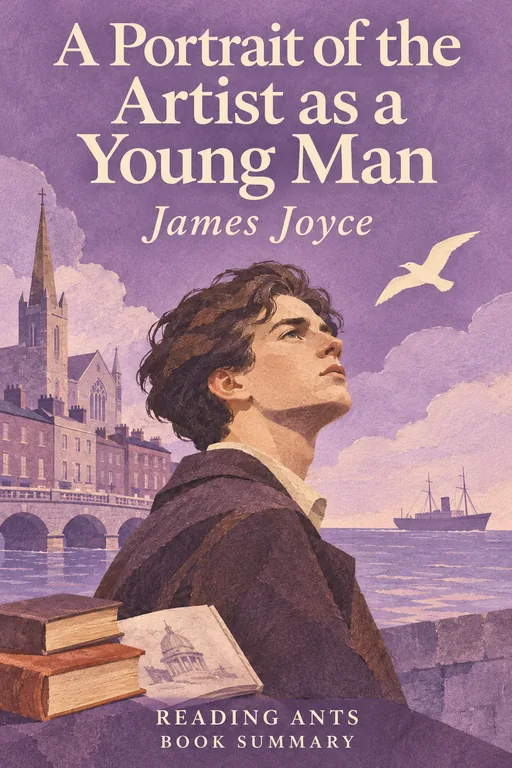
A Portrait of the Artist as a Young Man
A sensitive Irish boy, Stephen Dedalus, grows from childhood to young manhood in Dublin, rejecting the claims of family, religion and nation, and resolving to leave Ireland to become an artist.
Overview
A Portrait of the Artist as a Young Man is a novel by James Joyce, published in 1916, and it is a fictionalized version of his own early life. It follows Stephen Dedalus from infancy to the age of about twenty, in five chapters, and the style of the prose changes with his age, from childlike simplicity to complex thought. The book is an important early example of modernist writing, using free indirect style that lets the reader into Stephen’s inner experience, and it prepared the ground for Joyce’s later Ulysses. It is a story of intellectual and spiritual growth.
Main Characters
- Stephen Dedalus: a bright, introspective boy, who becomes a questioning young man.
- Simon Dedalus: his father, who is witty, careless with money and fond of drink.
- Mary Dedalus: his devout mother, who wants him to follow the church.
- Dante Riordan: a strict, devoutly Catholic governess in the family.
- Cranly: Stephen’s close friend at college, who listens to his ideas.
- Father Arnall and the school priests: religious teachers who shape his early life.
- The girl on the beach: a vision of beauty that inspires Stephen’s calling.
Full Summary
Childhood and school
The novel opens with Stephen as a small child, hearing a story from his father, and learning to feel the world through sound, touch and smell. At Clongowes Wood College, a Jesuit boarding school, he is shy and frightened, and bullied by other boys. He is unfairly punished by a priest for a broken pair of glasses, and, with a mixture of courage and fear, he reports it to the rector, which makes him a small hero among his classmates. At a Christmas dinner at home, a bitter argument breaks out over politics and religion, and Stephen sees the divisions in Irish life.
Family decline and the city
As his father’s money dwindles, the family moves to Dublin, and Stephen is sent to another school, Belvedere. He becomes a good student, writes well, and is admired. But he is growing restless, and he becomes aware of sexual desire. In his loneliness, he wanders the streets and has encounters with prostitutes, which fill him with both pleasure and shame. His sense of sin grows, as he is still a believer, and he feels divided between his body and the faith that he has been taught.
The retreat and the sermon
During a religious retreat at the school, Stephen listens to a series of terrifying sermons about death, judgment and the pains of hell. The priest describes eternal suffering in vivid detail, and Stephen is overwhelmed with guilt and fear. He goes to confession, and he is filled with relief. For a time, he lives a strict and holy life, with prayers and acts of self-denial, and he is praised as a model student. A priest even suggests that he might have a vocation to the priesthood.
The refusal and the vision
Stephen considers the priesthood, but he realizes that he does not want to give up his freedom, and that a life of obedience would not suit him. Walking by the sea, he sees a girl standing in the water, and he is struck by her beauty. This moment is a revelation to him, a call to a different life, devoted to beauty and creation, not religion. He decides that he will be an artist, and he feels joy at his new vocation, and at the sense that he has found his true path.
University and ideas
At University College in Dublin, Stephen studies and argues with fellow students about art, nationalism and religion. He develops a theory of aesthetics, based on ideas of beauty and form, and he discusses it with friends. He refuses to join the nationalist cause, or to take part in the Easter duty required of Catholics, and he rejects the claims of his family. His friend Cranly tries to talk him out of his rebellion, but Stephen insists that he will not serve what he does not believe, whether home, country or church.
Leaving Ireland
In the closing pages, which take the form of diary entries, Stephen prepares to leave Ireland, to pursue his art abroad in freedom. He writes of his hopes and his doubts, and of the stirrings of inspiration. He is full of confidence, and also aware of the loneliness of the path. The final entry is a prayer to an ancestral figure, the mythical craftsman after whom he is named, to stand by him. The book ends on a note of defiance and hope, with Stephen on the threshold of his future.
Why It Matters
A Portrait of the Artist as a Young Man is regarded as one of the key novels of the twentieth century, and an influential example of the coming-of-age story. Its technique, in which the language grows and changes with the hero’s mind, was innovative, and it influenced many later writers. The book also presents an honest picture of the effects of religious education and political conflict on a sensitive young person. For many readers, Stephen’s decision to follow his vocation is an inspiration, and the novel is often assigned in universities as an introduction to Joyce and modernism.
Key Takeaways
- Growing up involves rebellion. Stephen questions family, faith and nation.
- Language shapes experience. The prose style changes as he matures.
- Guilt can be powerful. The retreat sermon haunts his adolescence.
- Art can be a calling. A moment of beauty sets his course.
- Freedom has a cost. Choosing exile means isolation.
What We Can Learn
You can learn from Stephen that it is natural to question the beliefs that you were raised with, and that finding your own path takes courage, though it may also bring loneliness. The book also shows how strongly early experiences, such as fear or shame, can shape a person, and how important it is to look at them honestly. If you are inclined toward a creative life, you might notice what moves you, as the girl on the beach moves Stephen, and think about how to follow it. Reading the book slowly, aloud, can help you appreciate the language.
Criticism and Counterpoints
Some readers find the novel difficult or self-absorbed, with a hero who is arrogant and cold, and who treats the people around him, including family and friends, harshly. Others feel that the theoretical discussions of art and the long sermon are heavy going, and that the narrative lacks incident. Some critics question whether Joyce shares or mocks Stephen’s pride, since the tone is ambiguous. The book’s picture of Irish Catholicism has also been seen as one-sided. However, many admire its style and psychological truth.
Who Should Read It
This book is for mature readers from about sixteen who enjoy literary fiction, and for those who want to understand modernism. It can be challenging, but is much shorter and more accessible than Ulysses. Readers who appreciate it may continue with Dubliners and then Ulysses.
Want the whole book?
A summary is a taste, not the meal. Here is where to find the full book.
You reached the end 🎉
Nicely done. Mark this one as read, and we will suggest what to read next.
Read this next
Ulysses
James Joyce
On a single day in Dublin, 16 June 1904, an advertising salesman named Leopold Bloom and a young teacher named Stephen Dedalus wander the city, and their paths finally cross in a novel that recasts Homer's *Odyssey* in everyday life.
📜 ClassicsThe Catcher in the Rye
J. D. Salinger
After being expelled from his boarding school, a lonely, sarcastic sixteen-year-old wanders New York City for three days, struggling with grief, phoniness and the frightening idea of growing up.
📜 Classics
Great Expectations
Charles Dickens
A poor orphan boy suddenly receives a fortune from a secret benefactor and becomes a gentleman in London, but he learns that wealth and status mean nothing without loyalty, kindness and gratitude.
📜 Classics
Jane Eyre
Charlotte Bronte
A poor, plain but fiercely independent orphan becomes a governess, falls in love with her brooding employer, discovers his terrible secret, and refuses to give up her self-respect even for love.
📜 Classics
Pride and Prejudice
Jane Austen
Quick-witted Elizabeth Bennet and the proud, wealthy Mr. Darcy badly misjudge each other, and only by facing their own faults do they find their way to love.
📜 Classics
Nineteen Eighty-Four
George Orwell
In a future Britain ruled by an all-seeing Party, one man secretly rebels by keeping a diary and falling in love, and discovers just how completely a totalitarian state can crush the human mind.
📜 ClassicsWant something different?
Pick another topic and we will show you three books to start with.