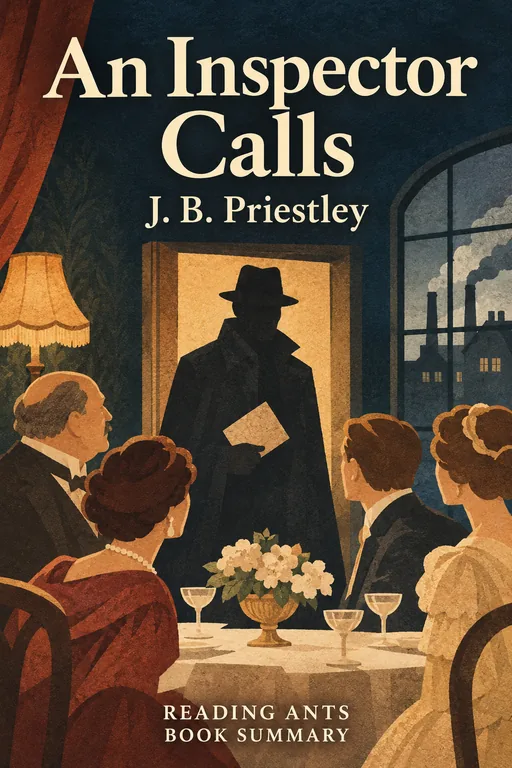
An Inspector Calls
During a family dinner in 1912, a mysterious inspector arrives to investigate the suicide of a young woman, and gradually shows that each member of the wealthy Birling family played a part in her downfall.
Overview
An Inspector Calls is a play in three acts by the English writer J. B. Priestley, first performed in the Soviet Union in 1945 and in London in 1946. It is set in 1912, in the home of Arthur Birling, a prosperous industrialist, but was written at the end of World War II, a gap that allows the audience to see how wrong the characters’ confident predictions are. The play takes place in real time in one room, and is built like a detective story, though the question is not who did it, but who is responsible, and what we owe to each other. It is a favorite of schools, and has been revived often.
Main Characters
- Inspector Goole: the stern, mysterious police inspector who questions the family.
- Arthur Birling: a wealthy factory owner, confident and self-satisfied.
- Sybil Birling: his wife, a proud, cold woman who runs a charity.
- Sheila Birling: their daughter, who is newly engaged and slowly develops a conscience.
- Eric Birling: their son, who drinks and hides a secret.
- Gerald Croft: Sheila’s fiancé, the son of a rival businessman.
- Eva Smith (Daisy Renton): the young woman whose death is investigated.
Full Summary
The Celebration
The Birling family is celebrating the engagement of Sheila to Gerald Croft. Mr. Birling makes a speech full of optimism, saying that the world is progressing, that there will be no war, and that the Titanic is unsinkable. He dismisses talk of social responsibility, and says that a man must look after himself and his family. At the height of the party, the doorbell rings, and a man announces himself as Inspector Goole, saying that a young woman has just died after drinking disinfectant.
Eva Smith and Mr. Birling
The inspector tells them that the woman, Eva Smith, was a worker in Birling’s factory, and was dismissed two years earlier after she took part in a strike for higher wages. Mr. Birling admits that he fired her, because she was a ringleader, and sees nothing wrong with his decision. The inspector shows a photograph, which he allows only one person at a time to see. The family thinks that the matter is concluded, but the inspector says that he has more questions.
Sheila
Sheila admits that she also played a part. After Eva lost her job, she found work in a department store, where Sheila, in a fit of jealousy and anger over a dress, complained to the manager, and had her fired. Sheila is shocked at what she has done, and feels deep remorse. The inspector says that Eva then changed her name to Daisy Renton, and Gerald, hearing the name, becomes uneasy.
Gerald
Gerald confesses that he met Daisy Renton in a bar, took pity on her and let her stay in a friend’s flat, and that they began an affair. He ended it before leaving town. Sheila is hurt, but appreciates his honesty. The inspector says that for a time Daisy was happy, and that this was the one bright period in her short life. Gerald, shaken, asks to leave the room for a time.
Mrs. Birling and Eric
Mrs. Birling, who chairs a charity committee for women in need, refused help to a young pregnant woman who came to her, because the woman had called herself Mrs. Birling. She says that the father of the child is responsible, and should be made to take care of her. The inspector draws from her an admission, and she insists that the father should be found. At this point, Sheila realizes that it is Eric. Eric returns and confesses that, while drunk, he pressured the girl into a sexual encounter, and later gave her stolen money from his father’s office to support her.
The Inspector’s Warning
The inspector delivers a speech to the family: there are millions of Eva Smiths and John Smiths, and we are members of one body, responsible for each other. If people do not learn this lesson, he warns, they will be taught it through terrible suffering and war. He leaves. Afterwards, the family discovers that there is no Inspector Goole in the police force, and no record of a woman’s death. Mr. and Mrs. Birling, along with Gerald, decide that they have been hoaxed, and they are relieved. But the telephone rings: a girl has just died, and an inspector is on his way to ask questions.
Why It Matters
An Inspector Calls is one of the most performed English plays of the twentieth century, and is a staple of the school curriculum in Britain. Its message of social responsibility reflects the mood of the postwar period, when the British people voted for a welfare state. A celebrated 1992 revival by the director Stephen Daldry brought it to a new generation.
The play’s structure, mixing detective story and moral parable, has made it popular, and its final twist remains a topic of discussion.
Examination boards in Britain have long set it as a text for students, which means that it is read and argued over by hundreds of thousands of teenagers, and many productions have updated its look while keeping its message.
Key Takeaways
- We are responsible for one another. The inspector’s message is communal.
- Small acts have large effects. Each family member contributes to the tragedy.
- Class and privilege can blind us. The older Birlings refuse to change.
- The young may learn. Sheila and Eric accept responsibility.
- Hindsight shows folly. Birling’s predictions are wrong.
What We Can Learn
The play invites us to examine how our actions affect others, even in indirect ways. A harsh word, a refusal or a dismissal may seem small to us but be huge to someone else.
It also asks whether we are willing to learn from our mistakes. The younger generation accepts guilt, while the older one tries to dismiss it, and the play suggests that change depends on honest reflection.
Finally, it reminds us that a society is judged by how it treats the vulnerable.
Criticism and Counterpoints
Some critics find the play preachy, with the inspector acting as a mouthpiece, and the characters as types, not as people. Others say that the twist ending is confusing, and that the idea that Eva Smith could be several different women is not clear. Some feel that it treats the working poor as victims without a voice.
The play’s political message, with a socialist tone, is also disliked by some. Still, it is admired for its dramatic construction.
Who Should Read It
This play suits teenagers and adults. It is short and gripping, widely studied in schools. It deals with a suicide, and with exploitation, though not graphically.
It is a good choice for a class or a group reading, since the questions it raises about blame and duty lead naturally to discussion.
Want the whole book?
A summary is a taste, not the meal. Here is where to find the full book.
You reached the end 🎉
Nicely done. Mark this one as read, and we will suggest what to read next.
Read this next

A Christmas Carol
Charles Dickens
On Christmas Eve, a cold-hearted, miserly old man is visited by the ghost of his dead partner and three spirits, who show him his past, present and future, and by morning he is transformed into a generous, joyful man.
📜 Classics
Pygmalion
George Bernard Shaw
A phonetics professor, Henry Higgins, bets that he can turn a poor London flower seller, Eliza Doolittle, into a lady by teaching her to speak properly, but Eliza shows that she already has a mind and a will of her own.
🎭 Epics, Drama & Poetry
The Crucible
Arthur Miller
In 1692 Salem, Massachusetts, a group of girls accuse their neighbors of witchcraft, and fear, jealousy and religious certainty spiral into a wave of false accusations and hangings that one honest farmer refuses to join.
🎭 Epics, Drama & Poetry
Death of a Salesman
Arthur Miller
An aging traveling salesman, losing his job and his grip on reality, clings to the dream of being "well liked" and rich, and in his last days wrecks his relationship with his sons before taking his own life so his family can collect insurance money.
🎭 Epics, Drama & Poetry
Our Town
Thornton Wilder
Through the ordinary lives of two neighboring families in a small New Hampshire town in the early 1900s, the play shows how precious everyday moments are, and how seldom we notice them while they last.
🎭 Epics, Drama & Poetry
The Odyssey
Homer
After the Trojan War, the clever hero Odysseus struggles for ten years against monsters, gods and temptations to return home to his faithful wife and son, then must win back his house from the men trying to steal it.
🎭 Epics, Drama & PoetryWant something different?
Pick another topic and we will show you three books to start with.