 Reading Ants
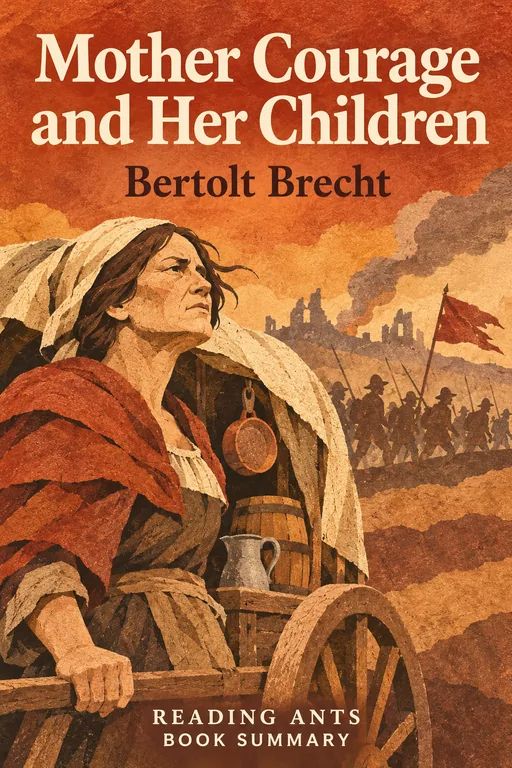
Mother Courage and Her Children
Original title: Mutter Courage und ihre Kinder
A shrewd canteen woman follows the armies of the Thirty Years' War with her wagon and her three children, hoping to make a living from the conflict, and loses all three of her children to it.
Overview
Mother Courage and Her Children is a play by the German dramatist Bertolt Brecht, written in 1939 and first performed in Zurich in 1941. It is set in the seventeenth-century Thirty Years’ War, but it was written in 1939, as Hitler’s armies invaded Poland. Brecht wanted audiences to think critically, not to lose themselves in emotion, and he used techniques such as songs, signs and direct address to keep them at a distance. The play is a bitter parable about how war feeds on ordinary people.
Main Characters
- Anna Fierling, called Mother Courage: a sharp-witted, tough, selfish and loving canteen woman.
- Eilif: her elder son, brave and reckless.
- Swiss Cheese: her younger son, honest and simple.
- Kattrin: her mute daughter, gentle and kind.
- The Cook: a cynical army cook, who flirts with Courage.
- The Chaplain: a clergyman who follows the army.
- Yvette: a camp follower and prostitute.
Full Summary
Recruitment
In 1624, in Sweden, Mother Courage arrives with her wagon, pulled by her two sons, with her mute daughter Kattrin beside her. A recruiting officer and his sergeant, who are short of men for the army, stop the wagon, and they try to enlist her sons, especially Eilif. She tells them that war takes what it needs, and tries to keep her children safe. To distract the soldiers, she has them draw slips of paper from the sergeant’s helmet, and the slip with a cross, which means death, comes up for those who draw. While the sergeant haggles over a belt buckle she has for sale, the officer persuades Eilif to enlist, and he leaves with the soldiers. She pays no more attention to the warning, since she wants to profit by the war.
Eilif’s heroism
Two years later, Mother Courage meets her son again, now a hero for killing peasants and seizing their cattle for his commander. He is praised, and he sings a song about his bravery. Courage scolds him, as she is angry that he took a risk, and that he is exposed to danger. But the war goes on, and she is busy selling food and supplies, and bargaining with soldiers and officers. She continues to profit from the conflict, and believes that war is good for business.
Swiss Cheese
Swiss Cheese, her honest younger son, is given the job of paymaster in a regiment, and he guards the regiment’s money. When the enemy attacks, he hides the cash box in a river bank, but he is captured. Mother Courage tries to bribe the soldiers to free him, haggling over the price, as she is anxious to save the wagon, and delays too long. Swiss Cheese is shot, and Courage, who sees his body, denies that she knows him, in order to avoid arrest. She is torn by grief, but must go on.
Her song and the years
Mother Courage goes to the officers’ tent to complain about damage to her goods, but she hears a young soldier’s complaint, sings a song about giving in, and decides to drop her own. Years pass, and the war goes on. In 1631, in Bavaria, she refuses to give up her linen to bandage villagers whose farm has been wrecked, because they cannot pay, and Kattrin threatens her with a board so that the Chaplain can take the shirts. Kattrin then runs into a burning farmhouse to rescue a child. A year later, Kattrin comes back from town with an injury to her face, after an attack by soldiers, and Mother Courage curses the war, but she does not leave it. The Chaplain, who has been traveling with them, proposes a closer relationship, and she turns him down.
The Cook and the plan
When a peace is briefly announced, the Cook arrives again, and Mother Courage hopes to see Eilif, but soldiers bring him in in chains. In peacetime, he has done what was praised as heroism in wartime, killing a peasant and seizing cattle, and he is to be executed. Mother Courage is away at the time, and she never learns of it. The war soon resumes, and the Cook stays with her. Two years later, business is bad. The Cook inherits an inn in Utrecht and invites her to run it with him, but he will not take Kattrin. Mother Courage refuses to abandon her daughter, and she and Kattrin pull the wagon away, leaving the Cook behind.
Kattrin’s sacrifice
In the last scene, soldiers approach a sleeping town, planning a surprise attack. Kattrin, who is left with a peasant family while her mother is in town, climbs onto a roof with a drum, and beats it, to warn the townspeople, in spite of the soldiers’ threats and pleas. She is shot, but her drumming has alerted the town. Mother Courage returns, sings to her dead daughter, has the peasants bury her, and then, since she has no other livelihood, hitches herself to the wagon and follows the army.
Why It Matters
Mother Courage and Her Children is among the most important plays of the twentieth century, and an influential work of political theater. Brecht’s idea of “epic theater,” which aims to make audiences think, not just feel, has shaped drama around the world. The play is also a powerful anti-war statement, which shows how ordinary people are used and destroyed by conflict. It raises questions about how far people are responsible when they depend on a harmful system. It is often revived, and the title role is considered one of the great parts for an actress.
Key Takeaways
- War consumes ordinary people. Courage loses all her children.
- Profit and love conflict. Her business sense leads to disaster.
- Complicity has a price. She profits from what destroys her family.
- Goodness can be silent. Kattrin sacrifices herself without a word.
- People may not learn. Courage goes on after tragedy, unchanged.
What We Can Learn
You can learn from the play how hard it is to stand outside a harmful system when you depend on it, and how easily we can excuse ourselves by saying that we only do what we must. It also shows how individual acts of courage, like Kattrin’s, can matter. If you read it, you might think about who profits from war, and who pays. Brecht wanted people to ask questions, so consider how the same patterns appear in modern life.
Criticism and Counterpoints
Some critics say that Brecht wanted the audience to condemn Courage, but that many viewers, nonetheless, feel sympathy for her, which undermines his purpose. Others find the play’s message, that war is an economic enterprise, too simple. Its episodic structure, and the use of songs and signs, can seem cold or lecturing to some. Brecht himself revised the play after the first production, because audiences sympathized with Courage and did not see her part in the war. However, the play’s power and relevance are widely acknowledged.
Who Should Read It
This book is for readers from about fourteen who are interested in drama, history and anti-war literature. It is short, and best experienced on stage or in a good performance. Readers who like it may enjoy Brecht’s The Good Person of Szechwan or The Threepenny Opera.
Want the whole book?
A summary is a taste, not the meal. Here is where to find the full book.
You reached the end 🎉
Nicely done. Mark this one as read, and we will suggest what to read next.
Read this next

All Quiet on the Western Front
Erich Maria Remarque
A young German soldier discovers that modern war destroys not only bodies but also the beliefs, relationships and futures of those forced to fight it.
🌍 World Literature
Catch-22
Joseph Heller
A bombardier named Yossarian tries to survive World War II by pretending to be crazy, but he is trapped by a military rule, Catch-22, that makes every escape impossible.
📜 Classics
Antigone
Sophocles
When her uncle Creon, the king of Thebes, forbids the burial of her dead brother, Antigone defies him in the name of the gods' law, and the clash of two kinds of duty ends in tragedy for them both.
🎭 Epics, Drama & Poetry
The Trial
Franz Kafka
A respectable senior bank officer is arrested one morning for a crime nobody will name, and is dragged through a vast, senseless legal system that he can neither understand nor escape.
🌍 World Literature
Waiting for Godot
Samuel Beckett
Two tramps wait beside a lonely tree on a country road for a mysterious man named Godot who never arrives, passing the time with games, quarrels and strange encounters in a play about hope, boredom and the meaning of existence.
🎭 Epics, Drama & Poetry
The Odyssey
Homer
After the Trojan War, the clever hero Odysseus struggles for ten years against monsters, gods and temptations to return home to his faithful wife and son, then must win back his house from the men trying to steal it.
🎭 Epics, Drama & PoetryWant something different?
Pick another topic and we will show you three books to start with.