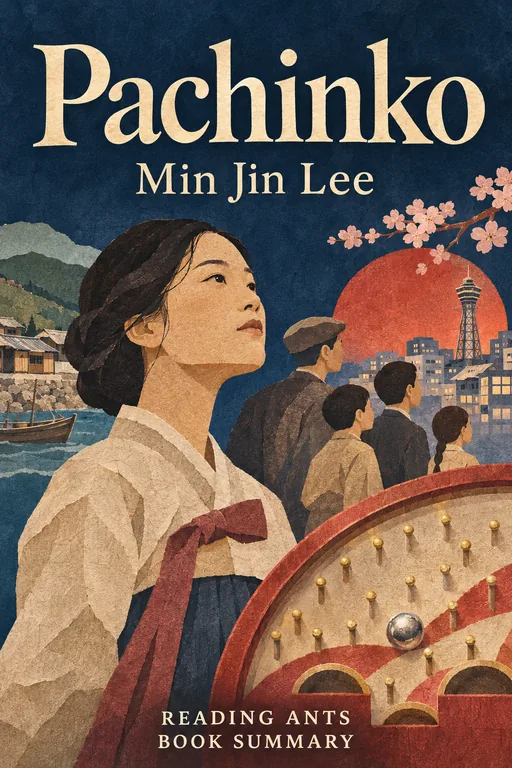
Pachinko
Over four generations, a Korean family struggles to survive and find a home in Japan, facing discrimination, poverty and war, while holding on to dignity, family and hope.
Overview
Pachinko, by Min Jin Lee, was published in 2017 and was a finalist for the National Book Award. The novel begins in a fishing village in Korea in 1910, when Japan has just colonized the country, and follows a family through the twentieth century, ending in 1989. At its center is Sunja, a quiet, strong-willed girl who becomes pregnant by a married man and then marries a kind minister, Isak, who takes her to Osaka. In Japan, the family belongs to a minority of Koreans who are looked down on, denied citizenship and limited in their jobs. Many of them, including Sunja’s sons, find work in pachinko, a form of Japanese pinball gambling. The title refers to the game, and the way fate can seem like chance.
Main Characters
- Sunja: the proud, hardworking heroine of the story.
- Hansu: a wealthy, powerful Korean-Japanese man who is Sunja’s first love.
- Isak: a gentle Christian minister who marries Sunja.
- Noa: Sunja’s eldest son, a scholar who dreams of passing as Japanese.
- Mozasu: Sunja’s younger son, who builds a pachinko business.
- Solomon: Mozasu’s son, who works in finance.
- Kyunghee: Isak’s brother’s wife, and Sunja’s close friend.
- Yangjin and Hoonie: Sunja’s loving parents.
Full Summary
Busan
In 1910, a lame man, Hoonie, and his wife, Yangjin, begin their married life in a poor fishing village near Busan, and later run a boardinghouse. Their daughter Sunja, born some years later, grows up to be a quiet, smart girl who works hard. When she is sixteen, she falls in love with Koh Hansu, a rich, older fish broker who visits the village. Hansu seduces her, and she becomes pregnant. When Sunja learns that he is already married with children in Japan, she refuses his offer to be his mistress.
A young minister, Baek Isak, who is sick and passing through, is moved by Sunja’s situation. He offers to marry her and take her with him to Osaka, giving her baby a name. Sunja accepts.
Osaka
Sunja, Isak and his brother’s family live in a poor Korean neighborhood in Osaka. Koreans are barred from many jobs and are treated as second-class. Sunja gives birth to a boy, Noa, and later has a second son, Mozasu, with Isak. During the 1930s and 1940s, as Japan goes to war, Isak is arrested for refusing to worship the Japanese emperor, is released in a terrible condition, and dies at home. Sunja and her sister-in-law Kyunghee support the family by selling kimchi at a market.
Hansu secretly helps the family from a distance, sending money and arranging for their safety. Sunja has always known that he is Noa’s father.
Noa
Noa grows up intelligent and serious and gets into Waseda University. He studies hard, wanting to avoid his heritage and to blend in. When he learns that his biological father is a yakuza figure, Hansu, and that his entire life has been supported by Hansu’s money, he is horrified and ashamed. He cuts off contact, leaves for Nagano and lives as a Japanese man, working in a pachinko parlor and marrying a Japanese woman, hiding his Korean identity. Sunja, for years, doesn’t know where he is.
Mozasu
Mozasu, who never excelled in school, works in a pachinko parlor and eventually becomes owner of several. Though the work is considered unsavory, it gives Koreans a way to make a living in a country that excludes them. He marries a Japanese-Korean woman, Yumi, and has a son, Solomon.
Solomon
Solomon, raised in comfort, studies in the United States and returns to Japan, where he works for a bank. He feels more Japanese, or international, than Korean. Working for a bank, he is pressed to persuade an elderly Korean woman to sell her land for a deal, which he does; soon afterward he is laid off, in an incident that exposes the prejudice of the people he works for. His girlfriend, a Korean woman named Phoebe, and others question his choices. After this crisis, Solomon decides to enter the family business.
Noa’s Fate
Years later, Sunja is told that Noa has been living in Nagano. She travels there for a reunion. They meet, and Noa tells her he is ashamed of his life. After the meeting, he shoots himself, unable to bear his mother’s love and his own secrecy. Sunja, in her old age, is left with grief, but she continues to live with strength, tending the graves of her husband and son and holding her family together.
Ending
The novel ends in 1989, with Sunja at the cemetery. She remembers the family’s journey and reflects on how she has survived. She is now an old woman, remembered for her kindness and strength. Her grandson Solomon, in his own way, carries on her legacy.
Why It Matters
Pachinko was a finalist for the 2017 National Book Award and was named one of the ten best books of the year by The New York Times. It was adapted into an acclaimed television series in 2022. Min Jin Lee spent nearly three decades researching and writing it, after first hearing about Koreans in Japan at a lecture in the United States, and later living in Japan.
The novel introduced many readers to the history of Zainichi Koreans, the community of Koreans in Japan, many of whom were born in Japan but have been denied full citizenship. It is praised for its sweeping story, its attention to women’s lives and its compassionate treatment of discrimination. It is widely read in book clubs and classrooms.
Key Takeaways
- Discrimination limits lives. Koreans in Japan are excluded from many opportunities.
- Family sustains resilience. Sunja and her relatives survive through mutual help.
- Identity is complicated. Noa and Solomon struggle with who they are.
- Hard work can bring dignity. Sunja’s labor supports her family.
- Fate and choice interweave. Like pachinko balls, lives bounce unpredictably.
What We Can Learn
Pachinko reminds us how prejudice can shape lives across generations, and why equal rights and respect matter. Understanding the history of minority groups helps us build fairer communities.
It also shows the strength of perseverance. Sunja endures poverty, war and loss, yet she never gives up on her family.
Finally, the book encourages us to see the work of immigrants and minorities as valuable, even when it is looked down upon. Many have made lives under difficult conditions, and learning their stories helps us treat newcomers in our own communities with respect.
Criticism and Counterpoints
Some critics find the novel’s long timeline leads to uneven pacing, with the last sections feeling rushed compared with the first. Others feel certain characters, such as Hansu, are idealized.
Some readers have noted that the novel’s story of Korean women’s endurance risks seeming like a story of suffering. Others have debated whether the portrayal of Japanese society is fully fair. Min Jin Lee has said she hoped to portray complexity, not to blame.
Who Should Read It
This novel suits mature readers who enjoy family sagas and historical fiction. It covers suicide, discrimination and hardship. Readers interested in Korean and Japanese history, or in the lives of immigrants, will find it moving and eye-opening.
Want the whole book?
A summary is a taste, not the meal. Here is where to find the full book.
You reached the end 🎉
Nicely done. Mark this one as read, and we will suggest what to read next.
Read this next
The Joy Luck Club
Amy Tan
Four Chinese immigrant mothers and their American-born daughters tell interlocking stories of hardship, love and misunderstanding across the gap between two cultures, as the daughters finally begin to understand who their mothers really are.
✨ Modern Fiction
Homegoing
Yaa Gyasi
Starting with two half-sisters in eighteenth-century Ghana who never meet, one married to a British slaver and one sold into slavery, this novel follows seven generations of each branch of their family, in Africa and America.
✨ Modern Fiction
The Sympathizer
Viet Thanh Nguyen
A half-French, half-Vietnamese Communist spy, working as an aide to a South Vietnamese general, flees to California after the fall of Saigon, continues to spy on the exiles, and writes his confession from a re-education camp.
✨ Modern Fiction
The Namesake
Jhumpa Lahiri
Gogol Ganguli, the American-born son of Bengali immigrants, struggles with his unusual name and his divided identity as he moves between his parents' traditions and the life he wants for himself.
✨ Modern Fiction
The Good Earth
Pearl S. Buck
A poor Chinese farmer named Wang Lung rises from poverty to wealth through hard work and his love of the land, but his prosperity brings new troubles, and his children turn away from the earth that made them.
📜 Classics
The Kite Runner
Khaled Hosseini
A wealthy boy in Kabul betrays his loyal best friend on the day of a kite tournament, and decades later, after fleeing to America, he returns to a Taliban-ruled Afghanistan to try to make things right.
✨ Modern FictionWant something different?
Pick another topic and we will show you three books to start with.