 Reading Ants
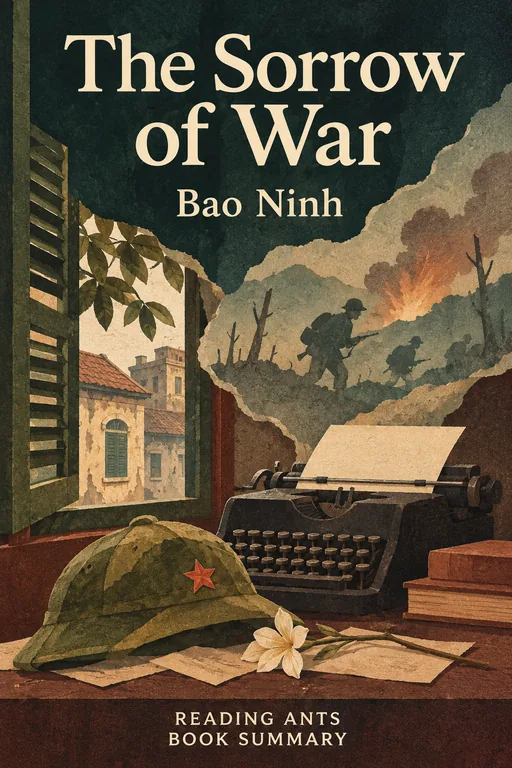
The Sorrow of War
Original title: Nỗi buồn chiến tranh
A Vietnamese soldier who survived the war with the North's army tries to write his story in peacetime Hanoi, and is overwhelmed by memories of death, love and loss.
Overview
The Sorrow of War is a novel by the Vietnamese writer Bao Ninh, published in 1990. It is set in Vietnam, mostly in Hanoi in the years after the end of the war in 1975, with flashbacks to the war itself. The hero, Kien, fought on the North Vietnamese side, and, like the author, was one of the few in his unit to survive. The book is told in a disordered, dreamlike way, as the memory of a traumatized man. It was a shock in Vietnam, since it did not tell a story of victory and glory, but of sorrow.
Main Characters
- Kien: the hero, a former soldier, who tries to write a novel about the war.
- Phuong: the girl next door whom he loved in his youth, who becomes a symbol of lost innocence.
- Kien’s father: a painter who spent his last years shut away in an attic studio, and who died when Kien was still a teenager, after burning all his paintings.
- Kien’s comrades: the men of his unit, especially the members of his scout platoon, most of whom die.
- The mute woman and the neighbors: figures in postwar Hanoi who are marked by their own losses, among them the lonely young woman, unable to speak, who lives in the attic and keeps Kien’s papers.
Full Summary
The Jungle of Screaming Souls
The book opens in 1975, after the war, when Kien is part of a team that searches the jungle for the remains of soldiers who died in battle. The place is known as the Jungle of Screaming Souls, because it was the site of a terrible battle. The team finds bodies, bones and relics, and Kien is haunted by what he sees.
He remembers that his own unit, the 27th Battalion, was surrounded and wiped out here in 1969. Only a handful of them survived, and Kien was one of them.
Hanoi
After the war, Kien returns to Hanoi by train, but he cannot settle. He drinks heavily and lives alone in the old apartment room where he grew up, in a shabby building whose neighbors know him as the local writer. He starts to write a novel, but his writing refuses to follow a clear path. He writes of one memory, and then another, until the pages are a mass of images, and he burns some of them.
The city is changed, and so is he. He feels like a stranger in the world that he fought to save.
Phuong
Kien remembers his early love for Phuong, a beautiful girl who lived in the room next to his in the same apartment building. As teenagers, they share a first love in Hanoi, and they are close enough to tap messages to each other through the wall at night. But their love was disturbed by the war and by their different characters.
When Kien leaves Hanoi for the army, Phuong insists on traveling with him on a crowded troop train at night. The train comes under air attack, Kien is thrown from the car and loses her, and in the confusion Phuong is sexually assaulted by men on board, an attack that changes her. At dawn he finds her at a bombed station, and in a rage he attacks one of the men with an iron bar. They escape the station and shelter in an abandoned school, but Phuong cannot speak of what happened, and Kien, unable to bear the change in her, walks away and leaves her there. They separate, and ten years pass. When Kien comes home to Hanoi after the war, they meet again and for a time live together, but the closeness they once had cannot be rebuilt.
Memories of Battle
Kien’s memories of the war are told without order, flashing between moments of horror and moments of quiet. He remembers the death of friends, the smell of the jungle and the sounds of the fighting. He recalls a young woman guide, Hoa, who in the retreat after the 1968 Tet offensive led him and a column of wounded soldiers through the forest, and who gave up her life to draw a patrol of American soldiers away from them. Kien, who is hiding nearby, holds back so that the wounded can be led to safety, and he is haunted that her sacrifice was soon forgotten.
He recalls the deaths of those who he could not save, and the way that the dead come back to him at night.
Tunnels of Memory
Some of Kien’s memories are of ordinary things: the long marches, and the rainy-season weeks his scout platoon spent in camp, hunting, fishing and playing cards through the evenings. He remembers the last game of cards that the four survivors of the platoon played at dawn, just before the final offensive on Saigon. In the fighting that followed, three of the four were killed, and a worn deck of cards is almost all he has left of them. Each memory leads to a darker one, and he cannot stop them coming.
When he tries to sleep, the dead soldiers come back to him in dreams and half-waking visions, and in the night he sometimes thinks he sees their ghosts in the dark corners of the stairs. Kien wakes in tears or in a cold sweat, and turns again to drink.
Failure and Escape
Kien struggles with his guilt, as a survivor. He cannot forget that the best of his comrades fell while he lived, and that some died because of his mistakes. He drinks and cannot find a settled place in peacetime. His life with Phuong breaks apart, she leaves him, and he is alone. He also remembers his father, a painter who burned all his paintings on the night before his death, long ago when Kien was a teenager, and whose sadness Kien seems to have inherited.
He keeps trying to write, and comes to see that writing is a way of living with his memories, and not of escaping them, a task he owes to the dead. In the end Kien disappears from the neighborhood without telling anyone, leaving his manuscript behind. The mute woman gathers the scattered pages and keeps them in her attic room, and later another narrator, a former soldier from the same neighborhood, obtains the jumbled papers, reads them in the order they happen to come, and copies them out in that accidental order, leaving out only pages he cannot read and adding nothing of his own.
Why It Matters
The Sorrow of War is one of the most famous novels about the Vietnam War written from the Vietnamese side. In the English-speaking world, the war has been told mostly through American eyes, and this book gave readers a different view. It showed that the soldiers of the winning side were wounded by the war too, and that victory does not heal everything. Some veterans and critics in Vietnam attacked it, and its publication was restricted for many years, but later the restrictions were lifted, it became widely read there, and it has been translated into many languages. It won the Independent Foreign Fiction Prize in the United Kingdom in 1994.
Key Takeaways
- War does not end with peace. Survivors carry its weight for life.
- Memory is not linear. The book shows how trauma disrupts time.
- Victory has a cost. Even the winning side is wounded.
- Innocence is lost. Kien and Phuong’s love is damaged by war.
- Writing is a way to survive. For Kien, telling the story is a kind of salvation, though it consumes him.
What We Can Learn
The book helps us to understand the human cost of war, beyond the headlines and the history. It encourages us to listen to veterans and survivors, and to treat them with patience and care.
It also shows how important it is to remember and honor the dead, including those whose sacrifices are quickly forgotten. If you or someone you know is dealing with trauma, it is important to seek support and not to suffer in silence. Finally, the novel shows that telling our story, even when it is painful, may bring a measure of peace.
Criticism and Counterpoints
Some readers find the book hard to follow, since it jumps between times and places with little warning. It is also very bleak, and there is little humor or hope. Others note that the women in the story, such as Phuong, Hoa and the mute woman, are seen mostly through Kien’s eyes and are often shown as victims or symbols of loss. The English edition was prepared by Frank Palmos from a rough translation by Phan Thanh Hao, and it differs in places from the Vietnamese original, so some readers feel that it changes the order and tone of the book. In Vietnam, some veterans and critics attacked the book as decadent and as unfair to the army, because it does not celebrate the war.
Who Should Read It
This book is for mature readers who are interested in the history of the Vietnam War and in war literature. It is not an easy book, and it contains disturbing scenes. Those who are sensitive to violence and trauma should read it carefully.
Want the whole book?
A summary is a taste, not the meal. Here is where to find the full book.
You reached the end 🎉
Nicely done. Mark this one as read, and we will suggest what to read next.
Read this next
All Quiet on the Western Front
Erich Maria Remarque
A young German soldier discovers that modern war destroys not only bodies but also the beliefs, relationships and futures of those forced to fight it.
🌍 World Literature
Slaughterhouse-Five
Kurt Vonnegut
Billy Pilgrim, a World War II soldier who survived the firebombing of Dresden, becomes "unstuck in time," bouncing between his past, present and future, and finds meaning in the idea that all moments exist forever.
📜 Classics
Catch-22
Joseph Heller
A bombardier named Yossarian tries to survive World War II by pretending to be crazy, but he is trapped by a military rule, Catch-22, that makes every escape impossible.
📜 Classics
The Sympathizer
Viet Thanh Nguyen
A half-French, half-Vietnamese Communist spy, working as an aide to a South Vietnamese general, flees to California after the fall of Saigon, continues to spy on the exiles, and writes his confession from a re-education camp.
✨ Modern Fiction
The Quiet American
Graham Greene
In French colonial Vietnam in the early 1950s, a jaded British journalist, Thomas Fowler, watches an idealistic young American, Alden Pyle, cause harm with his good intentions, and must decide whether to betray him.
📜 Classics
The Little Prince
Antoine de Saint-Exupery
A pilot stranded in the desert meets a small boy from a tiny planet, who teaches him that the most important things in life, like love and friendship, can only be seen with the heart.
🌍 World LiteratureWant something different?
Pick another topic and we will show you three books to start with.