 Reading Ants
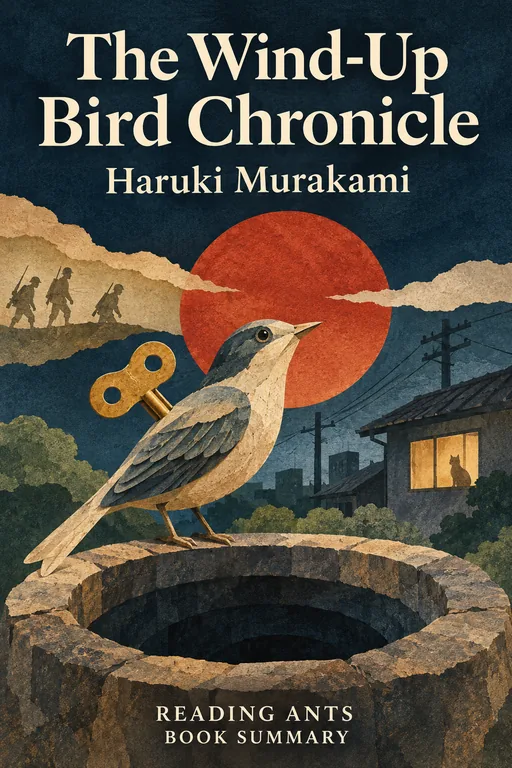
The Wind-Up Bird Chronicle
Original title: ねじまき鳥クロニクル
When his cat and then his wife disappear, an ordinary, unemployed Tokyo man is drawn into a strange world of hidden wells, lost memories and Japan's forgotten wartime past.
Overview
The Wind-Up Bird Chronicle is a long novel by the Japanese writer Haruki Murakami, published in three volumes between 1994 and 1995. It is set mostly in a suburb of Tokyo in the 1980s, with flashbacks to the Japanese army’s actions in Manchuria in the Second World War. It combines a detective story, a love story, historical fiction and dreamlike fantasy. The hero is an ordinary man who is forced to look for what he has lost, and who finds that his search leads him far from home.
Main Characters
- Toru Okada: the hero, a quiet man in his thirties, who has just quit his job.
- Kumiko Okada: his wife, who works at a magazine, and who suddenly disappears.
- May Kasahara: a teenage neighbor, outspoken and curious, who becomes Toru’s friend.
- Noboru Wataya: Kumiko’s brother, a cold, ambitious politician and media figure.
- Malta Kano and Creta Kano: two sisters with strange gifts, who help Toru.
- Lieutenant Mamiya: an old soldier who tells Toru of his experiences in the war.
- Nutmeg and Cinnamon: a rich woman and her son, who play a role in Toru’s later journey.
Full Summary
The Missing Cat
Toru Okada is cooking spaghetti one morning when he gets a strange phone call from a woman, who says she wants ten minutes of his time. At the same moment, his wife asks him to look for their cat, which has vanished. He goes to search in the alley behind their house. There he meets May Kasahara, a sixteen-year-old girl who is staying at home from school.
The cat does not return, and the strange phone calls continue. Toru finds himself drawn into odd encounters, with people who tell him about water and a mysterious bird, which sounds like a wind-up toy.
The Well
Toru meets Lieutenant Mamiya, who tells him a long story of his time in the war, in which he was a soldier in Manchuria. The lieutenant describes the brutality he saw, and how he was left alone to die at the bottom of a dry well in Mongolia.
Remembering the story, Toru later climbs into a dry well in an empty neighboring house, after his wife has disappeared (as told in the next part), and spends days in the dark, thinking. In the bottom of the well, he finds that he can pass through a wall into another place, a hotel room, where he meets people who may be part of his own mind.
Kumiko Leaves
Soon after the lieutenant’s visit, Kumiko fails to come home from work. A letter arrives, in which she says that she has left, and that she does not wish to see him again. Toru is bewildered. He tries to find out why, but the more he searches, the more he learns that his wife has kept secrets from him.
Her brother, Noboru Wataya, a powerful man, tells Toru to give up, and says that he will arrange for a divorce.
Nutmeg and Cinnamon
After Toru comes out of the well, he is joined by Nutmeg, a wealthy woman who has been healing the rich, and her silent son, Cinnamon. They give him a job, and use his strange gift to help others. They also teach him about the pain of his own heart.
Meanwhile, Toru learns that Noboru Wataya has done terrible things to Kumiko in the past, and that he is trying to control her. Toru decides to fight.
Toru and Noboru
Toru goes through the wall in the well into a dark hotel, to find Kumiko. Noboru, who is both a person and a force of evil, has taken control of her. Toru fights a dark figure in the hotel room, and in the real world Noboru suffers a stroke and falls into a coma.
Kumiko, who has been under his influence, is free. But the story does not end happily: she is arrested for killing her brother. Toru promises to wait for her.
The End
The book ends with Toru telling May Kasahara that he will wait for Kumiko, and saying goodbye to her. The mysterious wind-up bird, whose cry runs through the book, remains unexplained.
The reader is left to wonder about how much of the story was real, and how much was a dream.
Why It Matters
The Wind-Up Bird Chronicle is often seen as Murakami’s greatest work. It was a huge success in Japan and abroad, and it won the Yomiuri Prize. It also marked a turning point, in that Murakami began to deal directly with Japan’s history, especially its wartime actions in China, which many Japanese novelists had avoided. It is a book about the way that the past remains hidden in the present, and how a person can be drawn into history without knowing it. It has been translated into many languages and adapted for the stage.
Key Takeaways
- The past lurks in the present. Unresolved history affects everyone.
- Ordinary lives hide mystery. A small event can open a door to a hidden world.
- We do not fully know those we love. Toru discovers Kumiko’s secrets.
- Evil can be impersonal. Noboru represents a cold, controlling force.
- Endurance matters. Toru’s patience is his strength.
What We Can Learn
The book invites us to look at our own lives with fresh attention, and to realize that small, strange events may have meaning. It encourages us to face history, including painful or shameful parts, rather than to hide it.
It also suggests that when things fall apart, it can help to be still, to listen, and to wait. Finally, it reminds us that people we love may have pain that they cannot easily share, and that patience and compassion are important.
Criticism and Counterpoints
Some readers find the plot meandering and the ending unsatisfying. The surreal parts can be confusing, and the novel is long. Some critics find that Murakami’s female characters are underdeveloped, or exist to serve the hero’s story, and that sexual elements are often used in a way that can feel exploitative. Others say that its treatment of history is more symbolic than historical. Still, many consider it a landmark, and fans say that the way the story refuses to tie up its loose ends is part of what makes it feel true to life.
Who Should Read It
This book is for adult readers who like long, strange and thoughtful novels. It is not suitable for younger readers, and some scenes are very violent. Those who enjoy mystery and surrealism, and have the patience for a long book, may find it unforgettable.
Want the whole book?
A summary is a taste, not the meal. Here is where to find the full book.
You reached the end 🎉
Nicely done. Mark this one as read, and we will suggest what to read next.
Read this next
Kafka on the Shore
Haruki Murakami
A fifteen-year-old runaway and an elderly man who can talk to cats follow two strange paths that slowly draw together, in a story about fate, memory and the doors between worlds.
🌍 World Literature
Norwegian Wood
Haruki Murakami
Remembering his student years, Toru Watanabe struggles between a grief-bound love for fragile Naoko and the imperfect possibility of life represented by energetic Midori.
🌍 World Literature
The Master and Margarita
Mikhail Bulgakov
The Devil arrives in 1930s Moscow with a cat, a fanged assistant and a naked witch, and turns the city upside down, while a persecuted writer and his devoted lover try to save a novel about Pontius Pilate from oblivion.
🌍 World Literature
The Trial
Franz Kafka
A respectable senior bank officer is arrested one morning for a crime nobody will name, and is dragged through a vast, senseless legal system that he can neither understand nor escape.
🌍 World Literature
Cloud Atlas
David Mitchell
Six nested stories, set from the nineteenth century to a far future, each discovered by the next narrator, show how the strong prey on the weak and how small acts of courage can echo through time.
✨ Modern Fiction
The Little Prince
Antoine de Saint-Exupery
A pilot stranded in the desert meets a small boy from a tiny planet, who teaches him that the most important things in life, like love and friendship, can only be seen with the heart.
🌍 World LiteratureWant something different?
Pick another topic and we will show you three books to start with.