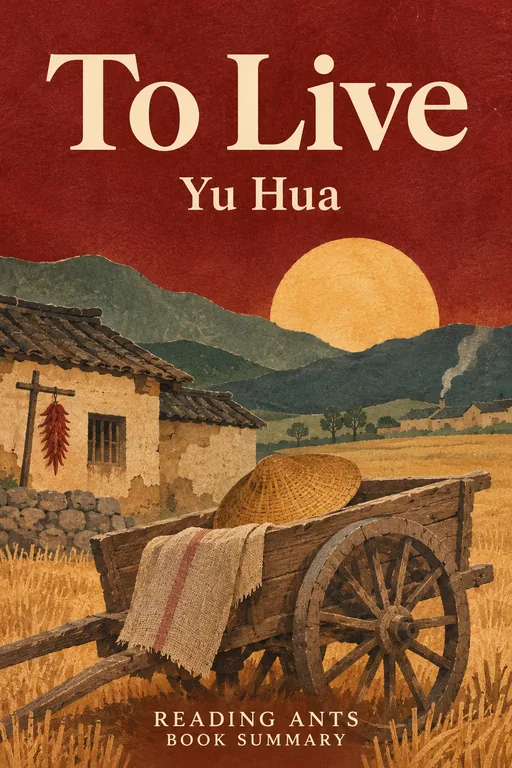
To Live
Original title: 活着
An old farmer tells how he lost his fortune, and then, one by one, the people he loved, through decades of war and political upheaval in China, and still chose to keep living.
Overview
To Live is a novel by the Chinese writer Yu Hua, published in 1993. It is told by an old peasant named Fugui, who recounts his life to a young man who is collecting folk songs. The story covers the years from the 1940s to the 1970s, and passes through the civil war, the Great Leap Forward and the Cultural Revolution. It is a book of great sadness, but it is told in a plain, quiet voice, and it is also warm and sometimes humorous. The question it asks is what gives a life meaning when so much is lost.
Main Characters
- Fugui: the hero, who begins as a spoiled rich man’s son and ends as a poor peasant.
- Jiazhen: Fugui’s wife, a gentle, loyal woman, who stands by him through everything.
- Fengxia: their daughter, who loses her hearing and her voice after an illness.
- Youqing: their son, a kind, energetic boy.
- Erxi: a kind, quiet working man, who marries Fengxia.
- Chunsheng: a former army comrade of Fugui, who becomes a local official.
- The old ox: the animal that Fugui buys in his old age.
Full Summary
A Gambler’s Fall
As a young man, Fugui is the son of a wealthy landlord, and he has no concern for anything but pleasure. He spends his days in gambling houses and brothels. His wife, Jiazhen, who is pregnant, begs him to stop, but he does not listen, and she is finally taken back to her father’s house, while their daughter, Fengxia, stays with Fugui.
One night, Fugui loses everything: the house, the land and the family’s fortune. His father, hearing of the loss, dies soon afterward. Fugui is left with nothing, and he must now work as a tenant farmer on land rented from the man who won his fortune. Jiazhen returns, and he swears to change.
The War
Soon afterward, when Fugui goes to the city to find medicine for his sick mother, he is captured by soldiers and forced to serve in the army. He spends the next years in the civil war, carrying supplies and seeing death all around him. He makes friends with a man named Chunsheng.
He is captured by the other side, but is released, and he walks home, where he finds that his mother has died, and that his daughter is deaf and mute, after a fever. In a land reform, Fugui is given the land that he had rented, and the man who took over his family’s house and land is executed as a landlord. Fugui realizes that if he had still been rich, he would have been shot.
The Great Leap Forward
In the years that follow, Fugui’s family is poor but happy. He and his wife raise their children, Fengxia and Youqing. But the new political campaigns bring hardship. During the Great Leap Forward, the villagers are forced to melt their pots and tools to make steel, and a famine follows.
Youqing, who is a school boy, is told to donate blood for a woman who has given birth, who turns out to be the wife of the county head, Chunsheng, Fugui’s old friend. The doctors take too much blood, and Youqing dies. Fugui is stunned, and when he recognizes Chunsheng, he cannot even be angry.
The Cultural Revolution
During the Cultural Revolution, Chunsheng is condemned as an enemy of the people, and he comes to Fugui and Jiazhen, wishing to die. They tell him that he must live, because he still owes them a life. He does not listen, and takes his own life.
Fengxia grows up and marries Erxi, a kind, good-natured man with a crooked head. They are happy, and they are expecting a child. But when Fengxia gives birth, she dies from bleeding, at a hospital that cannot save her.
The Last Years
Jiazhen, who has suffered much, falls ill and dies. Erxi is killed in an accident at work, leaving a son, Kugen. Fugui is left to raise the boy. They live together in a small house, and Fugui treats the child with love. But one day, when Kugen eats too many beans, he chokes and dies.
Fugui is left with an old ox, which he calls Fugui, after himself. The book ends with the old man in the field, talking to the ox, and singing a song. Though he has lost all, he is still there, and he is at peace.
Why It Matters
To Live is among the most widely read Chinese novels of recent decades. It was made into a film in 1994 by the director Zhang Yimou, which won a prize at the Cannes Film Festival but was banned in China for a time. The book has been translated into many languages. It is praised for showing the effect of history on ordinary people, without speeches or anger, and with great compassion. It is also an example of the shift in modern Chinese writing toward personal, human stories. Yu Hua wrote the book in a very plain style, with short sentences and few descriptions, and the effect is that readers feel they are listening to a real old man speaking. Many readers say that they cried at the book, and then felt oddly hopeful.
Key Takeaways
- Survival is a form of courage. Fugui goes on living in spite of loss.
- History falls on ordinary people. Political campaigns destroy the family.
- Wealth can be a burden or a gift. Fugui’s loss of money saves him later.
- Love endures. Jiazhen’s loyalty is the heart of the story.
- Acceptance brings peace. Fugui’s quiet acceptance gives the story its warmth.
What We Can Learn
The book reminds us that life is not about what we have, but about how we live with those we love. Fugui’s story is hard, but it shows that kindness and persistence can make life worthwhile.
It also warns against the harm that arises when a government or a movement sacrifices ordinary people for an idea. Finally, it shows the value of listening to the elderly and learning from their experiences, as the narrator does. We all have grandparents or older neighbors with stories, and the book is a reminder to ask them while we can, and to record what they tell us. Fugui’s patience in the face of loss can also teach us something about how to carry grief without being destroyed by it.
Criticism and Counterpoints
Some readers find the number of tragedies unbelievable and even manipulative, as if the author wanted to make the reader cry. Others say that Fugui’s passive attitude is a weakness, and that the book avoids blaming political leaders directly. Some critics have noted that the female characters are mainly patient sufferers. The simple style can seem flat to some. The film version, which changes the ending and softens some events, has also led to debates about which version is more faithful to the idea of the story. In China, the book was widely read and praised, though some readers feel that it avoids a direct political judgment.
Who Should Read It
This book is for mature readers who are interested in modern Chinese history and in moving family stories. It is short and easy to read, though very sad. Those who are sensitive to the death of children should be careful.
Want the whole book?
A summary is a taste, not the meal. Here is where to find the full book.
You reached the end 🎉
Nicely done. Mark this one as read, and we will suggest what to read next.
Read this next
Wild Swans
Jung Chang
Through the lives of her grandmother, her mother and herself, Jung Chang tells the story of China across the twentieth century, from warlords and foot binding to the Communist revolution and the Cultural Revolution.
🏛️ History
The Good Earth
Pearl S. Buck
A poor Chinese farmer named Wang Lung rises from poverty to wealth through hard work and his love of the land, but his prosperity brings new troubles, and his children turn away from the earth that made them.
📜 Classics
Pachinko
Min Jin Lee
Over four generations, a Korean family struggles to survive and find a home in Japan, facing discrimination, poverty and war, while holding on to dignity, family and hope.
✨ Modern Fiction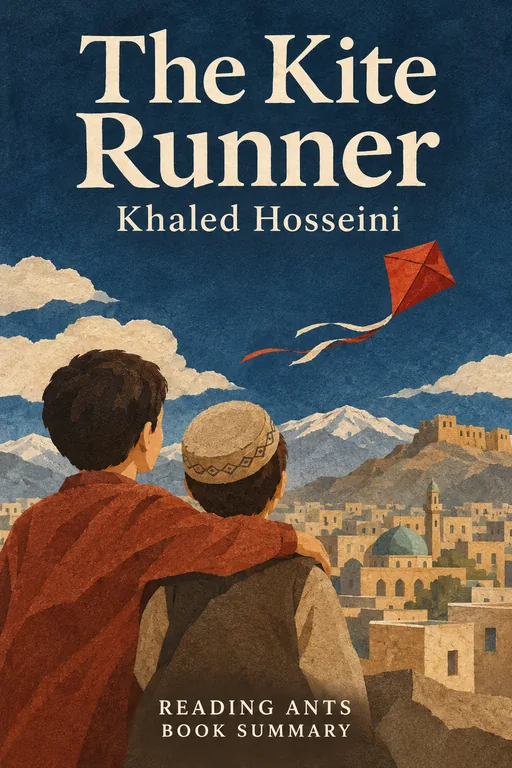
The Kite Runner
Khaled Hosseini
A wealthy boy in Kabul betrays his loyal best friend on the day of a kite tournament, and decades later, after fleeing to America, he returns to a Taliban-ruled Afghanistan to try to make things right.
✨ Modern Fiction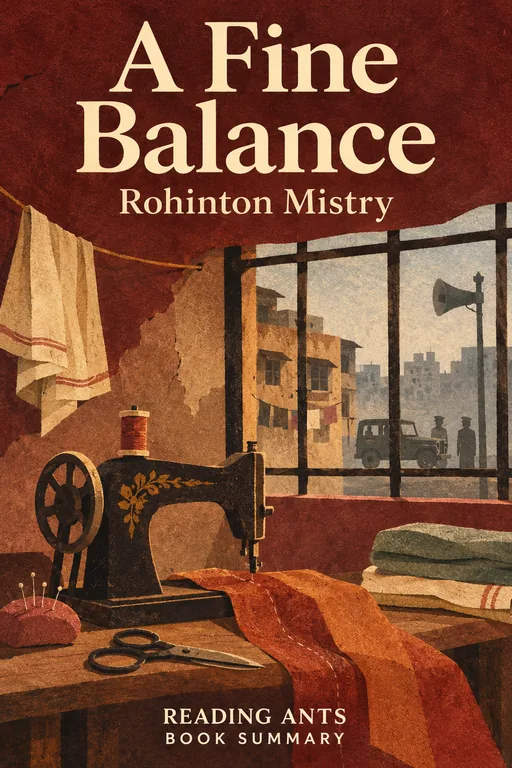
A Fine Balance
Rohinton Mistry
Four people from different backgrounds share a small apartment in India during the Emergency of 1975, and their friendship is tested by poverty, politics and cruelty.
🌍 World Literature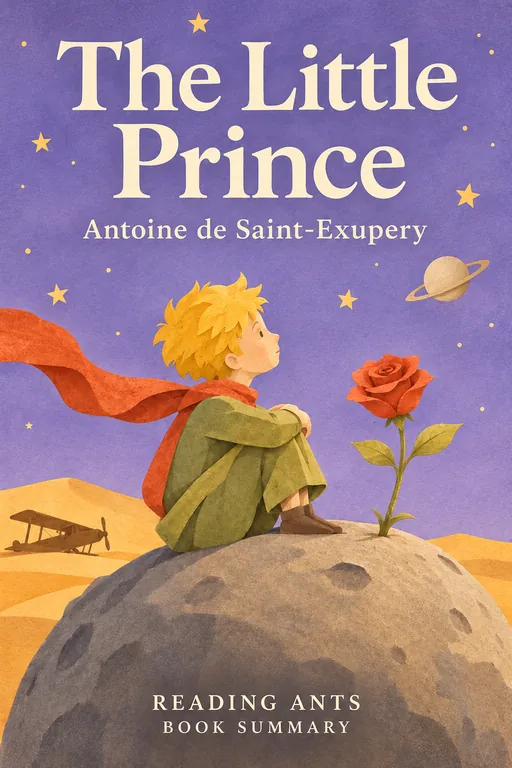
The Little Prince
Antoine de Saint-Exupery
A pilot stranded in the desert meets a small boy from a tiny planet, who teaches him that the most important things in life, like love and friendship, can only be seen with the heart.
🌍 World LiteratureWant something different?
Pick another topic and we will show you three books to start with.